 注: 建议图片大小150px*50px
丨
注: 建议图片大小150px*50px Views: 0 Author: Site Editor Publish Time: 2026-08-29 Origin: Site


Yes, EPDM rubber granules are widely regarded as one of the most suitable materials for playground surfacing. They offer shock absorption, slip resistance, weather durability, and design flexibility, which makes them a practical choice for kindergartens, school playgrounds, parks, and community play areas.
However, their suitability depends on more than just the material name. The right granule size, surface thickness, color stability, binder compatibility, and installation quality all affect safety, durability, and long-term performance.

Why EPDM Granules Are Commonly Used for Playgrounds
EPDM, or ethylene propylene diene monomer rubber, is a synthetic rubber material widely used in poured rubber surfacing systems. In playground projects, EPDM granules are typically mixed with a polyurethane binder and installed as a seamless wet-pour surface.
The main reasons EPDM granules are chosen for playgrounds include:
Shock absorption and impact protection – A properly designed EPDM surface can help reduce the impact force when children fall, which is especially important under play equipment, climbing structures, and activity zones.
Slip resistance – The textured surface of wet-pour EPDM flooring provides better grip than hard surfaces such as concrete or tiles, even when the surface is wet.
Seamless installation – Because the surface is poured and cured on site, it forms a continuous layer without joints or gaps, reducing tripping risks and making the area easier to clean.
Color and design flexibility – EPDM granules are available in multiple colors, allowing contractors to create play patterns, running tracks, hopscotch designs, school logos, and themed playground layouts.
Outdoor durability – EPDM rubber generally performs well in outdoor environments, including exposure to sunlight, rain, and temperature changes.
For playgrounds, kindergartens, and schools, these characteristics make EPDM granules a practical flooring option rather than just a decorative surface.

Key Factors That Affect Playground Suitability
Not all EPDM granules perform the same way. The actual performance of a playground surface depends on several technical and installation-related factors.
Granule Size
EPDM granules are commonly available in different particle sizes, such as 0.5–1.5 mm, 1–3 mm, 2–4 mm, and 3–5 mm.
For playgrounds, finer granules such as 1–3 mm are often preferred for the top layer because they help create a smoother, more uniform surface with better visual detail. Larger granules such as 2–4 mm or 3–5 mm may be used in the base layer or in sports and pathway applications where a more elastic or permeable structure is needed.
The choice of granule size affects surface smoothness, elasticity, binder consumption, and visual appearance.
Surface Thickness
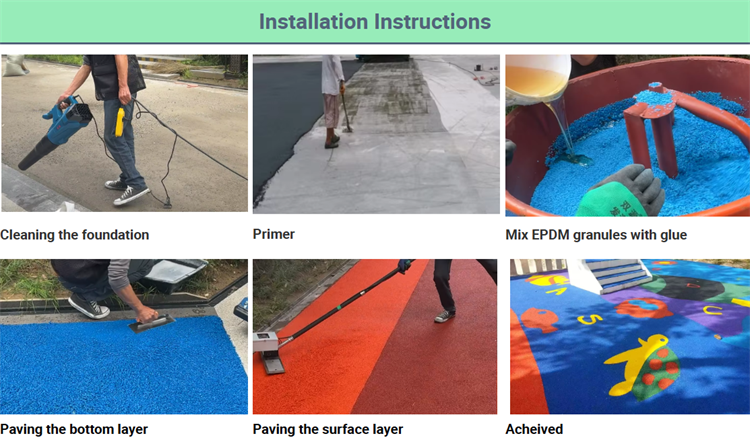
Playground EPDM surfaces are usually installed in two layers:
A base layer, often using larger or more elastic granules
A wear layer, usually using finer colored EPDM granules
A common reference thickness for playground areas is around 13 mm, such as an 8 mm base layer plus a 5 mm surface layer. However, the required thickness should be determined based on the equipment height, fall height, usage intensity, and local safety requirements.
Higher play equipment or areas with greater fall risk may require a thicker impact-absorbing surface.
Color Stability and UV Resistance
Playgrounds are exposed to sunlight, rain, and temperature changes. Over time, UV exposure can affect the color of rubber surfaces.
High-quality EPDM granules should maintain good color retention and resist fading, chalking, or surface degradation under normal outdoor conditions. For projects where appearance matters—such as kindergartens, preschools, and commercial playgrounds—color stability is an important selection factor.
Odor and Material Safety
For children's play areas, material safety is a major concern. A suitable playground EPDM surface should not produce strong or persistent odors after installation.
In some cases, odor issues are related to low-quality rubber materials, unsuitable binders, or improper curing conditions. For playground procurement, it is reasonable to request test reports and material safety information before making a decision.
Installation Quality
Even good EPDM granules can underperform if the installation is not properly controlled. Important installation factors include:
Proper base preparation
Correct granule-to-binder ratio
Uniform mixing
Accurate thickness control
Adequate curing time
Suitable weather conditions during installation
Poor mixing, incorrect thickness, or installation in wet or unsuitable conditions may lead to soft spots, surface damage, poor bonding, or reduced durability.

Practical Considerations for Buyers and Contractors
If you are evaluating EPDM granules for a playground project, focus on these practical points:
Application – Confirm whether the project is a kindergarten, school playground, park, daycare, or commercial play area, as each may have different safety and durability expectations.
Granule size – Choose finer granules for smoother surface layers and larger granules for base layers or sports areas.
Thickness – Match the surface thickness to fall height, equipment type, and applicable safety requirements.
Color options – Confirm available colors, color consistency across batches, and design requirements before ordering.
Durability – Consider UV resistance, weather resistance, and expected usage frequency when selecting granules.
Safety and odor – Request relevant test reports and avoid materials with strong or unusual odors, especially for children's areas.
Installation – Ensure the installer follows correct mixing, thickness, and curing procedures to achieve reliable performance.
For procurement teams, it is also important to confirm that the supplier can provide consistent granule size, stable color batches, and reliable delivery. Playground projects often require multiple colors and precise quantities, so batch-to-batch consistency matters.
How to Choose EPDM Granules for Playground Projects
When selecting EPDM granules for playgrounds, the decision should be based on the actual application rather than price alone.
For Kindergartens and Preschools
Choose finer granules such as 1–3 mm for the surface layer to support smooth finishes, colorful patterns, and comfortable foot contact. Color variety and design flexibility are usually important for these projects.
For School Playgrounds
School playgrounds often need a balance between safety, durability, and cost. The surface should be impact-absorbing, slip-resistant, and able to handle frequent use by students.
For Parks and Community Play Areas
Outdoor public playgrounds may require stronger weather resistance and long-term color retention, especially in areas with high sunlight exposure.
For High-Traffic Zones
Areas under slides, climbing frames, swings, or activity zones may need thicker or more impact-absorbing surface layers. These zones should be planned separately from general walking or decorative areas.

FAQ
Are EPDM granules safe for children's playgrounds?
EPDM rubber is commonly used for children's playgrounds because it can provide shock absorption, slip resistance, and a seamless surface. However, safety also depends on material quality, installation thickness, binder selection, and compliance with local playground safety requirements.
What EPDM granule size is best for playgrounds?
For playground surface layers, 1–3 mm granules are often preferred because they help create a smoother and more uniform finish. Larger granules such as 2–4 mm or 3–5 mm may be used in base layers or other outdoor rubber surfacing applications.
How thick should an EPDM playground surface be?
A common reference thickness for playground areas is around 13 mm, but the final thickness should be based on fall height, play equipment, usage intensity, and applicable safety standards.
Do EPDM playground surfaces fade over time?
All outdoor rubber surfaces can be affected by long-term UV exposure. High-quality EPDM granules with good UV resistance generally maintain better color stability, but performance may vary depending on the formulation, pigment quality, climate, and maintenance.
Can EPDM granules be used for indoor playgrounds?
Yes, EPDM granules can be used in indoor playgrounds, but the selection should consider ventilation, odor requirements, binder compatibility, and indoor safety standards. For indoor projects, low-odor materials and suitable binders are especially important.
How long does an EPDM playground surface last?
The service life of an EPDM playground surface depends on material quality, installation quality, usage frequency, climate conditions, and maintenance. A well-installed surface in normal outdoor conditions can often remain functional for many years, but exact lifespan cannot be guaranteed without project-specific details.
What should I check before purchasing EPDM granules for a playground?
Before purchasing, check the granule size, color consistency, material safety information, UV resistance, supplier production capacity, and whether the product is suitable for your intended surface thickness and installation system.

EPDM granules are a suitable and widely used material for playground surfacing because they combine safety, elasticity, slip resistance, weather durability, and design flexibility. For kindergartens, schools, parks, and community play areas, they offer a practical way to create colorful, impact-absorbing, and child-friendly surfaces.
However, the best result depends on choosing the right granule size, surface thickness, color system, and installation method for each project. If you are planning a playground, sports area, or wet-pour rubber flooring project and need EPDM granules in specific sizes, colors, or specifications, contact us to discuss your requirements and get a suitable product recommendation.

WOW(LYG) New Material Co Ltd is a manufacturer specializing in the production of EPDM rubber granules. We use sulfur-free vulcanization technology, it increases the service life by more than 3 times than traditional EPDM granules, and enhances the performance, including anti-aging, high-temperature resistance, and colorfastness.
We have over 25 years of production experience and offer customization for colors and granule sizes. NO MOQ.


