 注: 建议图片大小150px*50px
丨
注: 建议图片大小150px*50px Views: 0 Author: Site Editor Publish Time: 2026-09-01 Origin: Site


Yes, EPDM granules can be customized. Most manufacturers are able to adjust key specifications such as color, particle size, and certain performance-related properties to suit different applications.
However, customization is not unlimited. It depends on the manufacturer’s production capability, the type of EPDM compound, the required granule size, color consistency, and the performance requirements of the project. For playgrounds, running tracks, sports surfacing, wet pour surfaces, and other rubber surfacing systems, the right EPDM granule specification should match both the design requirement and the installation environment.
If you are sourcing EPDM rubber granules for a specific project, the most practical approach is to confirm the required color, particle size, density, hardness range, UV resistance, and application conditions with the supplier before placing an order.
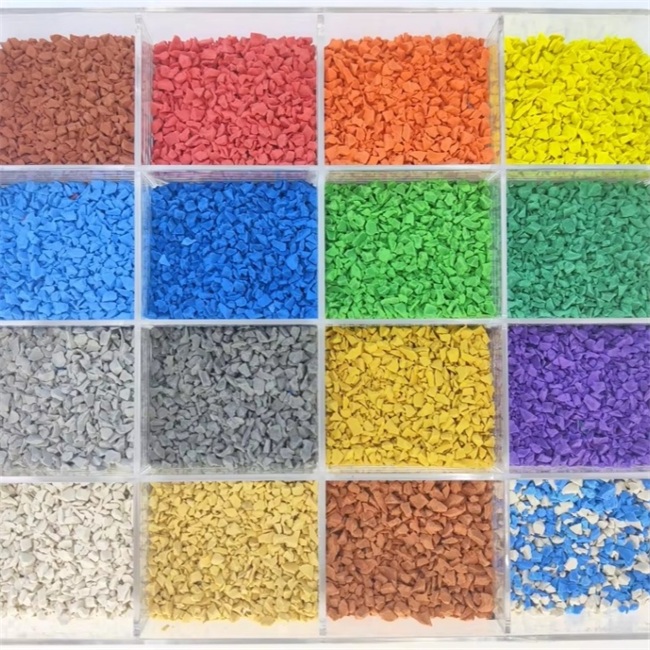
What Parts of EPDM Granules Can Be Customized?
EPDM rubber granules are widely used in safety surfacing and sports surfacing because they offer good elasticity, weather resistance, and design flexibility. In real projects, customization usually focuses on the following areas:
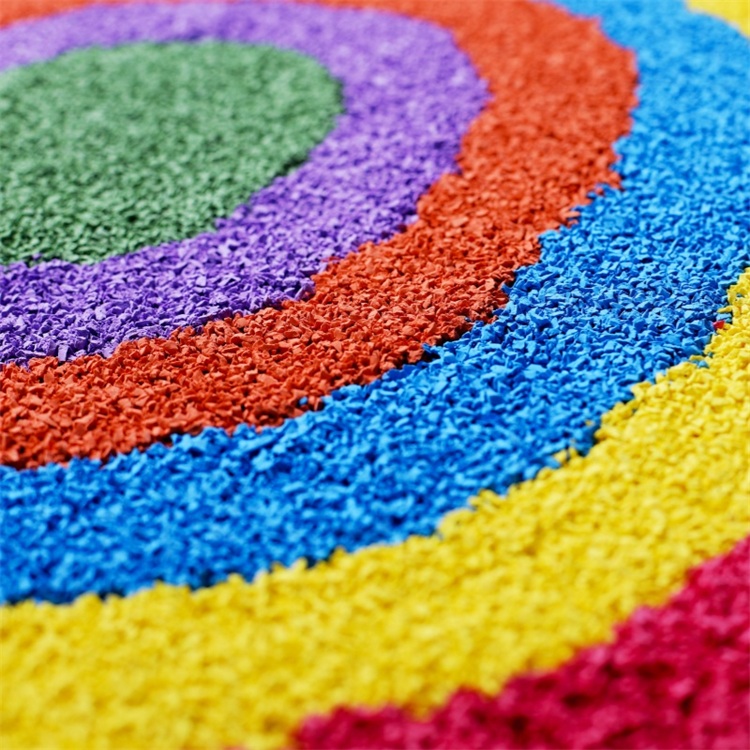
Color: EPDM granules are available in a wide range of colors. Custom colors can often be produced for playgrounds, running tracks, sports courts, and decorative wet pour surfaces.
Particle size: Different projects may require different granule sizes. Smaller particles are often used for finer surface finishes, while larger particles may be used where a more textured or porous surface is needed.
Granule shape and texture: The cutting and screening process can affect particle shape, surface texture, and how the granules bond within a binder system.
Hardness and elasticity: These properties can vary depending on the EPDM formulation. However, exact values should be confirmed based on the specific compound and application.
Density and bulk weight: Particle density and packing behavior can affect coverage, binder consumption, and installation performance.
Performance properties: Depending on the formulation, EPDM granules can be developed with different levels of UV resistance, color stability, aging resistance, and mechanical durability.
Customization should always be linked to the actual application. A playground surface, for example, may prioritize safety, color stability, and shock absorption, while a running track may place more emphasis on durability, elasticity, and long-term performance.

How Are EPDM Granules Customized?
Customization usually starts from the raw EPDM compound and the production process.
First, the manufacturer selects the base EPDM material and formulates it according to the required performance targets. This may include adjusting the compound to support better color stability, improved elasticity, or stronger resistance to outdoor weathering.
Then, the material is processed into granules through mixing, curing, cutting, and screening. The screening stage is especially important because it determines the particle size range. Consistent screening helps ensure that the granules have a more uniform size, which supports even mixing, smoother installation, and more consistent surface performance.
Color customization is usually achieved by adding pigments during compounding. The challenge is not just making the granules look bright at first, but keeping the color stable after long-term exposure to sunlight, rain, temperature changes, and regular use.
This is why color consistency and UV resistance should be checked carefully, especially for outdoor projects such as playgrounds, school sports areas, park pathways, and running tracks.
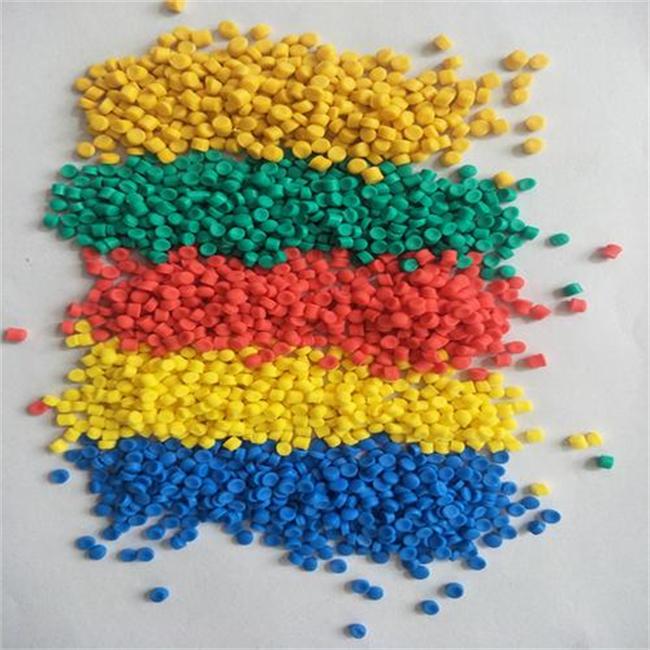
Why Customization Matters for Different Applications?
Different projects have different requirements. Choosing the same EPDM granule for every application may lead to problems such as poor color matching, uneven surface texture, higher binder consumption, or reduced long-term performance.
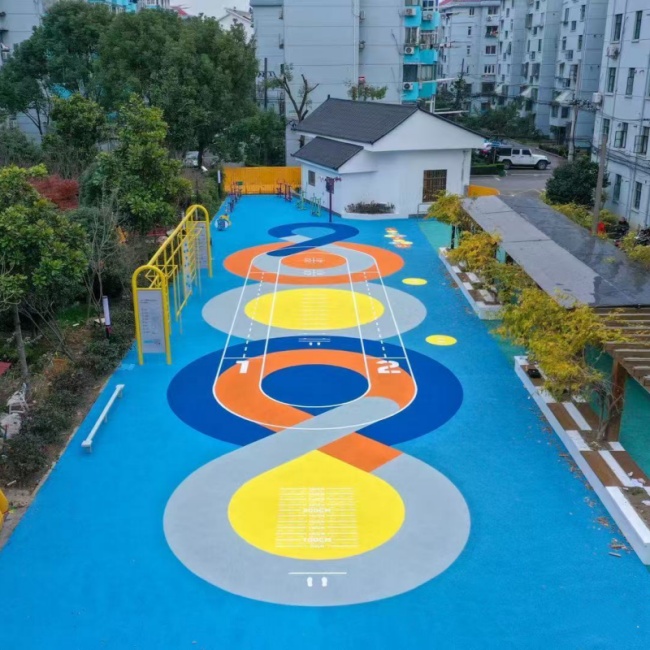
For playgrounds, color variety and visual design are often important. The granules should also support a safe, resilient surface when combined with the correct binder and installation system.
For running tracks and sports surfacing, consistency becomes more critical. The particle size, elasticity, and surface uniformity can affect how the floor performs during use.
For wet pour rubber surfaces, the granule size and shape can influence how well the material mixes with the binder, how smoothly it is laid, and how stable the finished surface appears.
For outdoor environments, UV resistance, color stability, and weather resistance are especially important. Surfaces exposed to strong sunlight and frequent temperature changes need EPDM granules that can maintain their appearance and performance over time.
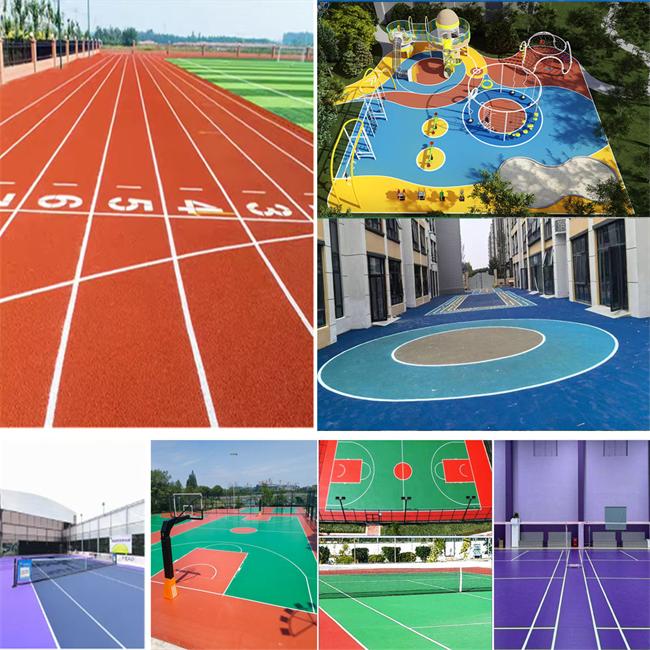
What Factors Affect EPDM Granule Customization?
Several factors influence whether a specific customization is practical and reliable.
Color Matching
Color is one of the most common customization requests. However, achieving consistent color requires more than just adding pigment. The final appearance can be affected by:
Raw material batch
Pigment type and dosage
Curing process
Particle size
Lighting conditions during inspection
Long-term UV exposure
For large projects, it is better to confirm color samples before bulk production. If the project requires multiple batches, batch-to-batch color consistency should be checked in advance.
Particle Size Range
Particle size affects surface texture, porosity, binder usage, and installation behavior. Some projects may require a narrow size range for a more uniform finish, while others may accept a broader range.
When ordering, it is helpful to specify:
Required particle size range
Maximum and minimum acceptable size
Whether fine particles or oversized particles should be limited
The intended application and installation method
Hardness and Elasticity
Hardness and elasticity are important for sports and safety surfaces, but they are not universal values. The suitable range depends on the application, surface design, binder type, and installation thickness.
Instead of only asking for “soft” or “hard” granules, it is more effective to confirm the required performance range and test method with the supplier.
UV Resistance and Color Stability
Outdoor EPDM surfaces are exposed to sunlight, rain, heat, and temperature fluctuations. Good UV resistance and color stability help the surface maintain its appearance over time.
Color fading can be affected by pigment quality, EPDM compound stability, environmental conditions, and maintenance. For projects in strong sunlight, color stability should be treated as a key selection factor.
Odor and Environmental Requirements
Some environments are more sensitive to odor, especially indoor or semi-indoor areas, schools, childcare centers, and public recreation spaces.
EPDM granules produced without sulfur-related compounds may have lower odor characteristics. However, odor perception can still vary depending on the binder, installation environment, ventilation, and curing conditions.
For projects with strict environmental or hygiene requirements, buyers should confirm whether the granules meet the relevant project specifications.
Production Feasibility
Not every customization request can be handled the same way. Some colors, sizes, or performance requirements may need special compounding, longer production time, or higher minimum order quantities.
Before ordering, it is useful to confirm:
Whether the required color or size is available
Whether a sample can be provided
The expected lead time
The minimum order quantity
Whether the supplier can maintain consistent quality across batches
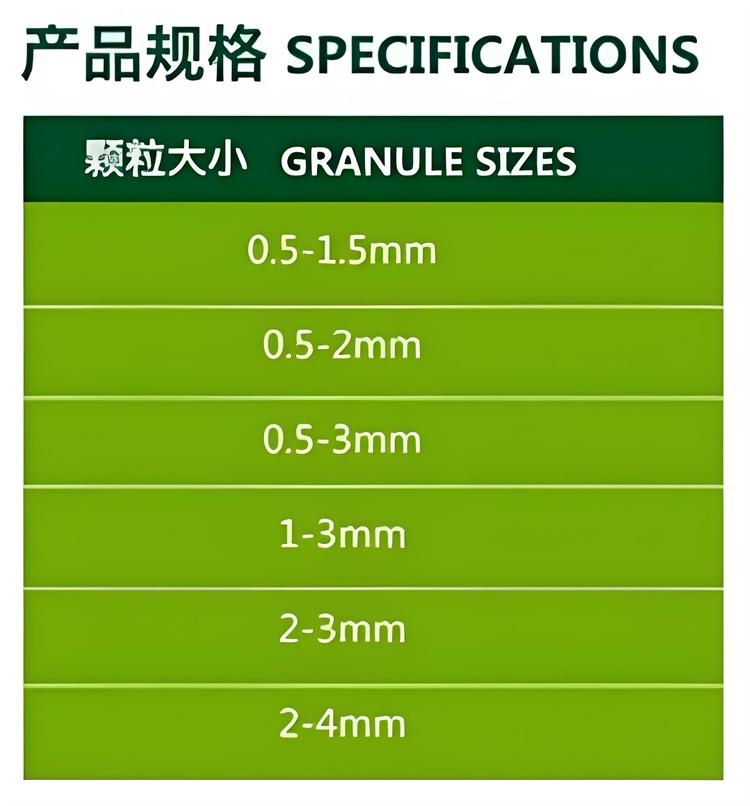
Practical Considerations When Ordering Custom EPDM Granules
From a purchasing and project perspective, customization should not be treated as a simple color or size choice. It should be evaluated as part of the whole surfacing system.
Confirm the Application First
Before requesting customization, clarify where the EPDM granules will be used:
Playground
Running track
Sports court
Wet pour surface
Fitness area
Park pathway
School activity area
Recreational surfacing
Different applications may require different particle sizes, colors, elasticity ranges, and durability expectations.
Request Samples
For color-sensitive projects, samples are essential. A photo or color code alone is usually not enough, because screen display, lighting, and material texture can all affect color perception.
Check Batch Consistency
For large projects, one of the most important factors is consistency. The granules delivered in different batches should match in color, particle size, and performance as closely as possible.
Evaluate the Whole System
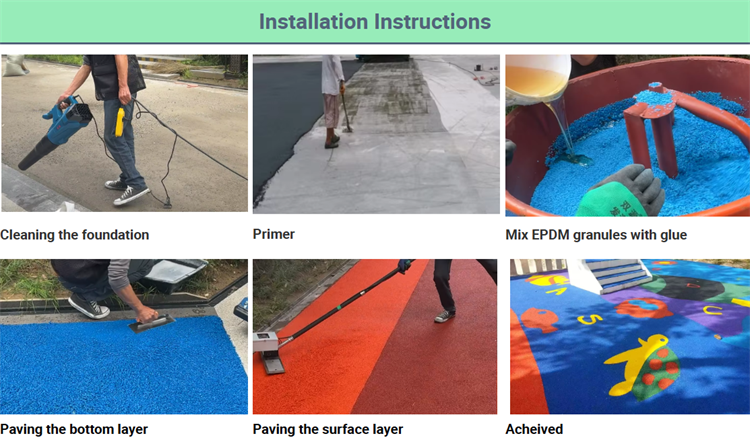
EPDM granules are usually used with a binder and installed as a wet pour or poured rubber surface. The final performance depends on:
EPDM granule quality
Binder compatibility
Mixing ratio
Installation thickness
Base preparation
Weather conditions during installation
Curing process
Even high-quality granules cannot guarantee a good result if the installation system is not properly controlled.
Avoid Choosing Only by Price
The lowest price may not always be the most economical choice. If granules have poor color stability, inconsistent particle size, or weak long-term performance, the project may face higher maintenance or replacement costs later.
How to Choose EPDM Granules for Your Project
When selecting EPDM rubber granules, the following points can help buyers make a more practical decision.
Match Particle Size to the Application
For smoother finishes, smaller or more uniform granules may be preferred. For textured or porous surfaces, larger granules may be more suitable. The exact choice should depend on the design, binder system, and installation method.
Prioritize Color Stability for Outdoor Use
If the surface will be installed outdoors, color stability and UV resistance are more important than initial brightness alone. A color that looks good after installation should also remain stable after long-term sun exposure.
Consider Elasticity and Durability
For sports and playground applications, elasticity and durability are important. However, the required level depends on the project type, usage intensity, and surface thickness.
Check Odor and Environmental Suitability
For schools, playgrounds, childcare areas, and indoor-related applications, low-odor EPDM granules may be preferred. Buyers should confirm the material composition and any relevant project requirements.
Work With a Supplier That Supports Customization
A reliable supplier should be able to provide:
Color samples
Particle size options
Technical guidance
Batch consistency control
Clear information on MOQ and lead time
Support for project-specific requirements
Customization works best when the supplier understands both the material and the application.
FAQ
Can EPDM granules be made in custom colors?
Yes. EPDM granules can usually be produced in custom colors, but the final result depends on pigment selection, production process, and batch consistency. For large projects, it is better to confirm a physical sample before bulk ordering.
Can I choose a specific particle size for EPDM granules?
Yes. Particle size can often be adjusted through screening and production control. The suitable size depends on the application, surface design, binder type, and installation method.
Are custom-colored EPDM granules less durable?
Not necessarily. Color customization does not automatically reduce durability. However, color stability depends on pigment quality, EPDM compound formulation, UV exposure, and environmental conditions. For outdoor projects, UV resistance should be confirmed.
Can EPDM granules be customized for playgrounds?
Yes. Playground projects often require specific colors, particle sizes, and performance characteristics. The final selection should consider safety, elasticity, color stability, weather resistance, and the complete installation system.
Is there a minimum order quantity for custom EPDM granules?
This depends on the supplier and the customization request. Standard colors and common particle sizes may have lower MOQs, while special colors, narrow size ranges, or specific performance requirements may require higher quantities.
Can EPDM granules be customized for running tracks?
Yes. Running track applications may require consistent particle size, suitable elasticity, good durability, and stable color performance. The exact specification should be confirmed based on the track design and performance requirements.
Do custom EPDM granules take longer to produce?
In many cases, yes. Custom colors, special particle sizes, or specific performance requirements may need additional compounding, sampling, screening, or quality checks. Lead time should be confirmed before ordering.
EPDM granules can be customized, but successful customization depends on clear project requirements and a supplier with stable production capability. Color, particle size, hardness, elasticity, UV resistance, odor level, and batch consistency all play a role in determining whether the granules are suitable for a specific application.
For playgrounds, running tracks, sports surfacing, wet pour surfaces, and other rubber surfacing projects, the best choice is not simply the brightest color or the lowest price. It is the EPDM granule specification that matches the application, installation system, and long-term performance expectations.
If you are looking for EPDM rubber granules with specific color, particle size, or performance requirements, it is best to share your application details and send us your inquiry so we can recommend a suitable specification.

WOW(LYG) New Material Co Ltd is a manufacturer specializing in the production of EPDM granules. We use sulfur-free vulcanization technology, it increases the service life by more than 3 times than traditional EPDM granules, and enhances the performance, including anti-aging, high-temperature resistance, and colorfastness.
We have over 25 years of production experience and offer customization for colors and granule sizes. NO MOQ.


