 注: 建议图片大小150px*50px
丨
注: 建议图片大小150px*50px Views: 0 Author: Site Editor Publish Time: 2026-07-13 Origin: Site


If you're a playground contractor, sports flooring installer, or purchasing manager searching for "Wet Pour EPDM Rubber Granules," you're likely beyond the "what is it" phase. You've probably already dealt with fading colors, inconsistent granule sizes, adhesive failures, and suppliers who promise quality but deliver something else entirely.
This guide is written specifically for professionals—contractors, importers, distributors, and specifiers—who need to understand not just the product, but how to select it correctly, avoid costly mistakes, and ensure long-term performance that meets safety standards and client expectations.

What Is Wet Pour EPDM Rubber Granules?
Wet pour EPDM (Ethylene Propylene Diene Monomer) rubber granules are the surface layer material in a two-part, on-site poured safety surfacing system. The "wet pour" refers to the installation method: EPDM granules are mixed with a polyurethane (PU) binder on-site, then troweled into place over a shock-absorbing base layer, typically made from recycled SBR rubber .
The system structure that experienced contractors understand:
The top layer is where EPDM granules matter most. This is the part your clients will see, touch, and judge. It's also the part that fails first if the material quality is compromised .

Why Choose EPDM Over Other Surfacing Materials?
The market offers options: loose-fill wood chips, sand, poured-in-place rubber, rubber tiles, and synthetic turf. So why are more projects specifying EPDM wet pour systems?
Verified Safety Compliance
When installed correctly with the appropriate sub-base thickness, EPDM wet pour systems can achieve critical fall height (CFH) ratings up to 3.23 meters—far exceeding what loose fill or basic rubber tiles can offer . For municipal playground projects and school contracts, this compliance isn't optional—it's the law.
Accessibility and ADA Compliance
EPDM surfaces are seamless, slip-resistant, and wheelchair-accessible. Unlike wood chips or sand, they don't shift or create mobility barriers . For government procurement and public works projects, this is a non-negotiable requirement.
Design Flexibility
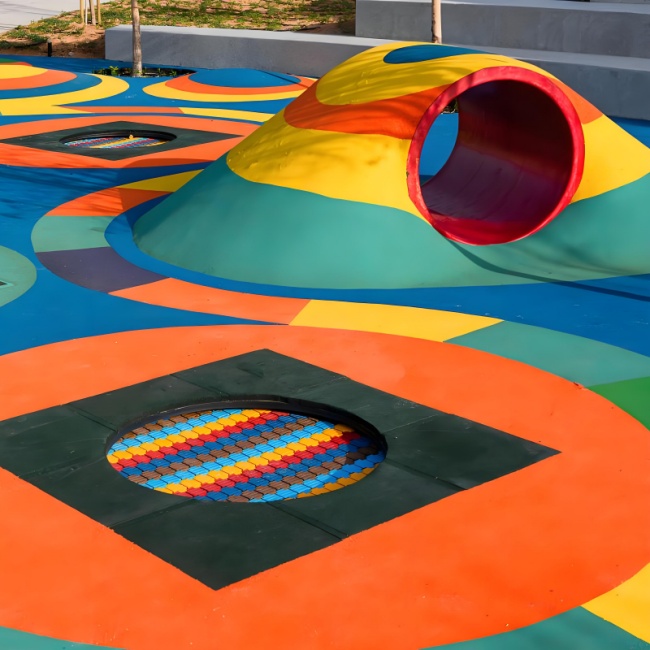
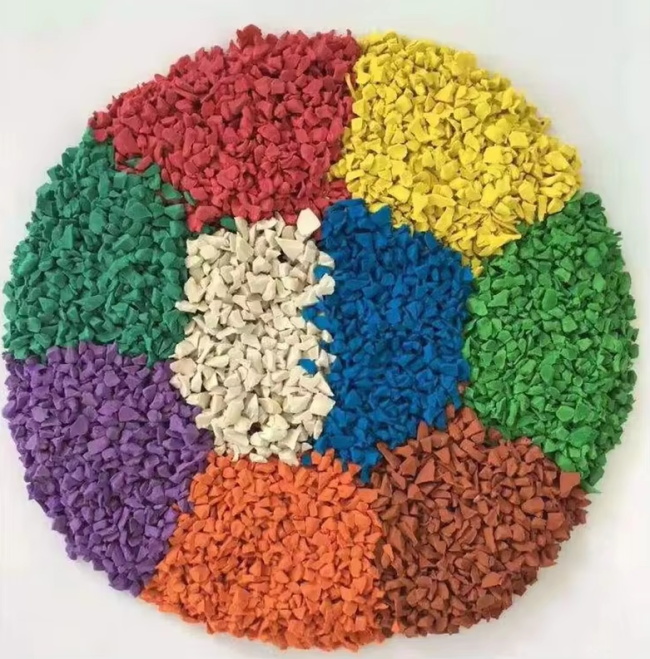
Available in 15-24 standard colors with custom color matching options, EPDM allows for logos, games, patterns, and zone differentiation—a feature that architects and landscape companies increasingly demand .
Drainage and Low Maintenance
The permeable structure allows water to drain naturally, preventing pooling and flood risks. Maintenance is straightforward: leaf blowers for debris, low-pressure washing with pH-neutral soap, and periodic inspections .
The Real Pain Points: What Contractors and Buyers Struggle With
If you've sourced EPDM granules before, you've likely encountered some of these issues. Here's what professionals consistently report and how to address them.
Pain Point 1: Color Fading and UV Degradation
The Problem: You install a vibrant blue playground in May. By October, it's a dull, faded version of itself—or worse, it has turned green or yellow.
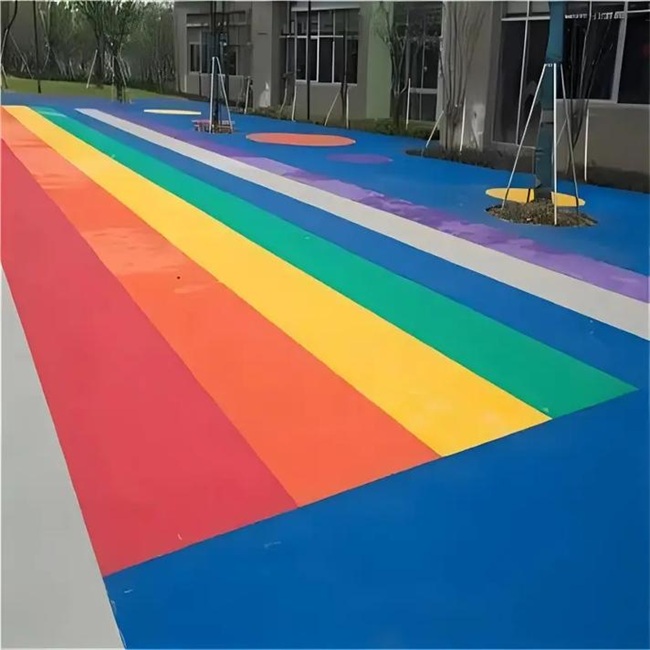
The Cause: UV radiation breaks down the pigment molecules and the binder. The "yellowing effect" occurs when aromatic PU binders are used with light-colored granules—the binder itself turns yellow when exposed to sunlight, chemically altering the visual appearance .
The Solution: Specify aliphatic PU binders for light and bright colors (whites, pastels, bright blues). For darker colors, aromatic binders may be acceptable but verify UV stability ratings .
Our Advantage: Our sulfur-free EPDM granules deliver unprecedented UV stability. Conventional EPDM contains sulfur compounds that, under UV exposure, decompose and release sulfuric acid derivatives—accelerating pigment breakdown. Our sulfur-free technology maintains the molecular structure, meaning color retention that lasts 5 times longer than standard sulfur-cured products. Colors stay vibrant even in high-UV environments like the Middle East, Australia, or the southern United States.
Pain Point 2: Inconsistent Granule Size and Shape
The Problem: You open the pallet and find granules ranging from powder to 5mm chunks. The surface you deliver is uneven, rough, or has bare spots where the binder pooled.
The Cause: Poor manufacturing controls, insufficient screening, or suppliers using regrind material mixed with virgin granules. Some suppliers even use recycled tire rubber colored and sold as EPDM.
The Solution: Request specifications: standard EPDM granule sizes range from 0.5-1.5mm, 1-3mm, 1-4mm, 2-4mm, and 3-5mm . The ideal wet pour top layer typically uses 1-4mm granules for optimal coverage and texture. Ask for sieve analysis documentation.
Our Advantage: Our granules feature irregular, angular shapes with strong three-dimensional profiles—not rounded or flat particles. This is critical because irregular shapes interlock mechanically when mixed with binder, creating a stronger bond and more stable surface. We offer full customization of size ranges from powder to 5mm, with strict screening protocols ensuring batch-to-batch consistency.
Pain Point 3: Odor Issues—"What's That Chemical Smell?"
The Problem: Weeks after installation, the playground still has a strong rubber or chemical odor. Parents complain. The school principal is concerned about health risks.
The Cause: Sulfur-cured EPDM granules contain residual sulfur compounds. Under high heat and UV exposure, these decompose and release sulfuric acid and volatile sulfur compounds—producing that unmistakable "rubber tire" smell .
The Solution: Source sulfur-free EPDM. Some manufacturers now offer peroxide-cured or sulfur-free formulations that eliminate this issue entirely .
Our Advantage: Zero sulfur content in our EPDM granules. No sulfur means no sulfuric acid decomposition products, no offensive odors, and no off-gassing concerns. This makes our material suitable for indoor installations, healthcare facilities, schools, and other sensitive environments. Our products meet food-grade hygiene standards—a level of purity that conventional sulfur-cured materials simply cannot achieve.
Pain Point 4: Poor Binder Adhesion and Granule Loss
The Problem: Within six months, granules are coming loose. Kids pick at them, and soon there are bare patches. The surface looks worn and unprofessional.
The Cause: Low polymer content, contamination (oils, dust, or release agents on the granule surface), or using the wrong binder-to-granule ratio.
The Solution: Ensure your EPDM supplier provides a polymer content of at least 20% . Lower polymer content means more filler (calcium carbonate) and less rubber—which means the binder has less to bond to. Also, the top layer binder ratio should be approximately 18-20% binder to granules, while the base layer uses only 6-8% .
Our Advantage: Our granules are manufactured with clean, virgin EPDM material with no surface contaminants. Combined with our high tensile strength of 4-7 MPa (compared to the industry minimum of 3-4 MPa), our granules form a mechanical and chemical bond with PU binders that is 3 times stronger than standard products. Less granule loss, fewer callbacks, better project reputation.
Pain Point 5: Short Service Life and Premature Failure
The Problem: The surface that was supposed to last 10 years is failing in 3. Cracking, fading, granule loss, and general deterioration are visible.
The Cause: Poor-quality materials (high filler content, insufficient polymer, sulfur-based degradation), improper installation (wrong thickness, inadequate compaction, poor curing conditions), or both.
The Solution: For contractors and specifiers, this means verifying both material quality and installation protocols. Do not cut corners on the SBR base layer—this "invisible" layer absorbs most of the impact, and inadequate thickness or compaction directly causes premature top-layer failure .
Our Advantage: Our sulfur-free molecular structure is inherently more stable, delivering a service life 3 times longer than conventional EPDM. Tensile strength reaches 4-7 MPa compared to the industry standard of approximately 4 MPa . Our performance retention rate is 5 times higher, meaning the material maintains its physical properties—elasticity, color, tensile strength—over time rather than degrading rapidly in year two or three.
Why the Sulfur-Free Difference Matters (Technical Deep Dive)
Most rubber, including most EPDM, is vulcanized using sulfur. This cross-linking process creates sulfur bonds between polymer chains. The problem? These sulfur bonds are weak points—they break under UV radiation, heat, and ozone exposure.
When sulfur bonds break, two things happen:
1. Sulfuric acid derivatives form, breaking down pigments and causing fading
2. The polymer network degrades, reducing elasticity, tensile strength, and durability
Our sulfur-free technology uses alternative cross-linking systems that create stronger, more stable carbon-carbon bonds. The result:
- No odor—no sulfuric acid decomposition products
- UV stability that is 5 times better than conventional EPDM
- Tensile strength of 4-7 MPa—2-3 times the elasticity and pull strength of standard products
- Heat resistance that maintains performance in high-temperature environments
- True color stability—colors remain vibrant because the binder and matrix don't degrade
Additionally, our low bulk density means our granules weigh less per volume, giving you more coverage per ton and better binder distribution. The angular particle shape mechanically interlocks with the binder system, increasing the mechanical strength of the finished surface.
How to Choose the Right EPDM Supplier: A Checklist for Contractors and Buyers
Before placing your order, verify these points:
Manufacturing Expertise
How long has the supplier been producing EPDM? What's their production capacity? Do they have complete, in-house production lines or do they outsource?
Our Credential: 25+ years of industry experience with fully integrated manufacturing facilities—complete control from raw materials to finished granules.
Material Certification and Testing
Ask for third-party test reports:
- Tensile strength (minimum 4 MPa for quality products)
- Elongation at break (minimum 400%, ideally >550%)
- Hardness (Shore A 55-65 typical)
- UV resistance testing (ask for Grey Scale ratings after 1000+ hours exposure)
- Environmental certifications (REACH, RoHS, EN 71-3 for playground safety)
- Polymer content (≥20%)
Our Credential: All products independently tested and certified to international standards.
Color and Size Customization
Can they match your required RAL or custom color? What size ranges are available? Is there a minimum order?
Our Credential: No minimum order quantity (no MOQ) for color and size customization. Choose from 24+ standard colors, unlimited custom colors, and any size from powder to 5mm.
Supply Chain Reliability
What's their delivery time? Do they maintain adequate inventory? Have they exported to similar markets?
Our Credential: Flexible order quantities with rapid fulfillment for both small and large orders. Global export experience with project references worldwide.
Technical Support
Do they offer installation guidance? Can they troubleshoot binder compatibility issues? Do they provide clear technical data sheets?
Our Credential: We provide comprehensive technical documentation, mixing ratio guidance, and ongoing support for contractors and installers.
Sustainability and Health Standards
Can the granules meet health and environmental standards? Are they free from hazardous substances?
Our Credential: Food-grade hygiene standard compliance. No heavy metals, no hazardous volatiles, and no sulfur compounds. Suitable for the most sensitive applications.

Frequently Asked Questions by Contractors and Buyers
Q: What's the difference between EPDM and SBR granules?
EPDM is synthetic rubber formulated for UV resistance and color stability, used for the top layer. SBR is recycled tire rubber, black, used only for the impact-absorbing base layer .
Q: How long does wet pour EPDM last?
With high-quality sulfur-free EPDM and proper installation, 10-15 years is realistic. Our sulfur-free technology extends this by 3 times compared to conventional products .
Q: Can EPDM be installed over uneven ground?
Yes—one of the advantages of wet pour systems. The poured material can be troweled to follow contours, but the base layer thickness must be adjusted to maintain consistent CFH performance .
Q: What maintenance is required?
Regular leaf/debris removal, low-pressure washing with pH-neutral soap, and annual inspections. Avoid solvents, oil-based liquids, and metal tools (which can cut the surface) .
Q: What's the minimum polymer content I should accept?
20% minimum . Lower polymer content means more filler, less durability, and poor binder adhesion.
Q: Do you offer samples?
Yes. We provide samples for testing and evaluation before order placement. We recommend contractors test with their specific binder system to confirm compatibility.
Q: What is your minimum order quantity?
No minimum order quantity—we support projects of all sizes, from small landscape jobs to major municipal contracts.
Why More Projects Are Specifying EPDM
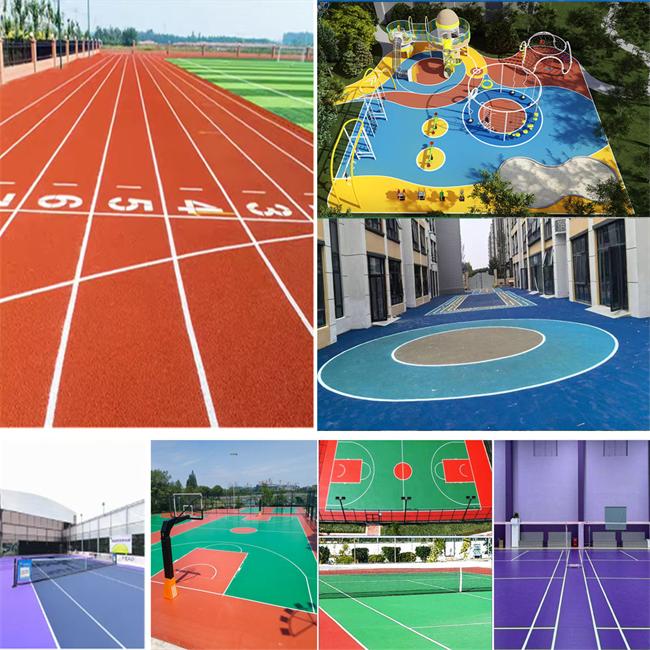
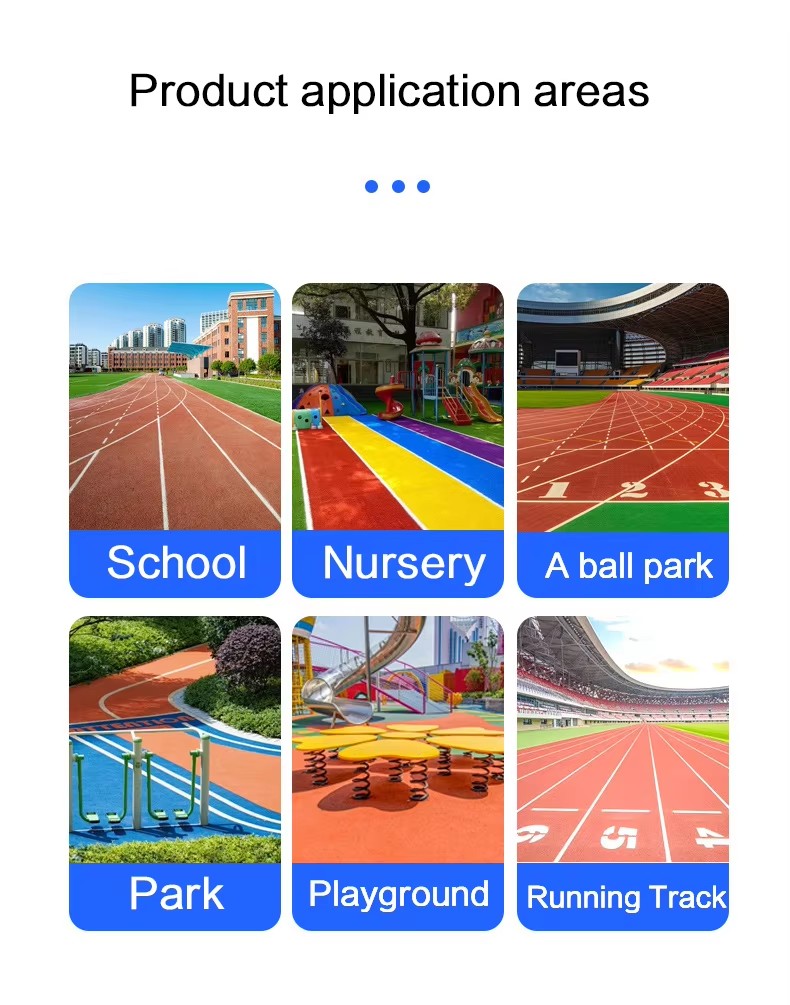
The trend is clear: municipal governments, school boards, and commercial developers increasingly require EPDM wet pour surfaces for playgrounds, parks, pathways, and sports facilities.
Key drivers include:
- Safety certification—meeting or exceeding EN 1177, ASTM F1292, and other critical fall height standards
- ADA compliance—accessible surfaces for all users
- Long-term value—lower total cost of ownership compared to loose fill (no annual top-ups, no replacements every 3-5 years)
- Aesthetic design—branded colors, custom games, and architectural integration
- Sustainability—recycled base layers, durable top layers, and materials free from hazardous substances

Final Recommendation: What to Do Next
If you're a contractor, installer, or purchasing manager evaluating EPDM suppliers for your next project:
1. Demand material certifications—don't take verbal assurances
2. Request UV stability test data—specifically long-term (1000+ hours) Grey Scale ratings
3. Confirm sulfur-free status—this should be a non-negotiable spec for any quality-sensitive project
4. Ask about binder compatibility—not all EPDM works with all binders
5. Get samples and test—with your specific binder, in your conditions
6. Verify no MOQ flexibility—suppliers who force large orders often have quality or cash flow issues
Ready to specify the right material for your next project?
Contact us for samples, technical data sheets, and no-obligation consultation.
- 25+ years of EPDM manufacturing expertise
- Sulfur-free technology—longer life, no odor, better color stability
- No MOQ—flexible orders from small projects to major contracts
- Full customization—colors, sizes, packaging
- Global shipping—fast delivery to all markets
Get Your Free Sample & Quote Today.


WOW(LYG) New Material Co Ltd is a manufacturer specializing in the production of EPDM rubber granules. We use sulfur-free vulcanization technology, it increases the service life by more than 3 times than traditional EPDM granules, and enhances the performance, including anti-aging, high-temperature resistance, and colorfastness.
We have over 25 years of production experience and offer customization for colors and granule sizes. NO MOQ.


