 注: 建议图片大小150px*50px
丨
注: 建议图片大小150px*50px Views: 0 Author: Site Editor Publish Time: 2026-08-25 Origin: Site


Features: Wide range of colors, cost-effective, easy to install, and requires minimal preparation of the subgrade.
Thickness: Typically 8 mm for sports courts; 10–25 mm for multi-purpose playgrounds in kindergartens.
Applications: Recreational and fitness facilities, kindergartens, basketball, badminton, and table tennis courts, amusement parks, water parks, Leisure Areas, walking paths, Scenic Spots etc.
Common Materials: Polyurethane adhesive, EPDM granules, and other elastic particles.
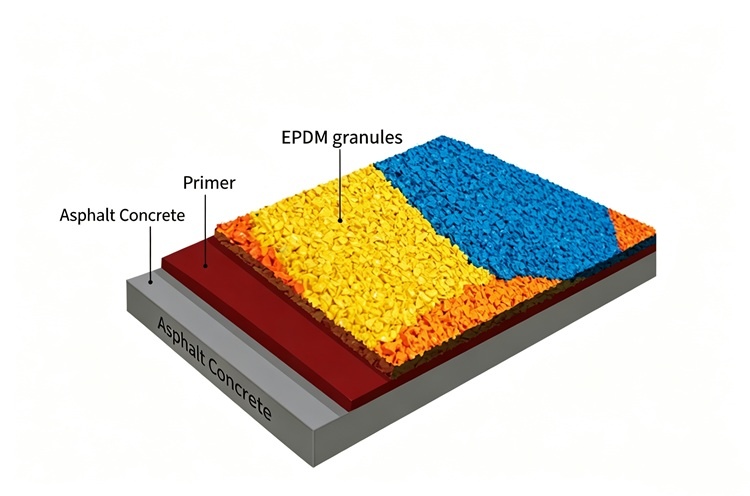
Installation Guide for Compacted Running Tracks
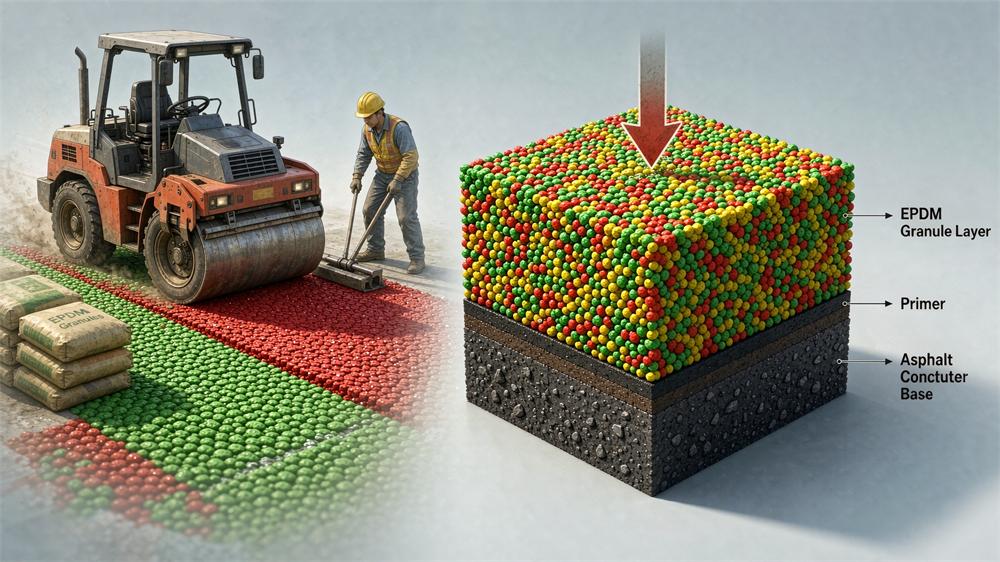
I. Subgrade Preparation
(1) Cleaning: Before construction, thoroughly sweep the subgrade surface; the subgrade must be free of dirt and other loose debris.
(2) Subgrade Construction Method: The primer for the specialized subgrade is F605, which enhances adhesion to the subgrade. Apply the F605 primer evenly to the subgrade surface using a roller at a rate of 0.15–0.2 kg/m².
II. Compacted Surface Layer
The compacted surface layer is composed of a single-component moisture-curing adhesive mixed in proportion with 1–3 mm EPDM granules. The recommended ratio of adhesive to granules is 1:6. Users may choose from two types of single-component moisture-curing adhesives: standard adhesives RN-1045 and RN-300, or yellowing-resistant adhesives RN-1185K and RN-1195K. No additional materials are required during normal construction to prevent the finished product from exceeding chemical standard limits. When constructing at temperatures below 15°C, 0.3%–0.5% organic tin catalyst may be added to the standard adhesive as needed, while 0.3%–0.5% CK-22 fast-curing catalyst may be added to the yellowing-resistant adhesive as needed to control the curing time.
A. Manual Paving of the Surface Layer
(1) Mixing and Stirring Materials: First, lay down plastic sheeting at the mixing site to ensure the floor remains clean.
(2) The mixing time for the single-component moisture-curing adhesive and EPDM granules depends on the specific temperature and humidity; at 70% humidity and 25°C, the mixing time is 3–5 minutes.
(3) Avoid direct contact with water during mixing, and ensure the mixture is thoroughly and evenly blended.
B. Mechanical Paving of the Surface Layer
(1) Before construction, thoroughly clean the surface. Only after confirming that the moisture content meets construction requirements should the primer be applied evenly with a roller brush. Check and adjust the paving machine’s height.
(2) Pour the thoroughly mixed material into the paving machine’s feed area.
(3) If material leaks occur on either side of the machine’s effective width, manually replenish the material promptly and clean up any excess or spilled material.
(4) At corners and around drain openings, use a trowel to smooth the surface at a slight angle, adding or removing material as needed to prevent depressions or bulges.
(5) Place a layer of fiberglass mesh under the drain openings to facilitate drainage.
(6) Promptly remove any debris, insects, leaves, or other foreign objects that have splashed onto the finished surface of the substrate.
(7) At the handoff points between work areas of consecutive shifts, use a trowel to smooth the joints, ensuring there is virtually no height difference.
(8) Determine the edge finishing locations and apply masking tape in advance.
(9) Once all substrate application for the shift is complete, remove the masking tape promptly.
III. Line Marking
The line marking paint is a two-component material with a hardener to white topcoat ratio of 1:3. A leveling agent may be added as needed during application. Measure and position according to standard dimensions to mark the boundary lines. Apply masking tape along both sides of the lines on the court. Use a short-nap roller with the specialized line marking paint to apply an even coat between the masking tape. Once the surface is completely dry, remove the masking tape.
IV. Precautions
(1) When mixing materials, weigh ingredients accurately and stir thoroughly.
(2) The surface must be kept clean before each step of the entire construction process.
(3) Ensure adequate ventilation in indoor facilities.
(4) Allow the surface to cure for at least 3–5 days before use.
(5) Strictly follow this construction procedure. In case of special circumstances, consult our sales manager by email; otherwise, our company assumes no responsibility for any construction quality issues that may arise.

