 注: 建议图片大小150px*50px
丨
注: 建议图片大小150px*50px Views: 0 Author: Site Editor Publish Time: 2026-08-28 Origin: Site


Yes, EPDM granule size directly affects the performance, appearance, binder consumption, surface texture, and application suitability of rubber surfacing systems. Smaller granules generally produce a smoother, denser surface with better color consistency, while larger granules offer a more textured finish, higher porosity, and different shock absorption characteristics. However, granule size is not the only factor — binder ratio, layer thickness, installation method, and material formulation also play important roles in the final performance of EPDM rubber surfaces.
Choosing the right EPDM granule size depends on the project type. Playground surfaces, running tracks, sports surfacing, wet pour rubber systems, and decorative outdoor areas may each require different particle sizes to meet safety, drainage, durability, and visual requirements.

How EPDM Granule Size Affects Performance
Surface Smoothness and Texture
Granule size has a clear impact on surface texture. Smaller EPDM granules tend to create a smoother and more uniform surface, while larger EPDM granules produce a more textured and open surface structure. For areas where children play, sit, or fall, a smoother surface may be more comfortable and easier to maintain. For outdoor sports or drainage-sensitive areas, a slightly more open structure may help with water permeability.
Binder Consumption and Cost Efficiency
Smaller granules usually have a higher surface area relative to their volume, which can increase binder consumption. Larger granules may require less binder per unit volume, but this depends on the grading, particle shape, and installation system. This means granule size can influence material cost, binder usage, surface density, installation efficiency, and long-term wear behavior. Project teams should not choose granule size based on appearance alone. Binder ratio and layer design must be considered together.
Shock Absorption and Safety
In playgrounds and sports surfacing, shock absorption is an important safety factor. Granule size can influence how the surface compresses and responds to impact, but it works together with layer thickness, rubber density, binder type and ratio, base preparation, and installation quality. A thicker layer with properly selected EPDM granules may provide better impact attenuation than a thin layer, even if the granule size is similar.
Color Appearance and Visual Consistency
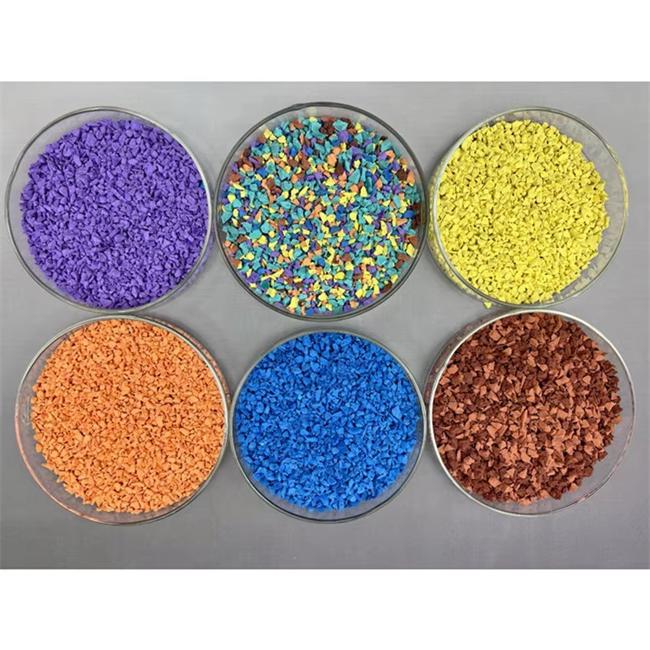
Granule size also affects color presentation. Smaller granules often give a more consistent and refined color appearance, while larger granules may create stronger visual texture and depth. Mixed-size systems can produce natural, decorative effects. Color stability depends more on material formulation, UV resistance, and environmental exposure than on size alone. For projects with strict visual requirements, such as school playgrounds, commercial landscapes, or branded sports areas, consistent granule size and stable color are both important.
Drainage and Porosity
For wet pour rubber surfacing and outdoor applications, drainage performance matters. Larger granules and well-graded particle systems can support better water permeability, helping reduce surface water retention. However, drainage is not determined by granule size alone. The binder ratio, compaction level, layer structure, and base drainage design all affect how water moves through the system.
Durability and Wear Resistance
Durability depends on several factors, including EPDM material formulation, UV and weather resistance, oxidation resistance, binder adhesion, traffic load, maintenance frequency, and installation quality. Granule size can influence surface wear patterns, but it should not be treated as the only indicator of durability. A well-formulated EPDM granule with good UV resistance, oxidation resistance, and stable physical properties is often more important than size alone.
Practical Considerations for Projects and Procurement
When selecting EPDM granules, engineers, contractors, and procurement teams should look beyond particle size and consider the full application environment.
For Playground Projects
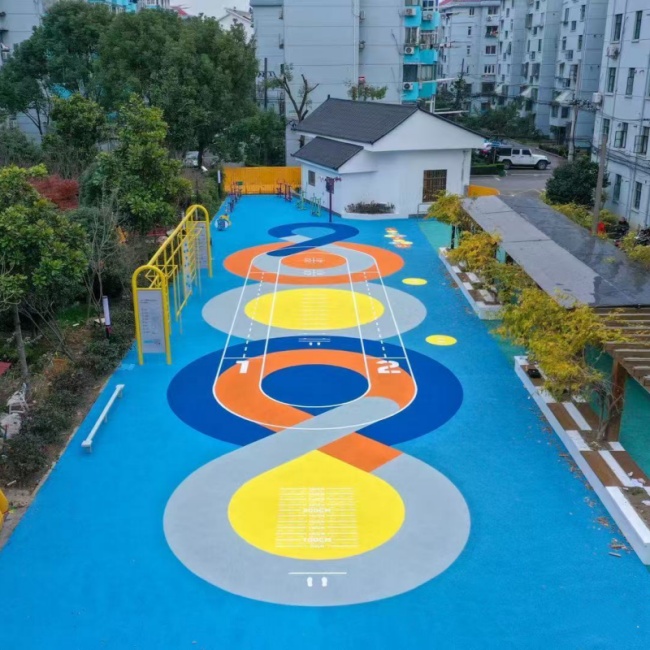
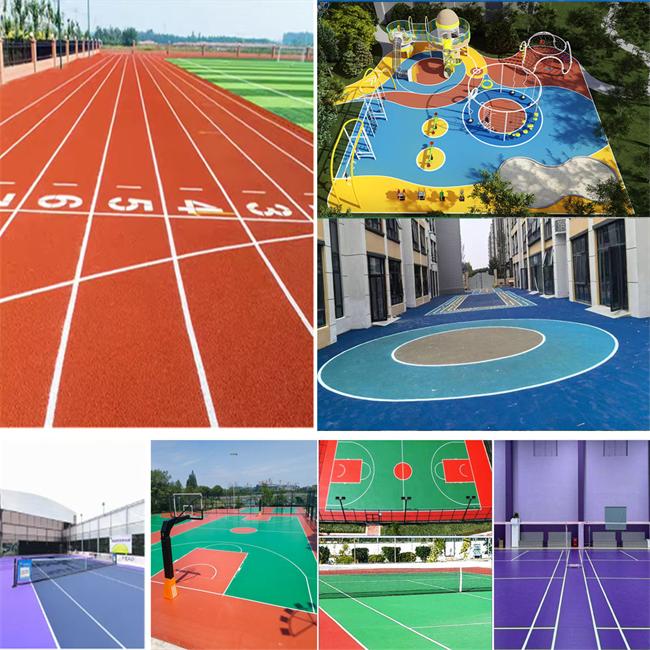
Playground surfaces usually need good shock absorption, a smooth and comfortable surface texture, color stability under sunlight, resistance to weathering and foot traffic, and consistent appearance over large areas. Smaller or medium-sized EPDM granules are often preferred for top layers because they provide a more even finish and better visual consistency.
For Running Tracks and Sports Surfacing
Sports surfaces require balanced performance between shock absorption, surface friction, elasticity, wear resistance, color visibility, and drainage. Granule size should be matched with the correct layer structure. The wearing layer, cushion layer, and base layer may use different particle sizes depending on the system design.
For Wet Pour Rubber Surfacing
Wet pour systems are commonly used in playgrounds, parks, pathways, and recreational areas. In these systems, EPDM granule size affects surface smoothness, binder coverage, water permeability, visual texture, and installation workability. A two-layer system is often used: larger granules in the base layer for cushioning and drainage, and smaller granules in the top layer for appearance and surface performance.
For Decorative and Landscape Applications
For landscape areas, walkways, pool surrounds, and outdoor recreational spaces, visual effect is often a priority. Larger or mixed-size EPDM granules can create natural, decorative textures, while smaller granules provide a cleaner and more uniform look.
How to Choose the Right EPDM Granule Size
When selecting EPDM granules for a project, several factors should be evaluated together rather than in isolation.
Application type — Identify whether the project is a playground, running track, sports surface, wet pour area, or landscape space. Different applications have different performance priorities.
Surface finish — Decide whether the project needs a smooth, textured, decorative, or uniform surface appearance.
Safety requirement — Determine if the project requires specific shock absorption, impact attenuation, or slip resistance performance.
Drainage need — Assess whether the surface needs high porosity and water permeability, especially for outdoor installations.
Visual requirement — Consider color consistency, texture depth, and whether mixed-color designs are part of the project plan.
Layer structure — Decide whether the system uses a top layer only, a base layer only, or a multi-layer configuration.
Material performance — Evaluate UV resistance, oxidation resistance, elasticity, and weather resistance as part of the overall selection.
A practical selection process should follow this order: First, define the application. Then check safety and performance requirements. Next, choose the layer structure and select the granule size range accordingly. After that, confirm color and specification, and finally evaluate the supplier's capability to deliver consistent particle size, stable color, reliable supply, and technical support.
EPDM Granules Selection: What Buyers Should Check
When purchasing EPDM rubber granules, granule size is important, but it should be evaluated together with material performance and supply reliability.
Particle size consistency — Uniform grading helps with installation quality and surface appearance. Inconsistent particle sizes can lead to uneven surfaces and unpredictable binder consumption.
Color stability — Outdoor projects need granules that resist fading under UV exposure. Color stability is closely related to material formulation, pigment quality, and oxidation resistance.
Elasticity and tensile performance — These affect shock absorption and long-term surface behavior. Higher elasticity generally supports better impact response and surface recovery.
UV and weather resistance — Important for playgrounds, running tracks, and outdoor sports surfacing that are exposed to sunlight, rain, and temperature changes throughout the year.
Oxidation and aging resistance — Helps maintain performance over time. Materials with stronger resistance to oxidation tend to retain their physical properties for longer periods.
Odor performance — Low-odor EPDM granules are often preferred for schools, playgrounds, and indoor-outdoor recreational areas where user comfort matters.
Environmental suitability — Some projects may require more environmentally friendly formulations, especially in sensitive or high-traffic public areas.
Customization options — Projects with specific design requirements may need custom colors, particle sizes, or blended specifications. A supplier's ability to offer flexible customization can be an important factor in project planning.
For projects with strict visual or safety requirements, it is useful to request samples, technical data, and application recommendations before placing a bulk order.

FAQ
Is smaller EPDM granule size always better?
No. Smaller EPDM granules are not automatically better. They usually provide a smoother surface and more consistent color, but larger granules may be better for drainage, texture, cushioning layers, or decorative effects. The best size depends on the application and layer design.
Does granule size affect playground safety?
Yes, indirectly. Granule size can influence surface texture, shock absorption, and installation density, but playground safety also depends on layer thickness, binder ratio, base preparation, and compliance with applicable safety requirements.
Does EPDM granule size affect color fading?
Granule size has less direct impact on color fading than material formulation does. Color stability is more closely related to UV resistance, oxidation resistance, pigment quality, and environmental exposure. However, smaller granules may make color inconsistency more visible if batch quality is not stable.
Can different granule sizes be used in the same project?
Yes. Many wet pour rubber surfacing systems use larger EPDM granules in the base layer and smaller granules in the top layer. This helps balance cushioning, drainage, surface smoothness, and visual appearance.
Does granule size affect installation cost?
It can. Smaller granules may require more binder due to higher surface area, while larger granules may affect coverage, texture, and compaction. Installation cost is influenced by granule size, binder ratio, layer thickness, labor efficiency, and project conditions.
Which EPDM granule size is best for running tracks?
There is no single "best" size for all running tracks. The choice depends on the track system, performance requirements, layer structure, and local standards. Sports surfacing usually requires a balanced combination of elasticity, wear resistance, friction, and shock absorption.
How can I confirm whether an EPDM granule size is suitable for my project?
The most practical approach is to match granule size with the application, layer structure, safety requirements, and visual expectations. Requesting samples, checking technical data, and consulting with the supplier based on your project drawings or specifications can help avoid unsuitable material selection.
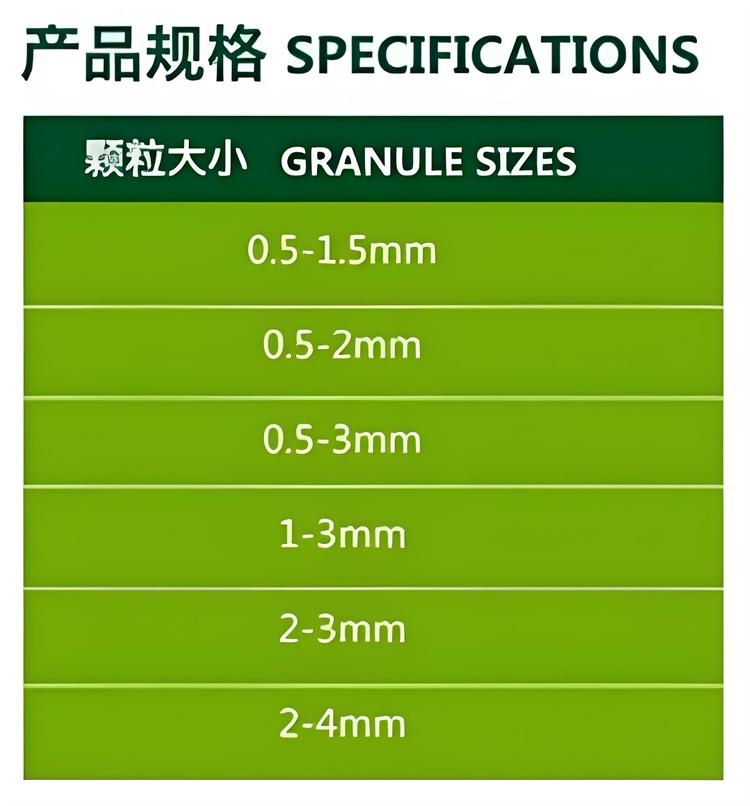
EPDM granule size does affect performance, but it should not be evaluated alone. The right particle size depends on the application, surface finish, safety needs, drainage requirements, binder system, and long-term durability expectations. Smaller granules are often suitable for smooth and visually consistent surfaces, while larger granules can support texture, drainage, and cushioning layers.
For projects such as playgrounds, running tracks, sports surfacing, wet pour rubber surfaces, and outdoor recreational areas, choosing the correct EPDM granule size is part of a broader material selection process. If you are selecting EPDM rubber granules for a specific project and need guidance on particle size, color, specification, or application suitability, feel free to reach out — we can help match the right granule size and formulation to your project requirements.

WOW(LYG) New Material Co Ltd is a manufacturer specializing in the production of EPDM rubber granules. We use sulfur-free vulcanization technology, it increases the service life by more than 3 times than traditional EPDM granules, and enhances the performance, including anti-aging, high-temperature resistance, and colorfastness.
We have over 25 years of production experience and offer customization for colors and granule sizes. NO MOQ.


