 注: 建议图片大小150px*50px
丨
注: 建议图片大小150px*50px Views: 0 Author: Site Editor Publish Time: 2026-07-17 Origin: Site


Choosing the right color for your EPDM playground or sports surfacing project seems simple. But for procurement professionals, contractors, and specifiers, color is rarely just about aesthetics. It is a decision loaded with technical considerations: UV stability, binder compatibility, long-term maintenance costs, and even supplier reliability. Choose wrong, and a vibrant playground can fade into a dull, patchy surface within months, leading to costly repairs and dissatisfied clients .
This guide is not a basic product introduction. It is a deep dive into everything procurement managers, contractors, and engineers need to know about EPDM color selection, common failures, and how to secure a surface that performs as good as it looks for years.

What Is an EPDM Granule Color Guide?
An EPDM Granule Color Guide is a reference system—often referencing RAL color standards—that catalogs the available colors for EPDM (Ethylene Propylene Diene Monomer) rubber granules . These granules are the wear layer (top surface) of "poured-in-place" (PIP) rubber surfacing, commonly found in playgrounds, running tracks, sports courts, and landscape projects .
However, the guide is more than a paint swatch. It reflects the specific dyes and pigments used during manufacturing (not surface-painted) and indicates which granules match specific polyurethane resin binders . This interplay between granule pigment and binder chemistry is the key to long-lasting color.
Why it matters to you:
- Contractors: Need to know which colors are difficult to install or require special binders.
- Importers: Need to verify if the supplier's color range matches international standards (RAL).
- Architects: Need to select colors that won’t degrade aesthetically under local UV conditions.
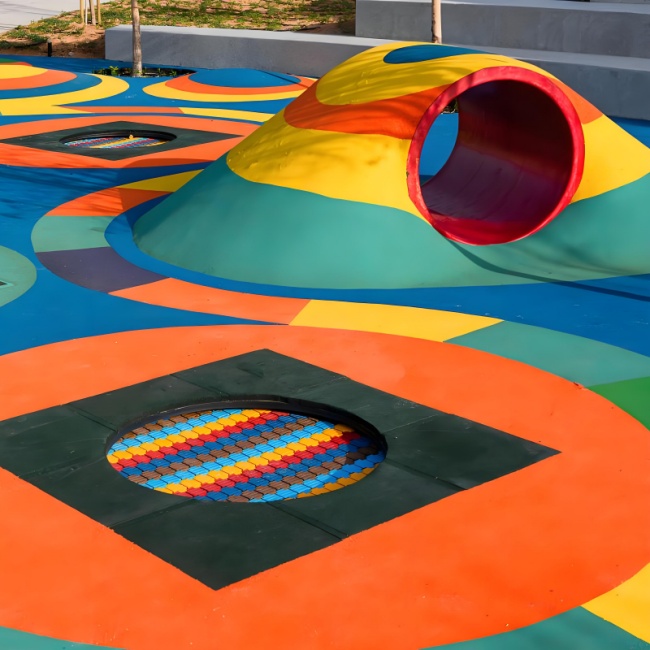
Common Applications & Why Color Choice Varies
Color isn't just about branding; it is about safety and performance. The guide serves different needs across different projects :
- Playgrounds & Kindergartens: Often use bright primary colors (Red, Blue, Yellow) for visual appeal and safety zones (Green for grass imitation). Pain point: These colors are often the most susceptible to fading if paired with the wrong binder.
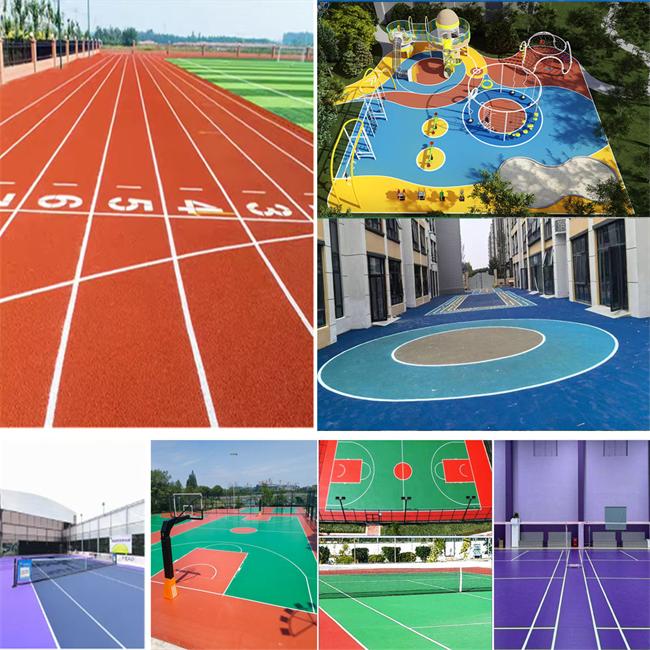
- Running Tracks & Sports Courts: Typically use Red (iron oxide) or Dark Green. These pigments are more UV-resistant and cost-effective for large areas. Note: Bright Blues or Oranges are risky for high-traffic competitive courts.
- Landscaping & Municipal Projects: Earth tones (Brown, Beige, Terracotta) are used for park trails. Pain point: Contractors worry about these colors looking "dirty" over time; specific anti-soiling properties are needed.
- Multi-Game Courts: Use a mix of colors for line marking and different zones. Pain point: Different colors may age at different rates, causing a patchy appearance over 3-5 years.
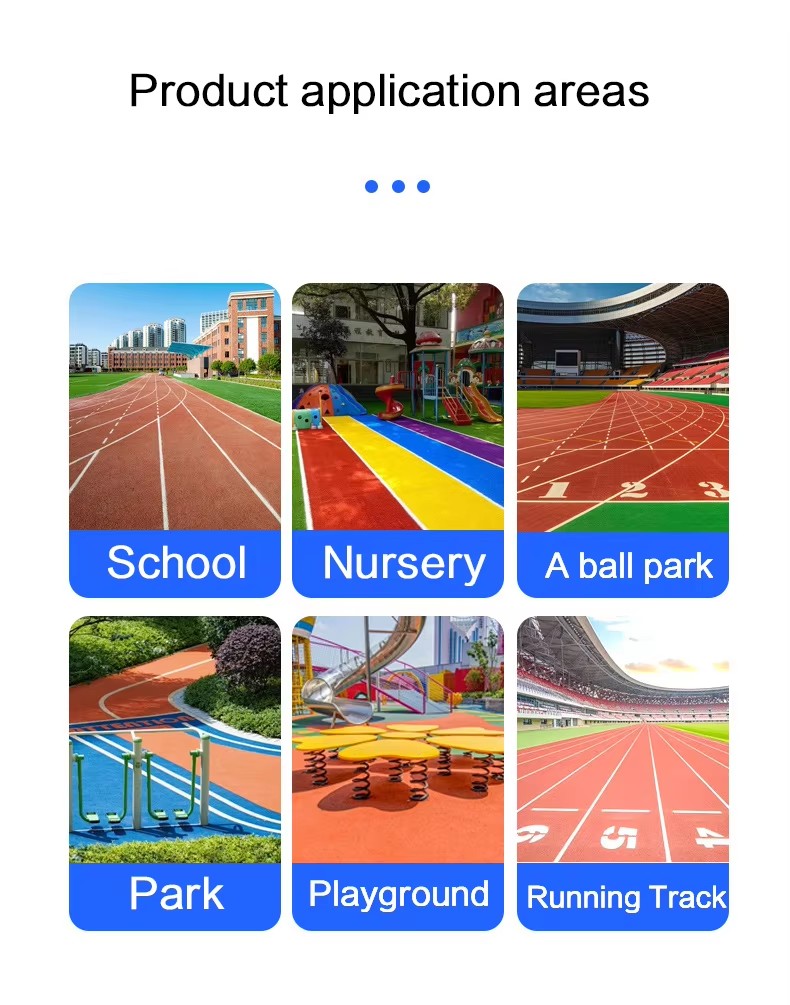
Why Colors Fail: The Hidden Incompatibility (Binder vs. Pigment)
This is the most misunderstood area of EPDM color selection. The color of the granule isn't the only factor in appearance; the glue (binder) holding it down is equally critical.
There are two main types of polyurethane binders :
Aromatic Binders (Non-UV Stable)
- Issue: They yellow or turn brown when exposed to UV light.
- Recommendation: Only suitable for dark colors where the yellowing effect isn't visible (e.g., Brown RAL 8025, Dark Green 6005, Red 3016) .
- Challenage: Some contractors use cheap aromatic glue on bright colors to save costs, resulting in the entire surface turning a murky "dirty" yellow within 6 months.
Aliphatic Binders (UV Stable)
- Advantage: Clear and does not yellow.
- Requirement: Essential for light and bright colors (White, Yellow, Bright Blue, Turquoise, Pink). If you don't use this, the color changes drastically .
- Pain Point: Aliphatic binders cost 20-40% more. Many procurement teams overlook this, prioritizing cheap "glue quotes," which ruins expensive colored granules.

How to Select the Right Color: Avoiding the "Fade" Trap
Case Study: The Light Color Mistake
An architect specified "Light Grey" (RAL 7038) for a school playground. The contractor used the granules with a standard binder. Within 3 months, the "Light Grey" looked a dirty yellow-brown. The issue wasn't the granule quality; it was the aromatic binder oxidizing .
The Rule of Thumb: If you are selecting a color from the "Bright" or "Light" spectrum, your procurement contract must mandate "Aliphatic PU Binder" as part of the material package.
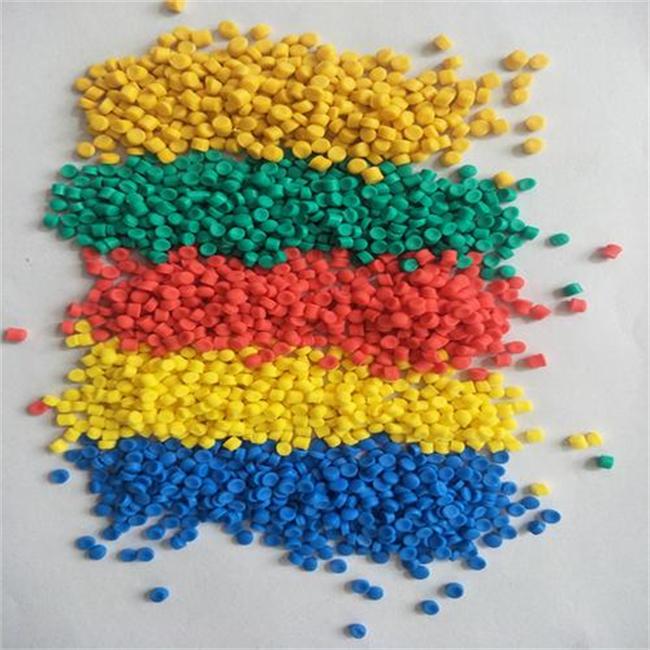
Our Technical Advantage: Solving the "Sulfur Smell" & Color Stability
Many suppliers offer a wide color guide, but our manufacturing technology is fundamentally different and solves the key industry pain points .
1. No Sulfur = No Smell & Superior Color
Traditional EPDM uses sulfur as a vulcanizing agent. Under heat and UV, sulfur breaks down and reacts with moisture to form sulfuric acid, which smells and degrades color stability . We utilize a sulfur-free curing system . Without sulfur, there is no acid release. This means:
- No odor even under intense sun and high temperatures.
- The molecular structure is more stable, preventing the "yellowing" caused by chemical breakdown (not just UV exposure).
2. Color Retention & Antioxidant Performance
Because we use a sulfur-free system combined with high-quality, inorganic color pigments, our granules offer superior anti-oxidation. The color remains vibrant and true to the RAL guide for longer than industry-standard sulfur-cured products.
3. Mechanical Performance (Elasticity & Strength)
We don't just focus on color; we focus on safety and durability. Our sulfur-free process increases tensile strength to 4–7 MPa (significantly higher than the industry standard of ~2.7 MPa) and elongation to 550%+ . This means the surface handles impact better and doesn't crack, preserving the aesthetic look of the color.
Procurement Mistakes & How to Avoid Them
Based on analysis of buyer behavior and supplier quality issues, here is how to avoid common mistakes :
Mistake 1: Falling for the "Cheap" Quoting Trick
- The Problem: Supplier quotes a low price. They use low polymer content (e.g., 10% EPDM vs. 20%) and load the granule with cheap fillers (calcium carbonate). The color looks the same in the bag but fades quickly .
- The Solution: Request the EPDM Polymer Content specifically. Minimum for good color retention is ≥20% .
Mistake 2: Ignoring Bulk Density
- The Problem: Cheap granules are "heavy" (high bulk density) because of limestone fillers. You pay by weight, but you get fewer square meters of coverage.
- The Solution: Our granules feature a low bulk density and "sharp angular" shape, meaning they interlock better and require less material to cover the same area, saving you money on shipping and material usage.
Mistake 3: Poor Batch Consistency
- The Problem: The supplier sends you a bright red sample, but the bulk shipment is a dull red. Pain point: This forces project delays and rejection by the architect.
- The Solution: Require a Color Chart from the actual production batch, and ensure the supplier uses automated color mixing systems, not manual labor.
Mistake 4: The "Sample vs. Shipment" Color Mismatch
- The Problem: Samples look great, but containers arrive with color inconsistencies because the supplier uses manual mixing.
- The Solution: Insist on automated mixing and quality testing. Our laboratory uses a color difference scheme (色差计) to maintain strict quality control, ensuring the products we ship meet the RAL standard you requested.

Why Global Contractors & Engineers Are Moving to Advanced EPDM
The industry is shifting. Procurement managers are not just looking for color; they are looking for Total Cost of Ownership (TCO) .
Here is the calculation:
- Standard Sulfur-Cured EPDM: Fades in 3-5 years, requires sealant or repainting to restore color, and may emit sulfur smell in high heat.
- Our Sulfur-Free EPDM: Extends service life by over 3 times thanks to stable molecular chains. The performance retention rate is improved by 5 times. You don't need to replace the surface for 8-10+ years.
For the Supply Chain (Importers/Distributors):
- We offer Zero MOQ (No Minimum Order Quantity) . This is rare in the industry and helps you test the market without risking capital on huge container loads.
- We support Custom Colors & Custom Sizes (0.5mm to 4mm) . If your RAL code isn't standard, we can match it.

The Ultimate EPDM Color Checklist
If you are a Purchasing Manager or Contractor reading this, use this checklist before you issue your PO:
- Color Code: Is the color confirmed using the RAL standard?
- Binder Type: If the color is White, Bright Blue, Turquoise, or Pink, is an Aliphatic binder specified in the contract?
- Sulfur-Free: Is the material sulfur-free to prevent odor and chemical degradation?
- Polymer Content: Is the EPDM content ≥20% for high wear/color areas?
- Color Consistency: Did you request a "Shipment Matching" sample sent to the lab?
- Bulk Density: Is the bulk density low (under ~680g/l) to ensure better volume coverage?

An EPDM Granule Color Guide is your starting point. However, the real value lies in understanding the chemistry behind the color. Faded surfaces, sulfur smells, and patchy finishes are not inevitable; they are the result of choosing the wrong material specs or binder combination.
As an experienced manufacturer with 25+ years in the industry, we specialize in sulfur-free, high-performance EPDM granules that deliver vibrant, lasting color without the odors or maintenance headaches.

Contact us directly to request physical color samples, detailed test reports on our sulfur-free process, or to discuss your specific project requirements (no MOQ, full customization). We are here to help you build a surface that stands the test of time and sun.
WOW(LYG) New Material Co Ltd is a manufacturer specializing in the production of EPDM rubber granules. We use sulfur-free vulcanization technology, it increases the service life by more than 3 times than traditional EPDM granules, and enhances the performance, including anti-aging, high-temperature resistance, and colorfastness.
We have over 25 years of production experience and offer customization for colors and granule sizes. NO MOQ.


