 注: 建议图片大小150px*50px
丨
注: 建议图片大小150px*50px Views: 0 Author: Site Editor Publish Time: 2026-07-18 Origin: Site


You’ve won the bid, signed the contract, and laid the foundation. Then the EPDM granules arrive—and within six months, the color fades, the surface begins to chalk, and the complaints keep pouring in. By the second year, you’re facing a complete overhaul.
This scenario plays out repeatedly at playgrounds, sports fields, and municipal projects around the world. And in the vast majority of cases, it’s entirely preventable.
For playground contractors, sports surface installers, EPDM granule importers, and government procurement buyers, the cost of a failed investment is extremely high. A 5,000-square-meter school track project represents a massive investment. If that track fails prematurely, it’s not just a financial loss—it’s a reputational disaster.
This guide provides a field-proven framework for inspecting the quality of EPDM granules. Whether you are a wholesaler screening suppliers, a designer establishing standards for municipal projects, or a project manager preparing for construction, the key metrics and testing methods outlined below are the factors that truly determine the success or failure of your project.
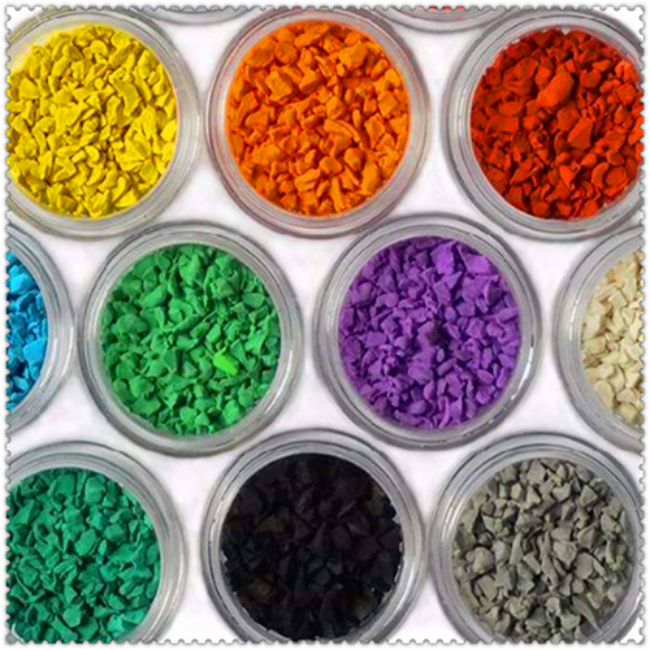
What Are EPDM Granules?
EPDM stands for ethylene-propylene-diene monomer. It is a synthetic rubber produced by the copolymerization of ethylene, propylene, and a non-conjugated diene (typically ENB or ethylidene-norbornene). The diene is introduced to provide cross-linking sites on the polymer molecular chains, giving EPDM a level of elasticity and durability that traditional rubbers cannot match.
In granule form, EPDM is widely used as a wear-resistant surface layer for various sports and safety surfaces. Specific applications include:
- Professional athletic tracks and school running tracks
- Safety mats and protective surfaces for children’s playgrounds
- Tennis courts, basketball courts, and multi-purpose sports fields
- Park landscaping, fitness trails, and theme parks
- Municipal pedestrian and bicycle paths
Why EPDM? Unlike natural rubber or SBR (styrene-butadiene rubber) granules processed from scrap tires, high-quality virgin EPDM granules offer overwhelming advantages in UV resistance, ozone resistance, aging resistance, and resistance to extreme temperatures. This is precisely why it is the top choice for all-weather outdoor surfacing materials.

The Hidden Truth About EPDM Granule Quality:
The quality of EPDM granules varies dramatically from one manufacturer to another. Many of these critical differences are impossible to detect with the naked eye, and by the time you notice them, it’s often too late.
1. Sulfur-Free Process vs. Sulfur-Based Vulcanization: A Critical Distinction
This is perhaps the most easily overlooked yet most crucial quality distinction for the vast majority of buyers.
Traditional EPDM granule production relies on a sulfur-based vulcanization system. The problem is that, under prolonged exposure to UV radiation and high temperatures, sulfur bonds break down and release sulfuric acid compounds. This directly triggers a triple catastrophic chain reaction:
- A persistent, pungent odor is emitted during the material’s degradation;
- The polymer backbone rapidly breaks down, causing a precipitous drop in service life;
- Pigments are eroded by acidic substances, causing rapid color fading and severe surface chalking.
In contrast, EPDM granules produced using sulfur-free (peroxide) cross-linking technology completely circumvent this chemical flaw. Since there are no unstable sulfur bonds in the molecular chains, their three-dimensional network structure is exceptionally robust. The resulting improvements are orders of magnitude greater:
- Product service life is directly extended to more than three times the original;
- Tensile strength and tensile load increase to 4–7 MPa, two to three times that of ordinary sulfur-containing products;
- Performance retention rates are more than five times higher in accelerated aging tests.
For projects located in regions with high sunlight exposure and high temperatures, EPDM utilizing sulfur-free technology is no longer merely an “upgrade option,” but a prerequisite for ensuring the project does not fail prematurely.
2. Rubber Hydrocarbon Content: A Key Performance Indicator
To cut costs, some manufacturers add large amounts of inexpensive fillers, such as calcium carbonate (heavy calcium carbonate powder), to EPDM compounds. As a result, the rubber content is severely diluted, and product performance plummets.
The industry-recognized threshold is that the rubber hydrocarbon content of high-quality EPDM granules must not be less than 20 percent. For venues with extremely high safety requirements, such as school playgrounds and children’s play areas, responsible engineers typically require a minimum of 25 percent.
Here’s a simple on-site identification method: Take a single granule and stretch it forcefully. Granules with high rubber content exhibit good ductility; they can be stretched to a great length and snap back quickly. In contrast, granules with low rubber content and high filler content have almost no ductility; they snap immediately upon stretching, and the fracture surface appears powdery—in plain terms, they are simply stone powder coated with a layer of color.
3. Coloring System and Color Stability
Color fading is the most obvious—and most frustrating—manifestation of quality issues. High-end EPDM granules use inorganic metal oxide pigments (such as iron-based or chromium-based pigments), which inherently possess extremely strong UV resistance. Cheap products, on the other hand, use organic synthetic dyes that oxidize and decompose within weeks or months under the combined effects of UV radiation and thermal oxidation, completely losing their original color.
A simple verification method: Request samples from the supplier and expose them to natural sunlight outdoors for seven days. High-quality granules will show minimal color variation, whereas inferior products will exhibit noticeable fading within a week.
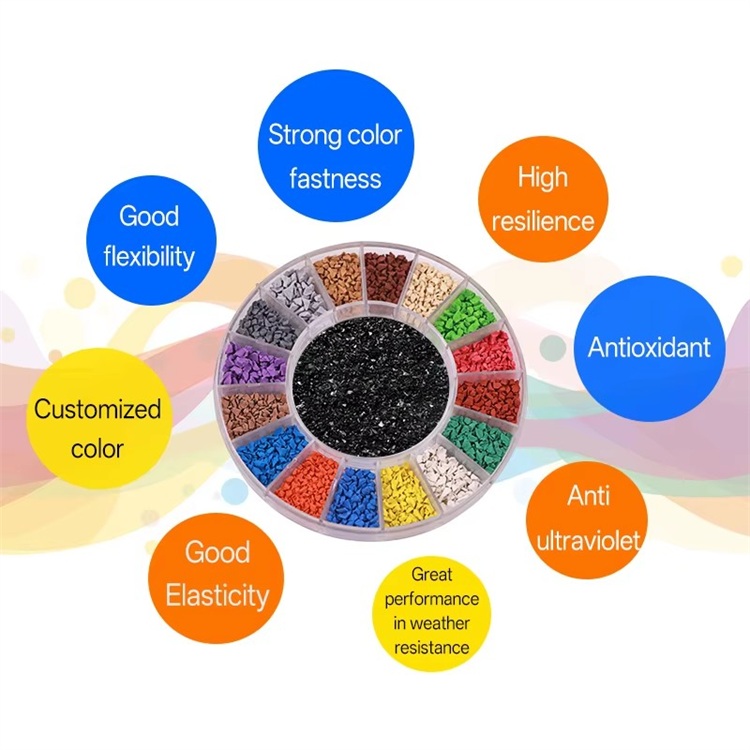
EPDM Granule Quality Inspection: A Comprehensive On-Site and Laboratory Checklist
When the goods arrive at your warehouse or construction site, the following inspection items must be carried out as a mandatory procedure. Never rely solely on the test reports provided by the manufacturer; every incoming batch must be verified in person.
Appearance and Physical Properties
First, examine the appearance and particle shape. High-quality granules should have an irregular, angular shape rather than a perfect sphere. This irregular shape allows the granules to interlock during installation, forming a denser, more stable structure with better compaction results. Also, observe the cross-section of the granules; it should be clean and dense, with no visible dust adhering to it. Excessive surface dust often indicates an excessively high filler content or poor control of the granulation process.
Next, examine the bulk density. High-quality EPDM granules typically have a lower bulk density, generally below 680 grams per liter. A lower density signifies higher rubber content and better elasticity, and it also means that less material is required per square meter to achieve the same铺装 thickness. These material savings can offset part of the difference in unit price, so be sure to calculate the total cost when purchasing.
Finally, verify the particle size distribution. For particle sizes rated at 1 to 3 millimeters, the industry-accepted upper tolerance limit is 10 percent. If the particle size distribution is severely uneven—with some particles too large and others too small—gaps will appear on the surface after installation, and the density will be inconsistent after compaction. This directly creates potential issues with wear and granule loss in the long term.

Mechanical Performance Indicators
Tensile strength is a key parameter for measuring a material’s resistance to breaking under tension. High-quality EPDM granules should have a tensile strength of no less than 3.5 MPa, while products manufactured using sulfur-free technology can reach 4 to 7 MPa. This directly corresponds to the surface’s durability when subjected to the grip of cleats and friction from sports equipment.
Elongation at break reflects the material’s flexibility and elasticity. Qualified products should have an elongation at break of no less than 550 percent. It is precisely this high elasticity that provides sports flooring with the necessary shock absorption and cushioning capabilities.
Hardness (Shore A) should be maintained within the range of 55 to 65 degrees. If the hardness is too high, the surface will feel stiff, lacking comfort and safety; if it is too low, wear resistance will be insufficient, and the surface will be prone to permanent deformation under heavy pressure.
Environmental Protection and Health & Safety Performance
The total emission of volatile organic compounds (VOCs) should not exceed 5.0 milligrams per square meter per hour. Granules produced using sulfur-free technology do not decompose to produce acidic gases at high temperatures, making them virtually odorless—a critical factor in both indoor and hot outdoor environments.
Limits on heavy metals and hazardous substances must comply with the mandatory requirements of GB 36246-2018, “Synthetic Surface Sports Facilities for Primary and Secondary Schools,” such as a lead content not exceeding 50 milligrams per kilogram and a cadmium content not exceeding 10 milligrams per kilogram.
The total content of polycyclic aromatic hydrocarbons (PAHs) must be less than 50 milligrams per kilogram. Exceeding PAH limits typically indicates that the product contains inferior recycled rubber or low-cost aromatic oils; these substances pose a clear carcinogenic risk and are an absolute red line in European and American markets.
Aging and Weather Resistance
Hot-air aging performance: After 500 hours of aging at 70 degrees Celsius, the tensile strength retention rate should be no less than 90 percent of the original value. This indicator serves as a key basis for predicting the rate of performance degradation during long-term use.
Ozone resistance: One of the core advantages of EPDM is its natural resistance to ozone. However, this advantage can be compromised by an improper formulation. In an accelerated ozone test conducted at a concentration of 50 pphm and a temperature of 40 degrees Celsius, no cracks should appear on the surface of the test specimen.

Quick Quality Screening Methods Applicable on Construction Sites
For project managers and construction crews, there are some simple and practical “field tests” that can serve as preliminary quality control tools upon the arrival of materials.
Burning Test: Take a small amount of granules and ignite them with a lighter. EPDM with a high rubber content burns slowly, may self-extinguish after the flame is removed, produces white smoke, and has a mild odor; in contrast, low-quality, highly filled products burn vigorously, accompanied by heavy black smoke and a pungent, plastic-like burning smell, leaving behind grayish-white powdery residue.
Settling Test: Pour a handful of granules into clean water. High-quality, low-filler EPDM granules have a specific gravity lower than water and will float on the surface; whereas low-quality granules heavily filled with calcium carbonate have a higher specific gravity and will sink rapidly to the bottom.
Olfactory Test: Take a handful of granules, clench them in your hand to warm them up, and then smell them. High-quality granules produced using sulfur-free technology emit virtually no odor even when heated to high temperatures. If you detect a distinct chemical sourness or a rubbery stench, it can generally be concluded that a sulfur-containing vulcanization system was used, and odor issues will only intensify over time.
Friction Test: Take two handfuls of granules and rub them vigorously together. High-quality products shed almost no powder during rubbing, and no pigment transfers to your hands. Low-quality products shed large amounts of fine powder during rubbing, and pigment transfers to your palms, indicating poor pigment adhesion and fillers that easily flake off.

Common Engineering Failure Modes:
Failure 1: Severe Fading and Whitening
Root Cause: Use of low-cost organic dyes, insufficient pigment content, or a sulfur-containing vulcanization system, where acidic decomposition products corrode the pigment molecules.
Prevention Strategy: Clearly stipulate in the procurement contract the use of inorganic metal oxide pigments. Request and retain the supplier’s lightfastness test data. Conduct the seven-day natural sun exposure sample comparison mentioned earlier.
Failure 2: Particle Detachment and “Particle Shedding”
Root Cause: This is a systemic defect that may result from the particles themselves having too low a rubber content, leading to poor compatibility with the polyurethane adhesive; it may also stem from an inappropriate choice of adhesive, resulting in bonding strength that fails to meet standards.
Prevention Strategy: Strictly control the mixing ratio of the polyurethane adhesive to the particles; the weight ratio should not be less than 1:5 (one part adhesive to five parts particles). Additionally, require that the solid content of the adhesive be no less than 98% to ensure an adequate amount of effective bonding components.
Failure Type 3: Surface Chalking
Root Cause: The material itself is fundamentally unable to withstand the continuous erosion caused by outdoor UV radiation and thermo-oxidative aging. Almost without exception, this issue occurs in low-quality products that are sulfur-cured and have low rubber content.
Prevention Strategy: Explicitly specify the use of high-quality granules produced via a sulfur-free process. Require suppliers to provide third-party test reports, with a focus on verifying the strength retention rate after thermal aging.
Failure 4: Surface Blistering and Delamination
Root Cause: Excessive moisture content in the base layer or the granules themselves. Under high summer temperatures, the moisture vaporizes and expands, forcing the surface layer upward and causing blistering. Industry standards require that granule moisture content be controlled below 0.75 percent.
Prevention Strategy: For projects in coastal areas with high humidity or during the rainy season, it is essential to require suppliers to test and control granule moisture content prior to shipment. Ensure that on-site storage includes adequate measures to protect against moisture and rain.

Why Are More and More Professional Projects Switching to High-Quality Sulfur-Free EPDM?
The shift toward sulfur-free EPDM is by no means merely for the sake of better performance specifications; rather, it is based on a comprehensive assessment of total life-cycle costs, safety, environmental protection, and long-term reputation.
Let’s do the math. Taking a standard outdoor sports field as an example, although low-quality sulfur-containing granules have a lower unit price per kilogram, their higher bulk density requires a greater amount per square meter, and they require a complete renovation every three to five years. In contrast, while high-quality sulfur-free granules have a slightly higher unit price, their lower bulk density results in reduced material consumption, and their actual service life can reach ten to fifteen years. When factoring in renovation costs, downtime losses, and the costs of handling customer complaints over this period, the total cost of ownership for the former over ten years far exceeds that of the latter.
The conclusion is self-evident: while it may seem like a savings on material costs, it actually erodes the project’s overall profitability and reputation.

In the construction and building materials industry, the projects you deliver today directly determine the types of contracts you’ll secure tomorrow. A surface that fades, crumbles, or even peels within three years not only compromises the user experience but also severely damages your professional reputation, making it difficult for you to recover for years to come.
We deeply understand the weight of this responsibility. With over 25 years of industry expertise, we have always prioritized product consistency and transparency. Our sulfur-free EPDM granules are specifically designed for environments with extreme UV exposure and high-traffic applications, offering excellent elasticity, resistance to aging, and vibrant, long-lasting color. Additionally, we provide flexible customization options for color and granule size with no minimum order quantity, ensuring that whether you’re a small local contractor or a large multinational distributor, you’ll receive prompt, reliable service and delivery.


WOW(LYG) New Material Co Ltd is a manufacturer specializing in the production of EPDM rubber granules. We use sulfur-free vulcanization technology, it increases the service life by more than 3 times than traditional EPDM granules, and enhances the performance, including anti-aging, high-temperature resistance, and colorfastness.
We have over 25 years of production experience and offer customization for colors and granule sizes. NO MOQ.


