 注: 建议图片大小150px*50px
丨
注: 建议图片大小150px*50px Views: 0 Author: Site Editor Publish Time: 2026-09-01 Origin: Site


When specifying materials for a playground, running track, or sports surfacing project, few decisions are as critical—and potentially confusing—as choosing the right EPDM granule specifications. The difference between a surface that performs flawlessly for a decade and one that fails within three years often comes down to understanding the numbers, standards, and supplier capabilities behind those colored rubber granules.

What Are EPDM Granule Specifications?
EPDM granule specifications refer to the complete set of physical, chemical, and performance characteristics that define a particular EPDM (Ethylene Propylene Diene Monomer) rubber granule product. These specifications typically include particle size distribution (granulometry), polymer (EPDM) content percentage, tensile strength and elongation at break, hardness measured in Shore A, density and bulk density, UV stability and color fastness, aging and weathering resistance, thermal stability range, chemical resistance properties.
For contractors and engineers, these specifications are not just academic numbers—they determine installation success, surface performance, safety compliance, and long-term durability.
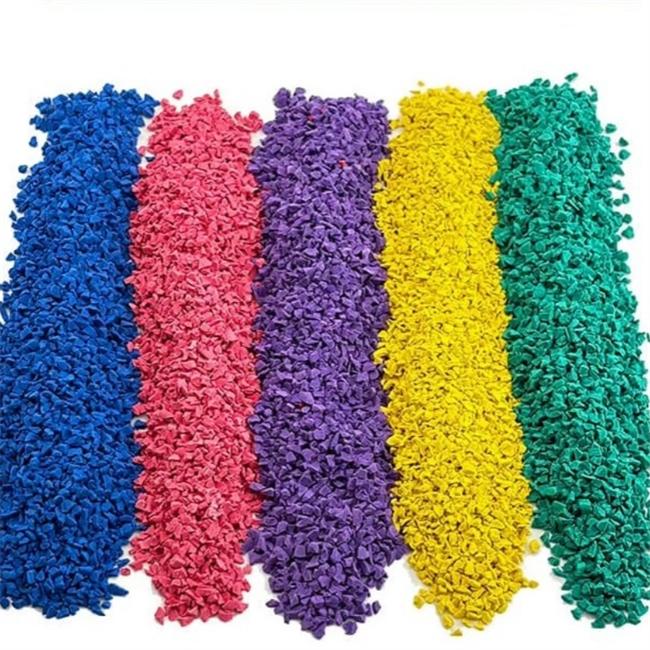
Applications and Why Specifications Matter Differently for Each
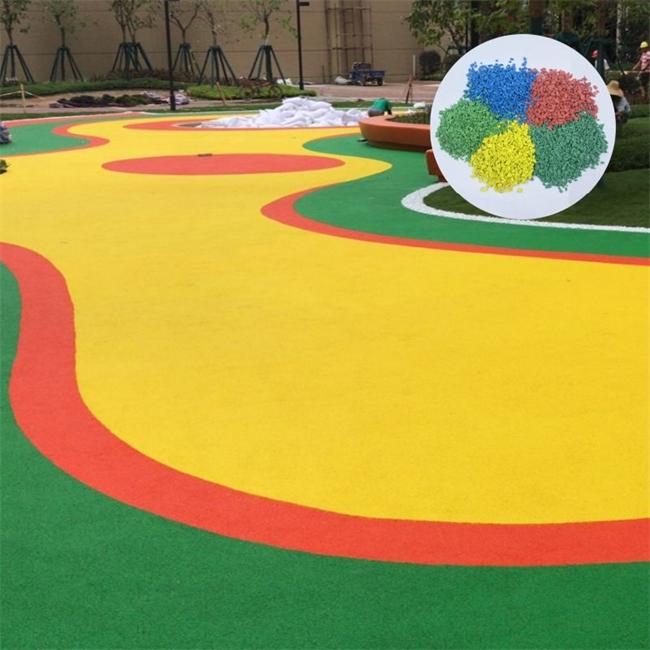
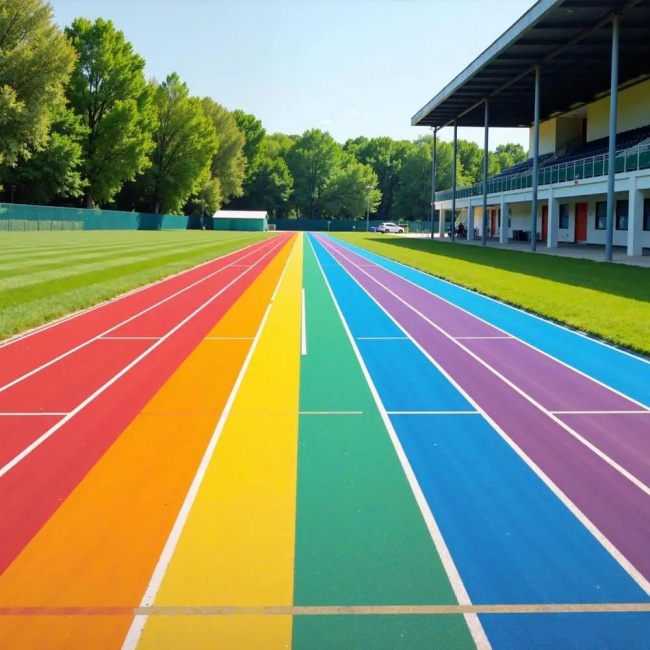
EPDM granules serve diverse applications, and the optimal specifications vary significantly by use case. For wet pour playground surfacing, the most common specification is 1 to 3 millimeter or 2 to 4 millimeter granules, with critical priorities being fall height rating compliance, UV stability, color retention, and proper binder compatibility. Running track systems typically require 1 to 3 millimeter granules for the base layer and 0.5 to 1.5 millimeter granules for the spray coat, with high tensile strength, abrasion resistance, and IAAF performance compliance being paramount.
For poured-in-place rubber surfaces, 1 to 3 millimeter or 2 to 4 millimeter granules are standard, with consistency in grain size for even compaction and high polymer content for longevity being the key factors. Artificial turf infill applications use 0.5 to 1.5 millimeter or 1 to 3 millimeter granules, prioritizing dust-free grading, low moisture absorption, and non-static properties. Splash pads and water play areas require 1 to 3 millimeter granules with non-toxic certification such as EN71-3, slip resistance, and drainage compatibility. Landscape and recreational paths typically use 2 to 4 millimeter or 3 to 5 millimeter granules, where weather resistance, aesthetic color stability, and cost-effectiveness for coverage are most important.
The school procurement example from USA specifies 13 millimeter thickness with 1 to 3 millimeter granules and requires EPDM content no less than 13 percent, plus aging resistance of 500 hours at 70 degrees Celsius with color fastness grade of at least 4. This highlights the growing regulatory rigor around EPDM specifications globally.
Key EPDM Granule Specifications Explained
Polymer (EPDM) Content
EPDM content is expressed as a percentage of the total granule weight. A higher EPDM content generally means greater elasticity and resilience, better resistance to UV and ozone degradation, and longer service life under dynamic loading such as running, jumping, and play activity. Most quality EPDM granules range from 20 percent to 40 percent EPDM content. Premium products often use 22 percent to 35 percent EPDM polymer content for optimal cost-performance balance.
One critical nuance is that some suppliers measure "polymer content" to include fillers and processing oils as polymer, while others specify only pure EPDM rubber content. Always verify whether the stated percentage refers to EPDM polymer exclusively or total polymer content including other synthetic rubbers.
Tensile Strength and Elongation at Break
Tensile strength measures how much stress the granule can withstand before breaking, expressed in megapascals or newtons per square millimeter. Elongation at break indicates how much the material can stretch before failure, expressed as a percentage. Typical quality benchmarks for tensile strength are 4.0 megapascals or higher as the industry standard, with premium products reaching 6.5 megapascals or more. For elongation at break, the standard benchmark is 500 percent or higher, with some products achieving 650 percent or more.
These properties determine how well the installed surface withstands repeated impact, foot traffic, and temperature cycling without cracking or disintegrating.
Hardness (Shore A)
Hardness typically ranges from 55 to 70 Shore A for EPDM granules. Softer granules in the 55 to 60 Shore A range provide better impact absorption for playground safety surfaces, while firmer granules in the 65 to 70 Shore A range offer greater durability for running tracks and high-traffic sports surfaces.
Density and Bulk Density
Specific gravity, or density, typically ranges from 1.45 to 1.60 grams per cubic centimeter. Bulk density ranges from 630 to 750 kilograms per cubic meter, depending on granule shape and particle size distribution. Lower bulk density generally indicates better angular cut particles with three-dimensional shape, which interlock more effectively with polyurethane binders, reducing binder consumption and improving surface cohesion.
UV Stability and Color Fastness
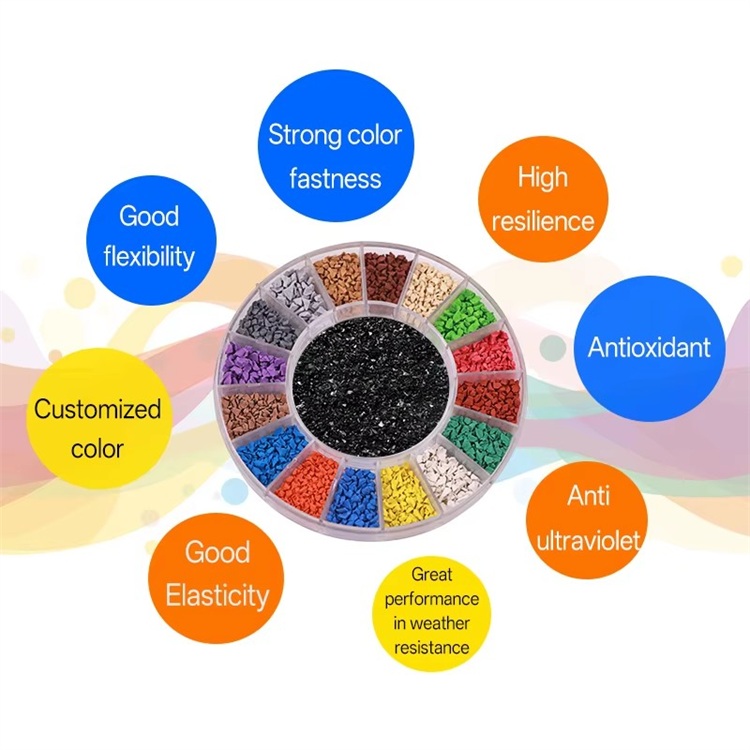
This specification determines how well the granule retains its original color after prolonged exposure to sunlight. EPDM granules use stabilized pigments in the formulation, but the quality of these pigments and the vulcanization system significantly impact long-term color retention. Poor-quality granules can fade noticeably within one to two years of outdoor exposure. Quality EPDM granules should maintain color stability for five to ten years in typical outdoor climates, with some products rated for over 5,000 hours of UVA aging testing.

Common Challenges and Specification Mistakes
Misinterpreting Recycled or Virgin Material
EPDM granules are manufactured using virgin EPDM polymer compounded with pigments, fillers, and curing agents. However, some suppliers offer recycled EPDM or SBR (styrene-butadiene rubber) granules that contain recycled rubber content from tires or industrial waste. The distinction matters enormously. Recycled rubber granules typically have lower and inconsistent tensile strength, higher moisture absorption, inferior UV stability—often turning gray or chalky within months—potential contamination with heavy metals or polycyclic aromatic hydrocarbons (PAHs), and a shorter service life of typically two to three years versus eight to twelve years for virgin EPDM. Reputable EPDM manufacturers use virgin EPDM compound with controlled formulations and do not use recycled rubber crumb as raw material.
Choosing the Wrong Particle Size
Particle size directly affects surface texture, binder consumption, and performance. A common mistake is specifying 0.5 to 1.5 millimeter granules for a surface that requires 2 to 4 millimeter granules for proper drainage and durability, or vice versa. For size guidance, 0.5 to 1.5 millimeter granules are best for spray coat top layers and fine-textured surfaces. The 1 to 3 millimeter size is the most versatile and suitable for playgrounds, wet-pour surfaces, and most sports applications. The 2 to 4 millimeter size is preferred for higher-traffic sports surfaces, running tracks, and thicker base layers. The 3 to 5 millimeter size is suitable for landscape path surfaces and some multi-use game areas.
Overlooking Weathering Resistance
EPDM granules installed in hot, tropical climates such as the Middle East, Southeast Asia, and the southern United States are exposed to intense UV radiation and high ambient temperatures. In these environments, UV resistance and thermal stability become paramount. For hot climates, consider higher EPDM polymer content of at least 25 percent for better aging resistance, exterior-grade pigments that are proven to withstand intense UV exposure, and applying a protective aliphatic polyurethane top coat to reduce color fading and surface degradation.

Technical Specifications: What to Look For
Based on industry benchmarks and manufacturer data, here are typical technical specifications for high-quality EPDM colored granules.
For grain size, the typical range is 0.5 to 1.5 millimeters, 1 to 3 millimeters, 2 to 4 millimeters, or 3 to 5 millimeters, with the quality benchmark being customizable per application. For EPDM content, the typical range is 14 percent to 40 percent, with 20 percent or higher preferred for durability. Tensile strength typically ranges from 3.5 to 6.5 megapascals, with 4.0 megapascals or higher for playground applications and 5.0 megapascals or higher for sports surfaces considered the quality benchmark. Elongation at break typically ranges from 450 percent to 735 percent, with 500 percent or higher being the quality benchmark. Hardness in Shore A typically ranges from 55 to 70, with 60 to 65 being typical for most applications. Specific gravity typically ranges from 1.45 to 1.60 grams per cubic centimeter, with consistent batch-to-batch performance being the quality benchmark. Bulk density typically ranges from 630 to 750 kilograms per cubic meter, with lower values indicating better angular shape. Shelf life is typically 12 to 24 months when stored in dry, temperature-controlled conditions. Color range typically includes 10 to 20 standard colors, with custom colors available via RAL, Pantone, or customer-matching as the quality benchmark.
These values represent industry norms, but actual specifications vary by manufacturer formulation and intended application. For critical projects, always request certified test reports from an independent laboratory.

Manufacturer Insights: How to Specify EPDM Granules for Your Project
Choosing the Right Particle Size
The correct granule size depends on your application, surface thickness requirements, and desired aesthetics. For safety surfacing under playground equipment, 1 to 3 millimeter EPDM granules over an 8 to 12 millimeter base layer provide the optimal balance of impact absorption, which determines critical fall height, and surface durability. For running tracks, 1 to 3 millimeter granules for the base layer and 0.5 to 1.5 millimeter granules for the top spray coat are standard for professional applications. For decorative pathways, 2 to 4 millimeter or 3 to 5 millimeter granules offer a more textured, rustic appearance and require slightly lower binder usage per square meter.
Selecting Colors for Maximum Durability
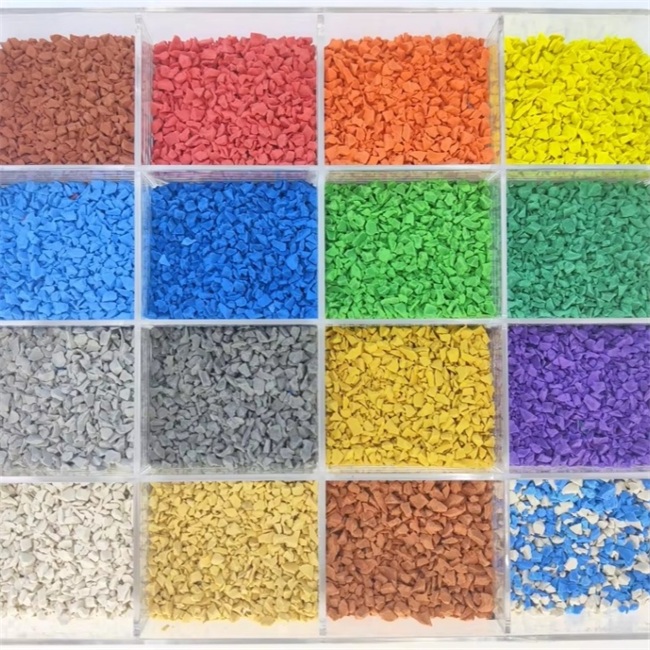
While EPDM granules are available in dozens of colors, not all pigments weather equally. For long-term outdoor applications, standard oxide colors such as terracotta red, oxide green, oxide yellow, and dark blue generally offer the best UV stability due to the inorganic pigment chemistry used. Lighter shades such as yellow, orange, bright blue, and pink can be produced with high-quality organic pigments but may require additional UV protection, either through pigment selection or a clear top coat. Darker colors may absorb more heat and require higher thermal stability in very hot climates.
When to Consider Custom Color Matching
Architects and designers increasingly request custom colors for brand alignment or aesthetic coordination. Professional EPDM manufacturers can match RAL or Pantone color references precisely, reproduce exact color samples submitted by clients, develop custom blends of two to three colors for unique surface patterns, and guarantee color consistency across entire production batches.
Controlling Procurement Costs
Cost is influenced by EPDM content, as higher EPDM content costs more but delivers longer service life. Color complexity also affects cost, with specialty colors potentially having higher pigment costs. Packaging choices impact cost, with bulk bags of 1,000 kilograms being more cost-effective than 25 kilogram bags for large projects. Order volume affects unit pricing, with container load quantities of 20-foot or 40-foot containers typically offering the best rates. Shipping arrangements also matter, as consolidation with other cargo in less-than-container-load shipments is possible for smaller orders but may increase per-unit costs.
Understanding Essential Parameters
When evaluating EPDM granule proposals, prioritize EPDM content, as this is the single most important determinant of longevity. Tensile strength and elongation determine resistance to cracking and impact damage. UV stability testing is critical—ask for specific aging test results including hours of UVA exposure and color change Delta E values. PAH and heavy metal testing is critical for children's playground applications. Batch-to-batch consistency is also essential, so ask about manufacturing process controls to ensure color and specification repeatability.
Why Global Buyers Choose Our EPDM Granules
Our company has manufactured and exported high-quality colored EPDM rubber granules for over 25 years. We are a specialized manufacturer focused exclusively on EPDM granule production—we do not produce finished flooring, run track installation, or compete with our customers in their markets.
Our technical advantages include sulfur-free vulcanization technology. Our EPDM granules contain no sulfur components. Under high-temperature and UV exposure, no sulfuric acid decomposition products are released, meaning no unpleasant odors. This is a critical advantage for indoor and enclosed applications such as school gymnasiums, indoor playgrounds, and splash pads.
We achieve enhanced molecular stability through our sulfur-free crosslinking system, which creates a more stable polymer structure, delivering up to three times longer service life than conventional sulfur-cured EPDM granules. Our products deliver superior elasticity and tensile strength, achieving tensile strengths of 4 to 7 megapascals—two to three times higher than standard industry benchmarks—for superior impact resistance and surface performance.
Our EPDM granules demonstrate five times greater performance retention over extended service life, reducing the need for premature surface replacement. We provide exceptional UV stability and color retention through advanced antioxidant and UV-stabilizer systems that keep colors vibrant and prevent yellowing or fading, even in harsh sunlight. Our formulations withstand extreme temperatures without degradation, making them suitable for all climates from northern Europe to the Middle East.
Our sulfur-free formulation is non-toxic and meets food-grade safety standards. We support comprehensive customization capabilities including custom colors matching RAL, Pantone, or customer samples; any granule size requirement from 0.5 to 1.5 millimeters, 1 to 3 millimeters, 1 to 4 millimeters, 2 to 4 millimeters, and specialty sizes; and private label packaging. We offer flexible order quantities with no minimum order quantity, and we welcome both full container and less-than-container-load shipments. Our global export expertise ensures our granules are engineered for diverse international climates, from Scandinavian cold to Australian UV intensity.
Frequently Asked Questions
What size EPDM granules should I choose for a playground?
For standard wet-pour playground safety surfacing, 1 to 3 millimeter EPDM granules are most common. The actual surface thickness, typically 10 to 15 millimeters for critical fall height of 1.2 meters or higher, and impact absorption requirements determine the final specification. For spray top layers on running tracks, 0.5 to 1.5 millimeter granules produce a finer texture. For thicker base layers or high-traffic areas, 2 to 4 millimeter granules are often preferred.
Can EPDM granules fade in sunlight?
All colored materials are subject to UV exposure. Quality EPDM granules use stabilized pigment systems to resist fading for five to ten years in typical outdoor use, but color change, measured as Delta E, is inevitable over time. Applying an aliphatic polyurethane top coat can significantly extend color vibrancy, especially in hot tropical climates where strong UV can accelerate fading.
How much PU binder is required with EPDM granules?
PU binder consumption typically ranges from 8 percent to 18 percent by weight of the EPDM granule, depending on the granule's surface texture, particle shape, and the required surface strength. The binders are designed with about 0.8 to 1.2 kilograms per square meter to lock the granules.
How long does EPDM surfacing last?
High-quality virgin EPDM granules installed with proper binder systems and a UV-stable top coat can last 8 to 12 years in service, with some applications reaching 15 years under moderate climate conditions. Recycled or inferior materials typically fail within 2 to 5 years.
Can you customize EPDM granule colors?
Yes. Professional manufacturers offer color customization to match RAL, Pantone, or customer-provided samples. We produce custom colors for our clients on demand, including multi-color blends for decorative surfaces.
What is the difference between sulfur-cured and peroxide-cured sulfur-free EPDM?
Sulfur-cured EPDM is the traditional method, which uses sulfur as a crosslinking agent. This can produce sulfur byproducts, specifically sulfuric acid, under UV or high-temperature exposure, causing odors. Peroxide-cured sulfur-free EPDM uses organic peroxides for crosslinking. This yields cleaner, odor-free granules with superior heat and UV resistance, better tensile strength, and longer service life—up to three times longer than sulfur-cured granules.
How should EPDM granules be stored?
EPDM granules should be stored in a cool, dry place away from direct sunlight, ideally at temperatures between 5 degrees Celsius and 25 degrees Celsius. Shelf life is typically 12 to 24 months when stored properly. High humidity can affect binder absorption, so moisture control is critical.
Can I order custom packaging or private label?
Yes. Professional manufacturers support custom packaging options including 25 kilogram bags, 1,000 kilogram big bags, private label printing, and tailored logistics configurations for full container or less-than-container-load shipments.
Understanding EPDM granule specifications is essential for contractors, engineers, and procurement professionals to ensure long-lasting, safe, and aesthetically successful surfacing projects. Key specification drivers—polymer content, tensile strength, UV stability, particle size distribution, and environmental certifications—all directly influence project outcomes and cost-effectiveness.
When specifying your next playground, sports track, or recreational surface project, evaluate EPDM granules not only on price but on their technical capabilities, manufacturing quality, and supplier reliability. A professional EPDM granule manufacturer with global export experience and proven technical expertise—like our company—will provide transparent specification data, certified test reports, and customized solutions that match your application requirements. With no minimum order quantity and flexible production capacity, we can support projects of any scale and specification demands.

Contact us for samples or a quotation to experience the quality of our EPDM granules firsthand.
WOW(LYG) New Material Co Ltd is a manufacturer specializing in the production of EPDM rubber granules. We use sulfur-free vulcanization technology, it increases the service life by more than 3 times than traditional EPDM granules, and enhances the performance, including anti-aging, high-temperature resistance, and colorfastness.
We have over 25 years of production experience and offer customization for colors and granule sizes. NO MOQ.


