 注: 建议图片大小150px*50px
丨
注: 建议图片大小150px*50px 


For playground contractors, sports surfacing installers, engineers, and procurement professionals, one of the most fundamental material decisions when specifying rubber surfacing is choosing between EPDM and SBR granules. While both materials are synthetic rubber compounds widely used in wet pour playground surfaces, running tracks, and safety surfacing, their performance characteristics, durability, and cost profiles differ significantly. Understanding these differences is essential for making informed decisions that balance project budgets, safety requirements, and long-term performance expectations.

What Are SBR Granules?
SBR (Styrene-Butadiene Rubber) is a synthetic rubber copolymer first developed in the 1930s. In surfacing applications, SBR granules are almost exclusively produced from recycled end-of-life vehicle tyres—commonly referred to as crumb rubber. The tyre rubber is shredded, granulated to controlled particle sizes (typically 0.5–4mm), and processed to remove metal and fibre contaminants.
Key characteristics of SBR granules include:
- Cost-effective due to recycled material source
- Good shock absorption and cushioning properties
- Typically black in colour (though PU-coated versions may offer limited colour options)
- Used primarily as the base cushioning layer in dual-layer systems

What Are EPDM Granules?
EPDM (Ethylene Propylene Diene Monomer) is a synthetic rubber terpolymer synthesised from ethylene, propylene, and a diene monomer. Unlike SBR, EPDM granules used in quality surfacing applications are manufactured from virgin synthetic rubber combined with inorganic pigments.
Key characteristics of EPDM granules include:
- Excellent UV and weather resistance due to saturated polymer backbone structure
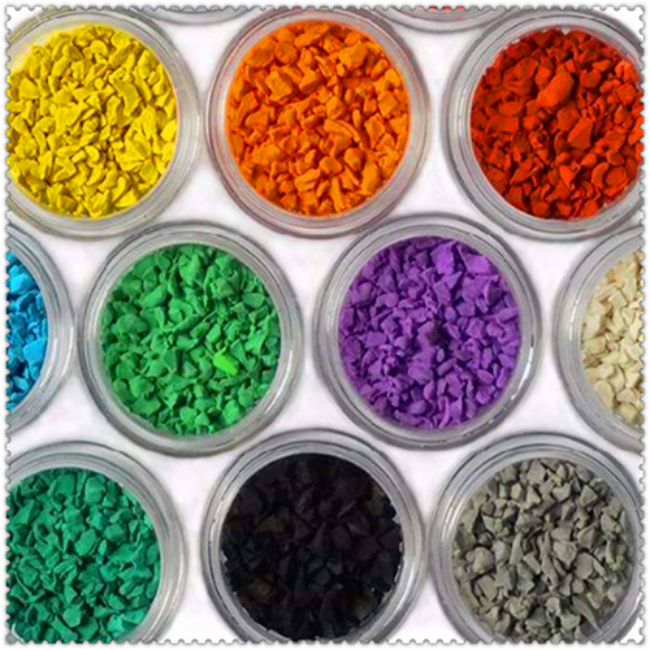
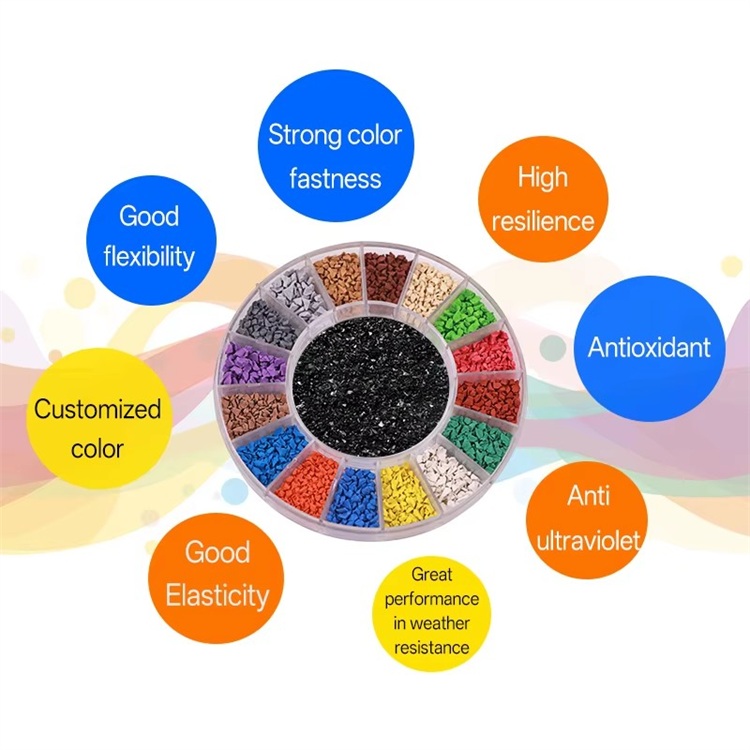
- Available in a wide range of vibrant, colour-stable shades
- Superior tensile strength (10–20 MPa compared to 2–5 MPa for recycled SBR)
- Temperature range of -50°C to +150°C
- Used as the top wearing course in dual-layer systems for colour and surface durability

EPDM vs SBR: Direct Comparison
When comparing EPDM and SBR granules, the most fundamental distinction lies in their material source. EPDM is manufactured from virgin synthetic rubber, whereas SBR used in surfacing applications is predominantly derived from recycled tyre rubber (crumb rubber). This difference in raw material origin drives nearly all of the performance variations between the two products.
In terms of application, EPDM is typically specified for the top wearing course of a dual-layer system, where it provides a durable, UV-stable, and aesthetically appealing finish. SBR, on the other hand, is almost exclusively used as the base layer—the shock-absorbing cushion beneath the EPDM surface. This division of roles reflects each material's inherent strengths and limitations.
Colour options represent one of the most visible differences. EPDM granules are available in a wide spectrum of vibrant, stable colours, with full custom matching to RAL or Pantone standards. By contrast, SBR granules are predominantly black; even PU-coated coloured versions cannot match the colour consistency and lightfastness of virgin EPDM.
UV resistance is perhaps the most critical differentiator for outdoor applications. EPDM's saturated polymer backbone provides excellent resistance to ozone and UV degradation, maintaining both colour and structural integrity under prolonged sunlight exposure. SBR, lacking this molecular stability, oxidises and degrades relatively quickly when exposed to UV, making it unsuitable for unprotected outdoor use.
Mechanical performance also differs considerably. Virgin EPDM typically exhibits tensile strength in the range of 10–20 MPa, whereas recycled SBR granules generally offer 2–5 MPa. This translates to better tear resistance, greater durability under heavy foot traffic, and longer service life for EPDM surfaces.
Service life expectations reflect these performance differences. In outdoor applications, a properly installed EPDM wearing course can be expected to last 8–12 years, while an unprotected SBR surface typically requires replacement after 5–8 years. This extended lifespan—combined with reduced maintenance costs—often offsets EPDM's higher initial material cost over the full project lifecycle.
Temperature tolerance is another area of divergence. EPDM remains stable across a wide range of -50°C to +150°C, making it suitable for diverse climatic conditions from cold northern European winters to hot Middle Eastern summers. SBR performs adequately between -30°C and +80°C but may become brittle at extreme low temperatures or soften under intense heat.
Finally, cost and environmental considerations present a trade-off. SBR's recycled content makes it more affordable and offers a clear environmental benefit in terms of tyre waste diversion. However, EPDM's superior durability and longer service life mean that over the full lifecycle of a project—particularly in demanding outdoor environments—the total cost of ownership may be more competitive than the initial purchase price suggests.
The Standard Dual-Layer System
In professional playground and sports surfacing, the industry-standard approach combines both materials in a dual-layer system:
SBR Base Layer: Provides critical impact attenuation and shock absorption. The thickness of this layer is determined by the required Critical Fall Height (CFH) rating, typically ranging from 20mm to 50mm depending on safety standards.
EPDM Top Wearing Course: Forms the visible, coloured surface, providing UV protection, colour stability, and long-term durability. The EPDM layer typically ranges from 10mm to 15mm in thickness.
This combination delivers the optimal balance of safety performance, aesthetics, and cost-effectiveness. The SBR base delivers impact protection, while the EPDM top layer protects the system from environmental degradation and provides design flexibility.
Why the Choice Matters for Project Success
For Outdoor Applications
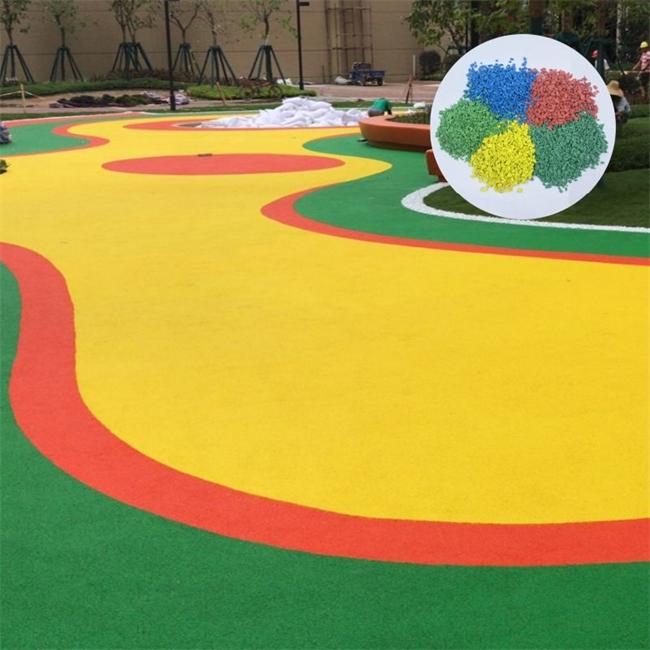
For exterior installations—including playgrounds, parks, school outdoor areas, and municipal projects—EPDM is essential as the top layer. SBR alone will degrade under UV exposure, oxidise, and lose elasticity, leading to premature surface failure, colour fading, and the formation of cracks. EPDM's saturated polymer structure (lacking double bonds) provides inherent resistance to ozone and UV degradation, making it suitable for extended outdoor exposure without significant deterioration.
For Colour Stability and Design
EPDM granules are manufactured with inorganic pigments that resist fading. The UV stability rating of quality EPDM granules typically reaches 4–5 on the Grey Scale after 1000 hours of exposure, indicating minimal colour change. SBR granules are normally black; coloured versions require PU coating, which adds cost and does not achieve the same colour stability as virgin EPDM.
For Performance Specifications
EPDM exhibits significantly higher tensile strength than recycled SBR, making it more resistant to tearing and wear under heavy foot traffic. This is particularly important for high-traffic applications such as school playgrounds, multi-use games areas, and commercial projects.
Manufacturer Insights: Selecting the Right Granules for Your Project
Drawing on our 25+ years of EPDM manufacturing experience, we offer the following guidance for procurement professionals and contractors:
1. When to choose SBR as the base layer
SBR is the most cost-effective solution for the cushioning base in any dual-layer system. For indoor applications or projects with very limited budgets where UV exposure is not a concern, a full SBR system may be considered—but expect a shorter service life and limited colour options.
2. When EPDM is non-negotiable
For any outdoor project—playgrounds, running tracks, splash pads, parks, or school grounds exposed to sunlight—EPDM is essential for the top layer. The UV stability and weather resistance of EPDM are critical to preventing premature failure and maintaining a safe, attractive surface over its expected lifespan.
3. Colour selection considerations
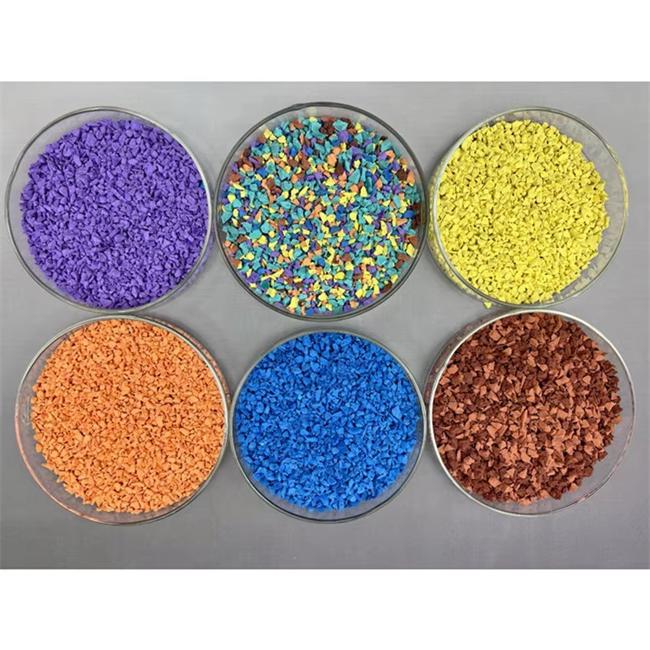
RAL and Pantone colour matching capabilities allow for precise brand or design colour requirements. Custom colours are achievable with EPDM; this is not feasible with standard recycled SBR.
4. Particle size selection
Recommended EPDM top layer sizes typically range from 0.5–1.5mm to 2–4mm, with the choice depending on the desired surface texture, slip resistance requirements, and specific application. Finer grades (0.5–1.5mm) produce a smoother, more consistent finish; coarser grades (2–4mm) offer increased slip resistance and a more textured appearance. Standard wet pour systems often specify 1–3.5mm EPDM granules for the wearing course.

Technical Data Comparison
From a material science perspective, the performance differences between EPDM and SBR granules can be quantified across several key parameters.
In terms of density, EPDM granules typically range from 1,100 to 1,400 kg/m³, while recycled SBR falls between 1,000 and 1,200 kg/m³. Hardness, measured on the Shore A scale, is generally 50–75 for EPDM compared to 40–60 for SBR, indicating EPDM's slightly firmer and more resilient character.
Tensile strength is where the distinction becomes most pronounced. Virgin EPDM achieves 10–20 MPa, whereas recycled SBR offers only 2–5 MPa. This difference directly impacts resistance to tearing, abrasion, and mechanical stress during both installation and service.
Thermal performance also differs markedly. EPDM remains stable across temperatures from -50°C to +150°C, making it suitable for diverse global climates. SBR performs between -30°C and +80°C, which may be limiting for extreme environments. UV resistance presents the greatest contrast: EPDM exhibits excellent stability with minimal degradation, while SBR's poor UV resistance necessitates protection by an EPDM top layer for any outdoor application.
These performance characteristics translate directly to service life expectations. EPDM installed as a top wearing course in outdoor applications typically delivers 8–12 years of reliable service. Unprotected SBR surfaces generally require replacement after 5–8 years. However, when SBR is used as the base layer beneath an EPDM top course, it benefits from the UV protection provided by the EPDM layer and can achieve extended service life as part of the complete system.

Common Challenges & Solutions
Challenge: Colour fading and surface degradation
Solution: Always specify EPDM for exposed top surfaces in outdoor applications. Quality EPDM granules with high UV resistance maintain colour stability and structural integrity for 8–12 years.
Challenge: Budget constraints
Solution: Use the cost-effective dual-layer approach: SBR base for shock absorption (where it performs effectively) and EPDM only where necessary—the top 10–15mm wearing course.
Challenge: Sourcing colour consistency
Solution: Work with a manufacturer that maintains strict colour batch control and offers RAL/Pantone matching. Inconsistent colour between batches leads to visible patchwork in installations.
Challenge: Ensuring long-term supplier reliability
Solution: Assess potential suppliers for production capacity, quality control systems, and track record of on-time delivery for international projects.
Why Global Buyers Choose Our EPDM Granules
As a specialist EPDM manufacturer with 25 years of industry experience, we focus exclusively on EPDM granule production—not finished surfacing installation. This concentration enables us to deliver superior material quality and technical expertise.
Our manufacturing advantages:
- Sulfur-free formulation eliminates odour issues—no sulfuric acid decomposition under UV exposure
- More stable molecular structure delivers 3x longer service life compared to conventional EPDM formulations
- Higher elasticity and tensile strength (4–7 MPa)
- Excellent UV stability and antioxidant properties—colours remain vibrant
- Enhanced high-temperature resistance
- Food-grade safety standards, suitable for the most sensitive environments
- Low bulk density with distinct three-dimensional particle shape for optimal surface finish
Customisation capabilities:
- OEM, ODM, and Private Label support
- RAL and Pantone colour matching
- Custom colour development from client samples
- Particle sizes: 0.5–1.5mm, 1–3mm, 1–4mm, 2–4mm, and custom specifications
- Flexible packaging options
- Full container or consolidated shipping (LCL)
- No minimum order quantity (No MOQ)
Quality assurance:
All products are supported with comprehensive Technical Data Sheets (TDS), Material Safety Data Sheets (MSDS), and relevant certifications upon request.
FAQ
What is the main difference between EPDM and SBR granules?
EPDM granules are manufactured from virgin synthetic rubber with high UV stability and colour retention, used for the top wearing course. SBR granules are recycled from tyres, more economical, and used for the shock-absorbing base layer.
Which is better for outdoor playgrounds, EPDM or SBR?
EPDM is essential for the top layer of outdoor playgrounds due to its excellent UV and weather resistance. A dual-layer system with an SBR base and EPDM top layer is the industry standard for outdoor applications.
How long does EPDM last compared to SBR?
EPDM typically lasts 8–12 years in outdoor applications, while SBR exposed to UV lasts 5–8 years. The SBR base layer under an EPDM top layer also benefits from the protection of the EPDM surface.
Can EPDM granules fade over time?
Quality EPDM granules manufactured with inorganic pigments and UV stabilisers show minimal fading. Premium products achieve a UV stability rating of 4–5 on the Grey Scale after 1000 hours of exposure.
What size EPDM granules should I choose for my project?
Common sizes range from 0.5–1.5mm to 2–4mm. Finer grades (0.5–1.5mm) produce a smoother finish; coarser grades (2–4mm) provide greater slip resistance. Standard wet pour systems often specify 1–3.5mm EPDM granules for the top layer.
Can I get custom colours for EPDM granules?
Yes. Quality manufacturers offer custom colour matching to RAL, Pantone, or client-provided samples with consistent batch-to-batch colour control.
How much PU binder is required for EPDM installation?
Binder ratio depends on granule size and specific product formulation. Technical support is available to assist contractors with site-specific calculations.
Can EPDM and SBR granules be shipped internationally?
Yes. As an experienced exporter serving Europe, North America, Australia, and the Middle East, we support both full container (FCL) and consolidated (LCL) shipments with flexible packaging options.
What certifications are available for EPDM granules?
Our EPDM granules meet food-grade safety standards and comply with relevant international environmental and performance specifications. Certification documentation is available upon request.
The choice between EPDM and SBR granules is not simply a matter of material substitution but of understanding the distinct functional roles each material plays in a professionally designed surfacing system. For any outdoor installation, the dual-layer approach—SBR base for impact absorption and EPDM top layer for UV protection, colour stability, and surface durability—represents the industry-standard solution for balancing performance, aesthetics, and cost-effectiveness.
For contractors, engineers, and procurement professionals specifying materials for international projects, the selection of a reliable EPDM granule supplier is as critical as the material choice itself. Manufacturing consistency, customisation capabilities, quality assurance, and supply chain reliability all contribute to project success.

For technical consultation, colour matching, sample requests, or detailed product specifications, we welcome your inquiry.
WOW(LYG) New Material Co Ltd is a manufacturer specializing in the production of EPDM granules. We use sulfur-free vulcanization technology, it increases the service life by more than 3 times than traditional EPDM granules, and enhances the performance, including anti-aging, high-temperature resistance, and colorfastness.
We have over 25 years of production experience and offer customization for colors and granule sizes. NO MOQ.


