 注: 建议图片大小150px*50px
丨
注: 建议图片大小150px*50px 


When children fall from playground equipment, the surface beneath them is not just a finishing layer — it is part of the safety system. That is why fall-protection granules have become one of the most important material choices in modern playground construction, school projects, municipal parks, sports areas, and poured rubber surfacing systems.
However, many buyers search for fall-protection granules without fully understanding what really determines safety performance, long-term durability, color stability, and installation efficiency. The truth is that the quality of EPDM rubber granules directly affects critical factors such as impact absorption, UV resistance, aging resistance, binder consumption, color consistency, and the overall lifespan of a poured-in-place rubber surface.
As a Chinese manufacturer specializing in colored EPDM rubber granules, we produce EPDM granules for playgrounds, wet pour surfacing, poured-in-place rubber systems, running tracks, safety surfacing, sports surfacing, walking paths, splash pads, and outdoor recreational areas. We do not install finished surfacing or running tracks. Our expertise is focused on the granule material itself — how it is produced, how it performs, how it should be specified, and how buyers can reduce procurement risk when sourcing from international suppliers.
This guide is written for playground contractors, sports surfacing contractors, engineers, architects, landscape companies, municipal buyers, importers, wholesalers, distributors, purchasing managers, brand owners, and OEM buyers who need practical decision-making support rather than generic product promotion.
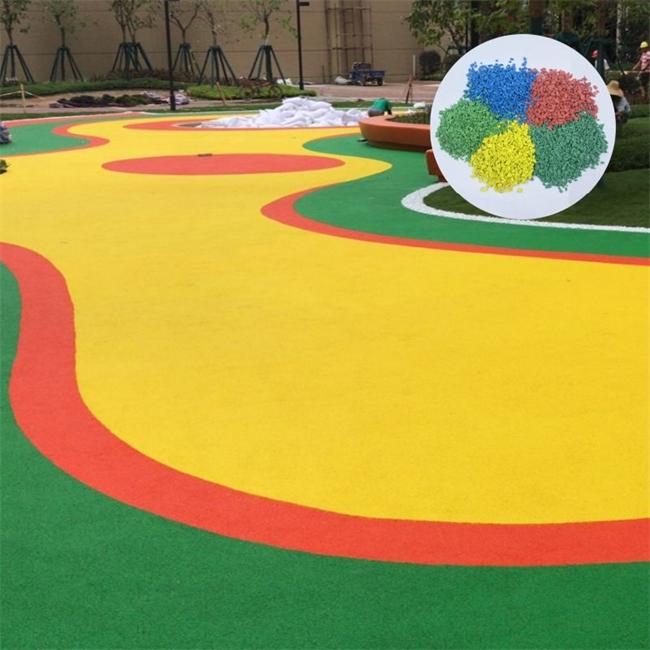
What Are Fall-Protection Granules?
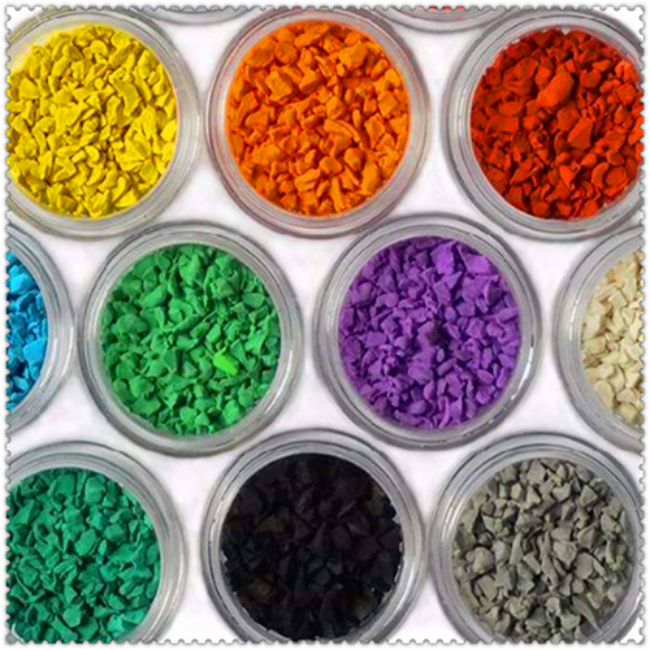
Fall-protection granules are specially produced rubber granules used in impact-absorbing surfaces, especially in wet pour playground surfacing and poured-in-place rubber (PIP) systems.
In most cases, these surfaces are created by mixing EPDM colored rubber granules with a polyurethane binder and installing the mixture over a prepared base. The finished surface provides cushioning, slip resistance, design flexibility, and improved safety for areas where children, athletes, or the public may fall during play, walking, running, or recreation.
Fall-protection granules are not simply decorative rubber granules. Their performance depends on material composition, granule size, elasticity, density, UV stability, color fastness, aging resistance, and compatibility with the binder system.
The main applications include:
Wet pour playground surfacing
Poured-in-place rubber surfaces
Running track systems
Sports surfacing
Safety surfacing
Outdoor rubber surfacing
Recreational areas
Walking paths
Splash pads
Parks
Schools
Kindergartens
Commercial and municipal projects
For contractors and engineers, the correct choice of fall-protection granules is not only about color and appearance. It is about ensuring that the surface can maintain its safety performance, visual quality, and structural integrity over years of outdoor exposure.
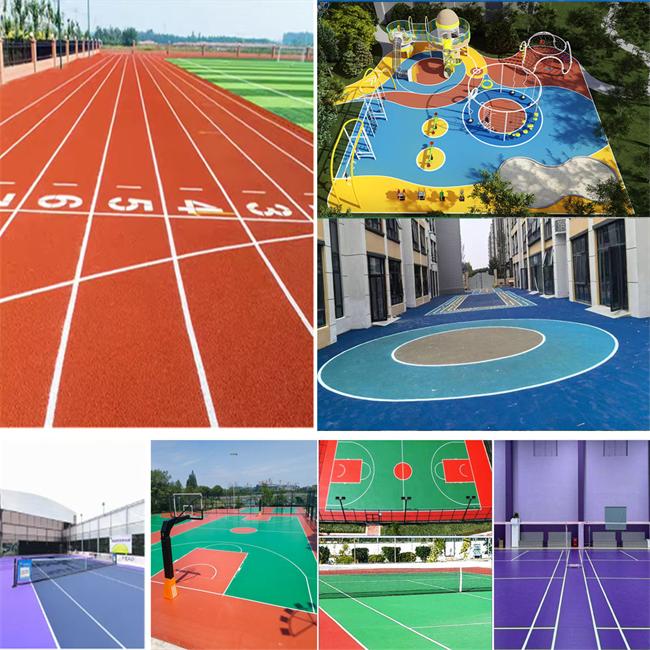
Why Fall-Protection Granules Matter in Playground and Sports Projects
Playground and sports surface projects often face three major pressures: safety compliance, long-term durability, and project cost control. Fall-protection granules influence all three.
Safety Performance
In playground environments, the surface must help reduce injury risk when children fall from play equipment. The granules contribute to the cushioning performance of the finished surface, especially when combined with the correct base layer, thickness, binder ratio, and installation method.
For contractors, this means that granule quality cannot be treated as a minor detail. If the granules are too brittle, inconsistent, or poorly produced, the finished surface may not perform as expected over time.
Long-Term Outdoor Durability
Outdoor rubber surfaces are exposed to sunlight, rain, temperature changes, foot traffic, cleaning, and mechanical wear. This is why UV stability, weather resistance, and aging resistance are more important than initial color brightness.
A surface may look good after installation but fade, discolor, or lose elasticity if the EPDM granules are not produced with stable raw materials and proper quality control.
Visual Identity and Project Presentation
For schools, kindergartens, parks, and municipal projects, color design is often part of the project requirement. Clients may request specific color combinations, themed playground areas, running lanes, safety zones, or branded designs.
This makes color consistency and customization capability essential, especially for large projects, phased installations, or repeat orders over time.
Installation Efficiency
Contractors care about how easily the granules mix with binder, how evenly they spread, how much binder is required, and whether the material creates waste during installation. Consistent granule size, clean granules, and stable density help improve on-site efficiency.
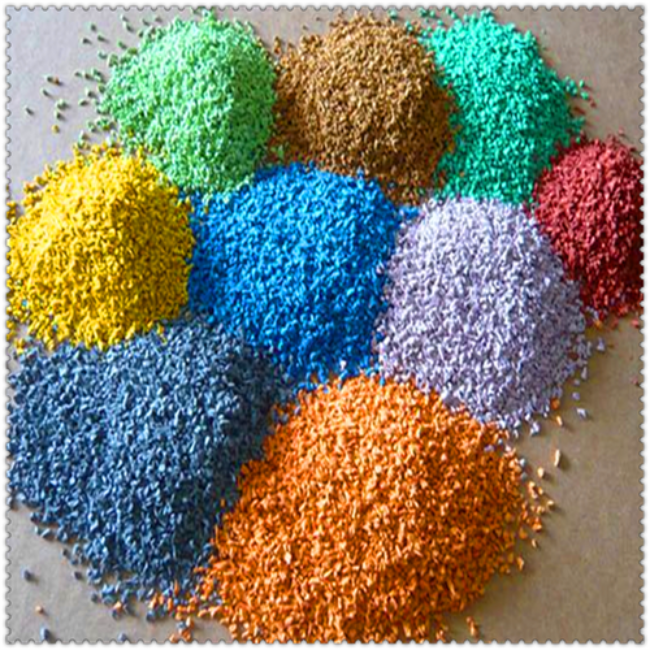
Key Benefits of High-Quality EPDM Fall-Protection Granules
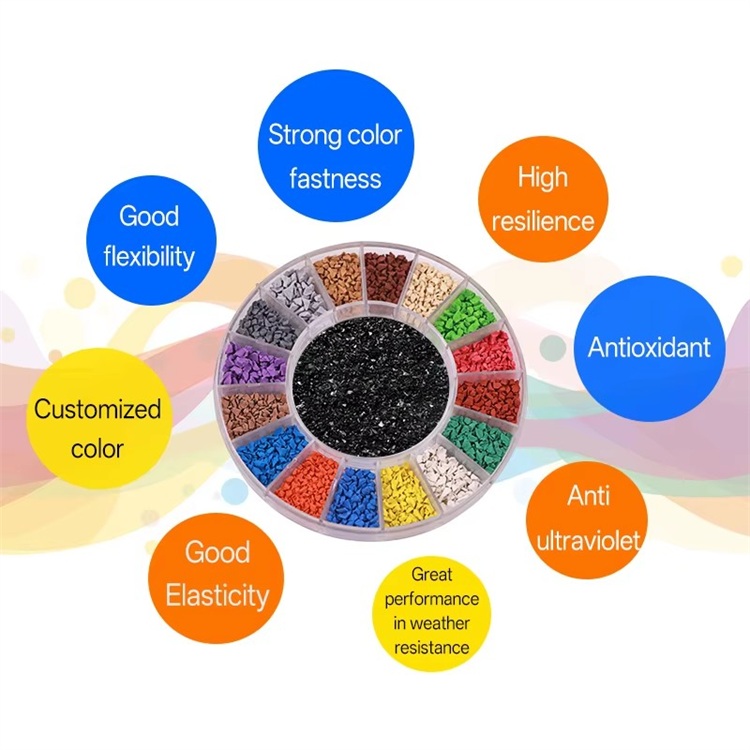
High-quality EPDM fall-protection granules should offer more than color variety. Their real value appears during installation, after curing, and throughout years of outdoor use.
UV and Weather Resistance
Outdoor playgrounds and sports areas are continuously exposed to sunlight and weather. EPDM granules with strong UV resistance are less likely to fade quickly, helping the surface maintain a more consistent appearance over time.
Color Stability
Color consistency is one of the most common concerns in large projects. If different batches show obvious color differences, the finished surface may look uneven, especially in large playground zones, running tracks, or multi-color designs.
Elasticity and Toughness
Good EPDM granules should have sufficient elasticity and mechanical strength. This helps the finished surface resist compression, cracking, and surface wear caused by foot traffic, play activity, and environmental stress.
Low Odor and Cleaner Performance
Odor is an important concern for schools, kindergartens, indoor-outdoor transition areas, and projects with strict environmental requirements. EPDM granules produced without sulfur-related components tend to have lower odor, which is especially valuable in sensitive environments.
Better Aging Resistance
Aging resistance determines how well the granules maintain their physical performance over time. For projects with long service expectations, such as municipal parks, school playgrounds, and commercial recreational areas, aging resistance is often more important than short-term appearance.
Design Flexibility
EPDM granules support a wide range of color combinations, patterns, safety zones, and themed designs. This makes them suitable for creative playground layouts, educational environments, sports areas, and public recreational spaces.
Common Challenges Buyers Face When Sourcing Fall-Protection Granules
Many procurement problems do not appear when the order is placed. They appear during installation, after curing, or months later when the surface begins to fade, discolor, or underperform.
Challenge 1: Color Inconsistency Between Batches
For large projects, color consistency is critical. If a contractor orders the same color in different batches and receives slightly different shades, the finished surface may show visible color variation.
This is especially problematic for:
Large playground areas
School and kindergarten projects
Municipal parks
Running tracks
Multi-phase construction projects
OEM and private-label buyers
Buyers should confirm whether the supplier can control batch-to-batch color consistency and whether custom color matching is available.
Challenge 2: Unclear granule Size Selection
granule size affects surface texture, binder consumption, installation smoothness, and visual appearance. Choosing the wrong size can lead to poor workability, excessive binder use, or an uneven finished surface.
Different projects may require different granule sizes, such as:
0.5–1.5 mm
1–3 mm
1–4 mm
2–4 mm
The best choice depends on the surface system, design requirement, installation method, and performance expectation.
Challenge 3: Difficulty Judging Quality From Photos
EPDM granules may look similar in photos but perform very differently in real applications. Color brightness, granule shape, density, cleanliness, elasticity, and UV stability cannot always be judged from images alone.
For serious buyers, requesting physical samples is one of the most effective ways to reduce risk.
Challenge 4: Fear of Low-Quality or Recycled Materials
Some buyers worry about receiving granules mixed with low-quality rubber, recycled materials, or unstable fillers. This concern is reasonable, especially when purchasing from unfamiliar suppliers.
The best way to reduce this risk is to request technical documents, test reports, sample evaluation, and clear product specifications before placing bulk orders.
Challenge 5: Installation Problems Caused by Material Variability
If granules have inconsistent size, poor cleanliness, unstable density, or poor binder compatibility, contractors may face installation difficulties. This can increase labor time, material waste, and project risk.
For contractors, material consistency is often more valuable than a slightly lower unit price.

How to Choose Fall-Protection Granules for Your Project
Choosing the right fall-protection granules requires balancing safety requirements, installation conditions, design expectations, and long-term maintenance.
Step 1: Confirm the Application
Different applications have different performance priorities.
For playgrounds and kindergartens, buyers usually focus on safety, color design, UV resistance, and child-friendly performance.
For running tracks and sports surfacing, buyers may pay more attention to elasticity, durability, color consistency, and installation efficiency.
For municipal parks and public recreational areas, long-term weather resistance and low maintenance become more important.
Step 2: Choose the Right granule Size
granule size should be selected based on the surface system and design requirement.
Finer granules are often suitable for smoother finishes and detailed color designs. Larger granules may be used where a more textured surface or different visual effect is required.
Common size ranges include:
0.5–1.5 mm
1–3 mm
1–4 mm
2–4 mm
Special granule sizes can also be customized depending on project requirements.
Step 3: Confirm Color Requirements Early
If the project requires a specific color, buyers should provide reference information as early as possible. Color matching is easier when the supplier has clear references.
Custom color options may include:
RAL color matching
Pantone color matching
Customer sample matching
Multi-color combinations
Private-label packaging
OEM and ODM production
For large projects, confirming color approval before bulk shipment is essential.
Step 4: Check Technical Parameters
Before purchasing, buyers should confirm key technical parameters such as granule size range, color code, density, elasticity, UV resistance, aging resistance, odor level, and binder compatibility.
Requesting a Technical Data Sheet and Material Safety Data Sheet helps engineers and purchasing teams make more accurate comparisons.
Step 5: Evaluate the Supplier’s Production Stability
A reliable supplier should be able to provide consistent quality across different orders. This is especially important for international buyers who may place repeat orders over months or years.
Key supplier evaluation points include:
Production experience
Quality control process
Color consistency control
Customization capability
Sample availability
Technical documentation
Delivery stability
Export experience
Ability to support OEM, ODM, and private-label buyers

Technical Specifications to Confirm Before Ordering
Before placing an order for fall-protection granules, buyers should confirm the following technical and commercial details.
Material Type
Confirm that the product is EPDM rubber granules suitable for wet pour, poured-in-place rubber, playground surfacing, or sports surfacing systems.
Granule Size
Confirm the required size range, such as 0.5–1.5 mm, 1–3 mm, 1–4 mm, or 2–4 mm. If the project requires a special size, this should be confirmed before production.
Color Standard
Confirm whether the color is based on RAL, Pantone, customer sample, or standard color chart. For large projects, batch color approval is strongly recommended.
Performance Requirements
Confirm whether the project requires specific performance characteristics such as UV resistance, weather resistance, elasticity, low odor, aging resistance, or environmental compliance.
Packaging and Shipping
Confirm packaging type, bag weight, container loading, mixed container options, labeling requirements, and delivery schedule.
Documentation
For professional projects, buyers should request:
TDS
MSDS
Test reports
Color approval records
Product specifications
Shipping documents
These documents help engineers, contractors, and importers verify product suitability before installation.

Manufacturer Insights: Professional Advice From an EPDM Granule Producer
As a manufacturer with more than 25 years of industry experience, we often see buyers make the same mistakes: choosing color first, price second, and technical performance last. In reality, the correct order should be application first, performance second, color third, and price last.
Choose granule Size Based on Installation, Not Appearance
A finer granule does not automatically mean better quality. The right granule size depends on the surface system, design effect, binder ratio, and installation method. Contractors should test sample mixes before large-scale application.
Confirm Color Approval Before Bulk Production
For projects with strict visual requirements, color approval is essential. Small differences in lighting, camera settings, and screen display can make the same color look different online. Physical sample approval is much more reliable.
Do Not Judge EPDM Quality by Color Brightness Alone
Bright color does not guarantee long-term performance. What matters more is whether the granules can maintain color stability, elasticity, and physical performance after long-term UV exposure and weathering.
Control Binder Consumption Through Consistent Granules
Inconsistent granule size, irregular shape, or unstable density can affect binder consumption. Consistent granules help contractors control material costs and improve installation efficiency.
Build Long-Term Supply Stability
For contractors and distributors, the most valuable supplier is not always the one offering the lowest first-order price. The most valuable supplier is the one who can deliver consistent quality, stable colors, reliable lead times, and flexible customization over many orders.

Why Global Buyers Choose Our EPDM Fall-Protection Granules
We are a professional manufacturer of colored EPDM rubber granules, focused on production, customization, quality control, and global supply. Our strength lies in helping contractors, importers, brand owners, and project buyers source reliable EPDM granules with consistent performance.
Our production advantages include:
More than 25 years of industry experience
Complete production lines for EPDM rubber granules
Custom colors based on RAL, Pantone, or customer samples
Flexible granule sizes such as 0.5–1.5 mm, 1–3 mm, 1–4 mm, and 2–4 mm
OEM, ODM, and private-label support
Custom packaging options
No minimum order quantity
Sample support for evaluation
Technical documentation available upon request
Stable supply for repeat orders
Export experience serving international markets
Our EPDM granules are produced with sulfur-free technology, which helps reduce odor and supports cleaner performance in sensitive environments. The material also offers improved elasticity, with tensile strength reaching approximately 4–7 MPa, better aging resistance, stronger UV stability, and improved performance retention over time.
These characteristics make our EPDM granules suitable for playgrounds, schools, kindergartens, parks, sports areas, running tracks, walking paths, splash pads, recreational zones, and municipal safety surfacing projects.
For buyers, this means more than product supply. It means access to a manufacturer that understands how EPDM granules perform in real installation environments and how to support international procurement requirements.
What are fall-protection granules used for?
Fall-protection granules are mainly used in wet pour playground surfacing, poured-in-place rubber systems, safety surfacing, sports surfacing, running tracks, walking paths, splash pads, parks, schools, and kindergartens. They are mixed with binder and installed as a cushioned, durable, and visually flexible rubber surface.
How do I choose the right granule size?
granule size should be chosen based on the surface system, design requirement, installation method, and desired texture. Common sizes include 0.5–1.5 mm, 1–3 mm, 1–4 mm, and 2–4 mm. For precise selection, contractors should test sample mixes before full installation.
Can EPDM fall-protection granules fade over time?
All outdoor materials are affected by long-term UV exposure. High-quality EPDM granules are designed for better UV resistance and color stability, but the actual performance depends on raw material quality, production process, climate conditions, installation quality, and maintenance.
How much PU binder is required?
Binder consumption depends on granule size, granule density, surface thickness, installation method, and project specification. There is no universal ratio suitable for every project. Contractors should confirm the recommended binder ratio with their system supplier and test it on-site before large-scale application.
Can you customize colors?
Yes. We support custom colors based on RAL codes, Pantone codes, or customer samples. We also support multi-color combinations, OEM production, ODM production, and private-label packaging.
Is there a minimum order quantity?
We support flexible order quantities with no minimum order quantity, making it easier for contractors, distributors, brand owners, and new buyers to evaluate samples or place trial orders.
How long can EPDM rubber surfacing last?
Service life depends on installation quality, base preparation, binder ratio, climate conditions, traffic intensity, UV exposure, and maintenance. High-quality EPDM granules with good UV and aging resistance can help extend the visual and functional life of the surface, but the exact lifespan should be evaluated based on project conditions.
Are your EPDM granules suitable for hot climates?
Yes. Our EPDM granules are designed with improved heat resistance, UV stability, and aging resistance, making them suitable for outdoor projects in different climate conditions. For extremely hot or high-UV regions, buyers should confirm color selection, granule size, and installation requirements in advance.
How can I reduce procurement risk when buying from China?
Buyers should request samples, confirm granule size, approve color before bulk production, check TDS and MSDS, clarify packaging and shipping terms, and confirm delivery schedule. For large projects, it is better to start with sample evaluation and trial orders before placing full container shipments.

Fall-protection granules are a critical material in modern playground, sports, and safety surfacing projects. Their quality affects not only the appearance of the finished surface, but also its safety performance, installation efficiency, color consistency, durability, and long-term maintenance cost.
For contractors, engineers, importers, and project buyers, the best purchasing decision is not based on color charts or photos alone. It should be based on application requirements, granule size selection, color approval, technical documentation, supplier stability, and real sample evaluation.
As a professional EPDM colored rubber granule manufacturer, we focus on producing consistent, customizable, and export-ready granules for wet pour playground surfacing, poured-in-place rubber systems, running tracks, sports surfacing, safety surfacing, and outdoor recreational projects. With more than 25 years of industry experience, flexible customization, technical documentation support, and global supply capability, we help buyers make safer, smarter, and more reliable procurement decisions.
If you are sourcing fall-protection granules for an upcoming project, we recommend starting with sample evaluation and technical confirmation before placing bulk orders. This is the most practical way to reduce risk, improve installation quality, and ensure long-term project performance.

WOW(LYG) New Material Co Ltd is a manufacturer specializing in the production of EPDM rubber granules. We use sulfur-free vulcanization technology, it increases the service life by more than 3 times than traditional EPDM granules, and enhances the performance, including anti-aging, high-temperature resistance, and colorfastness.
We have over 25 years of production experience and offer customization for colors and granule sizes. NO MOQ.


