 注: 建议图片大小150px*50px
丨
注: 建议图片大小150px*50px Views: 0 Author: Site Editor Publish Time: 2026-08-27 Origin: Site


Selecting the right color for EPDM rubber granules is more than an aesthetic choice—it directly impacts project durability, UV stability, and overall lifecycle cost. For playground contractors, sports flooring specialists, and municipal buyers, the decision between green and blue EPDM granules involves technical considerations that affect color retention, binder compatibility, and long-term performance.

What Are Green and Blue EPDM Granules?
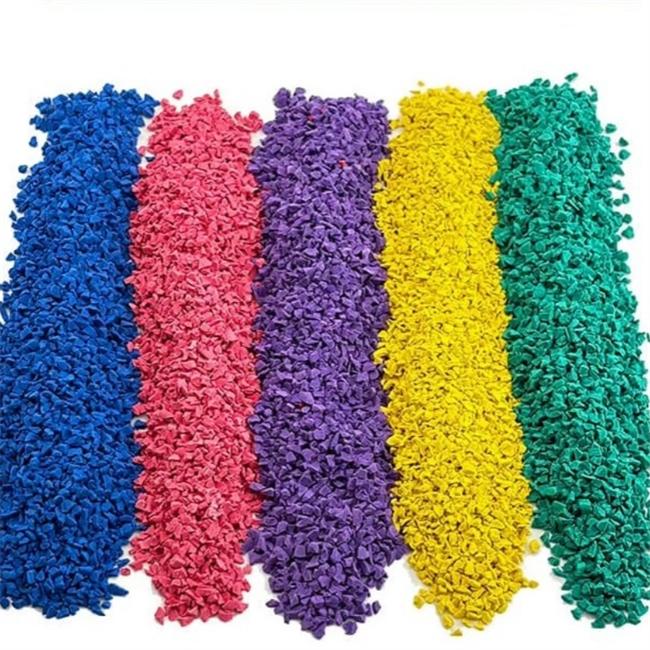
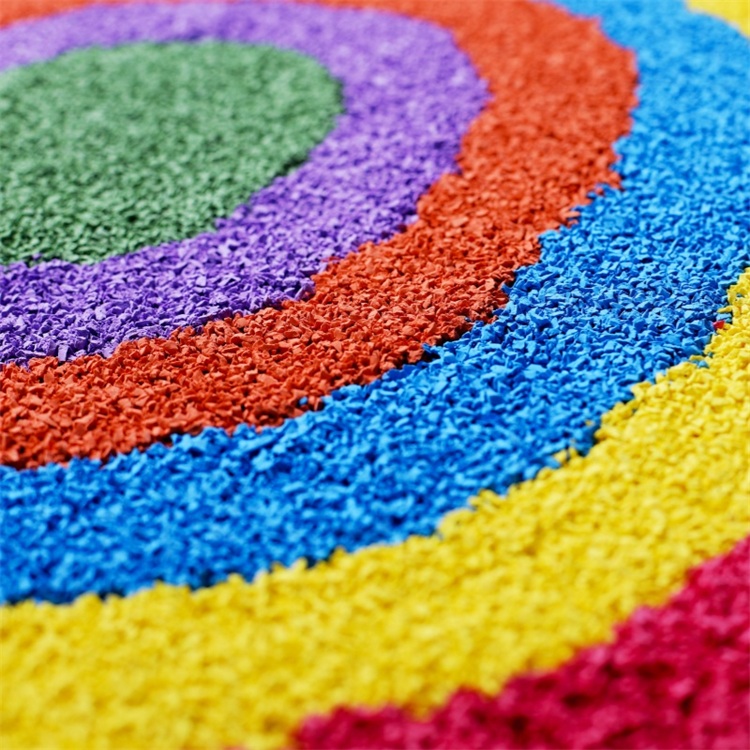
EPDM (Ethylene Propylene Diene Terpolymer) is a synthetic rubber known for its exceptional weather resistance, UV stability, and elasticity. Green and blue EPDM granules are colored variants produced by adding pigments and UV stabilizers during manufacturing, creating vibrant, durable surfacing materials for wet pour playground surfaces, poured-in-place (PIP) rubber systems, running tracks, and other recreational applications.
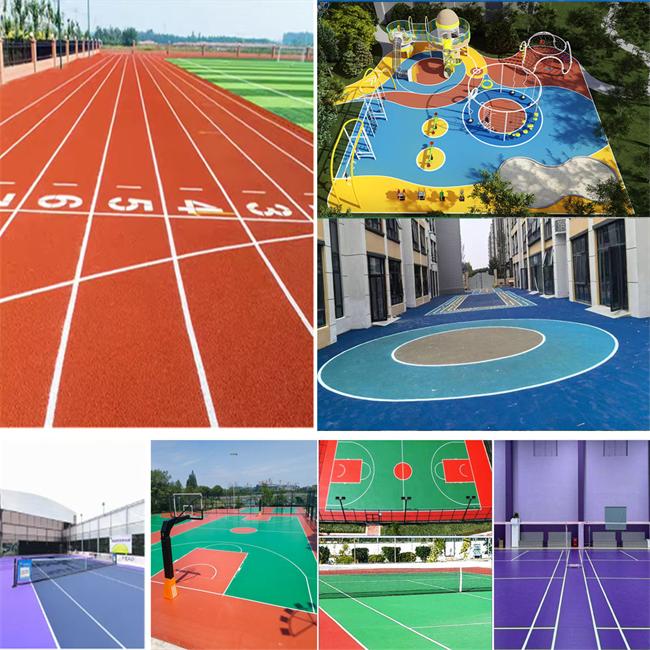
Typical applications include wet pour playground safety surfacing, sports flooring and athletic tracks, municipal parks and recreational areas, splash pads and water play zones, as well as walking paths and landscaping projects.
Applications of Green and Blue EPDM Granules
Both green and blue EPDM granules serve distinct market segments with specific design preferences.
Green EPDM Granules are commonly specified for parks and nature-themed playgrounds, golf pathways and landscape integration, school outdoor activity areas, and projects requiring natural color schemes that blend with surrounding environments.
Blue EPDM Granules are preferred for water-themed playgrounds and splash pads, sports tracks and multi-sport surfaces, modern commercial and municipal designs, and projects seeking high visual contrast and vibrant aesthetics.
Color Stability: The Critical Technical Difference
The most significant technical consideration when choosing between green and blue EPDM granules is UV stability and color fade resistance.
Industry testing reveals important distinctions based on pigment chemistry. According to UV resistance data from leading EPDM manufacturers, lighter and brighter colors—including certain shades of blue—can be more susceptible to fading when exposed to intense sunlight. For instance, bright blue (RAL 5012) and turquoise blue (RAL 5018) require UV-stable aliphatic binders to maintain color integrity, whereas darker greens like RAL 6005 and RAL 6021 demonstrate greater tolerance with standard aromatic resins.
This difference exists because color pigments react differently to UV radiation. Higher-quality EPDM granules use premium pigments and UV stabilizers to minimize degradation. Industry leaders have developed products achieving grey scale ratings of 4-5 (the highest possible score) after 2,550 hours of UVA exposure, with some maintaining ratings of 3.5-4 even after 5,000 hours. These ratings indicate minimal visible color change.
For contractors, this means a critical consideration: if your project specification requires bright blue or turquoise, always confirm that the EPDM manufacturer provides documented UV stability testing data to avoid premature color fade complaints from clients.

Technical Specifications and Performance Requirements
EPDM granules used in professional installations must meet specific technical standards regardless of color selection.
Polymer content should exceed 20 percent EPDM, as higher content directly correlates with better durability and color retention. Tensile strength requirements generally fall between 4 and 5 megapascals or higher, ensuring surface integrity and resistance to tearing. Elongation at break should reach 400 to 800 percent, providing the flexibility and impact absorption necessary for safety surfacing applications. Hardness typically measures 62 to 67 Shore A, delivering optimal cushioning for fall protection. Density is approximately 1.6 grams per cubic centimeter, which affects coverage rate calculations and overall cost estimation. UV resistance should achieve grey scale ratings of 3 to 4 after 2,550 hours of UVA exposure, with higher ratings indicating superior color stability.
Critical note: color does not affect mechanical properties. Tensile strength, elongation, and hardness remain consistent across green and blue variants. The primary difference lies in UV resistance, which is governed by pigment formulation and binder selection rather than the base polymer itself.

Common Challenges and How to Avoid Them
Challenge 1: Premature Color Fading
The most frequent complaint from end users is color fading within one to three years of installation. Solution: verify UV testing documentation before purchasing. Reputable manufacturers provide independent lab test results, such as ISO 17025 accredited certifications, confirming grey scale ratings. For projects in high-sun regions including Australia, the Middle East, and Southern Europe, choose products with documented performance at extended exposure durations beyond the standard testing period.
Challenge 2: Inconsistent Color Between Batches
Color variation between production batches can create visible seams and uneven appearance. Solution: request color consistency guarantees and maintain batch traceability throughout your project. Professional EPDM manufacturers implement rigorous quality control with spectrophotometric color measurement to ensure uniformity across batches. As an industry best practice, mixing granules from different batches during installation can help compensate for minor variations.
Challenge 3: Binder Incompatibility
Using the wrong binder type with your selected color leads to yellowing and discoloration over time. Solution: match binder type—aromatic or aliphatic—to your selected color. Aliphatic binders, which are UV-stable, are strongly recommended for light and bright colors to prevent yellowing and maintain vibrancy. Dark greens and darker blues perform well with standard aromatic binders, but aliphatic binders offer superior long-term aesthetics for all colors and are worth the additional investment for premium projects.
Challenge 4: Incorrect Particle Size Selection
Using the wrong granule size compromises both aesthetics and performance. Solution: match granule size to installation method and application requirements. Fine granules between 0.5 and 1.5 millimeters are ideal for top coats and decorative detailing. Standard granules from 1 to 3 millimeters suit most wet pour applications. Larger granules from 1 to 4 millimeters work well for playground safety surfaces requiring greater thickness and impact absorption. The 2 to 4 millimeter range is preferred for high-wear sports surfaces that demand extra durability.
How to Choose Between Green and Blue EPDM Granules
Decision Factors to Evaluate
UV Exposure Level: In high UV environments, dark greens such as RAL 6005 and 6021 may offer better inherent stability with standard binders compared to bright blues. Bright blues require aliphatic binders and premium UV formulation to maintain their appearance over time. Assess your project's sun exposure and specify accordingly.
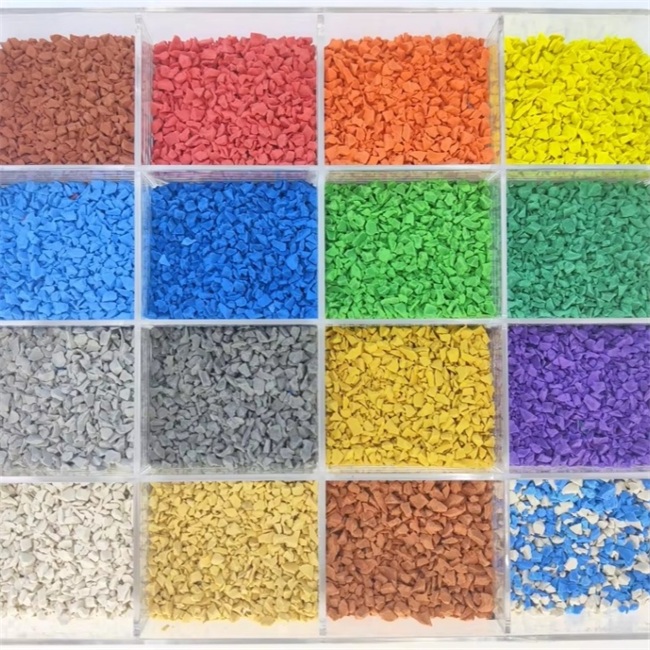
Design Theme and Aesthetics: Natural landscapes typically call for various shades of green, while water features and splash pads benefit from blue tones. Consider using multiple colors for playground graphics and patterns to create engaging, themed environments.
Project Type and Usage: For heavy foot traffic and daily use applications, consider darker colors that mask minor wear and extend the perceived lifespan of the surface. Commercial and municipal projects should always specify products with proven UV stability documentation to protect public investment.
Budget Considerations: Premium UV-stable products may have higher upfront costs but provide reduced long-term maintenance and replacement expenses. Quality EPDM granules deliver lifecycle cost savings through extended color retention and durability, making them more economical over the full lifespan of the installation.
Manufacturer Insights: Expert Recommendations
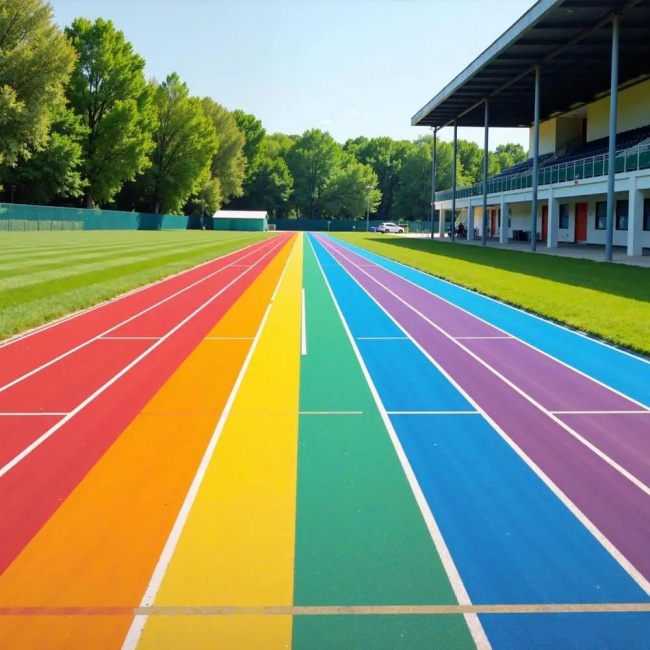
Based on our 25 years of experience manufacturing EPDM rubber granules for global markets, we offer the following professional guidance.
Selecting the Right Particle Size
For wet pour playground surfaces, 1 to 3 millimeter or 1 to 4 millimeter granules balance aesthetics, safety, and installation efficiency. For running tracks and high-performance athletic surfaces, 0.5 to 1.5 millimeter granules offer finer texture suitable for precision applications. For custom design graphics, consider blending different granule sizes to achieve pattern precision and unique visual effects.
Optimizing Color Performance
For bright blues, vibrant greens, and all vivid colors, always use UV-stable aliphatic binders to prevent yellowing and maintain long-term color integrity. Request laboratory UV testing reports from your supplier before committing to large orders, and verify that the testing duration matches or exceeds the expected exposure conditions of your project location. When multiple color zones are required—for example, green and blue play areas within the same facility—plan batch alignment carefully to ensure consistent shades across all zones.
Evaluating Quality and Reliability
Certification matters significantly in international procurement. Look for ISO 9001 quality management certification and relevant international standards for your target market. Higher polymer content, specifically above 20 percent EPDM, correlates with better durability and color stability. Confirm that your supplier conducts regular independent lab testing for UV resistance, tensile strength, and other critical parameters, and that they provide documentation upon request.
Avoiding Common Procurement Mistakes
Do not select based solely on initial price—inferior granules fade within one to three years, leading to client complaints and costly replacements. Do request physical samples before ordering to verify color, texture, and quality firsthand rather than relying solely on digital representations.

Why Global Buyers Choose Our EPDM Granules
As a specialized EPDM rubber granules manufacturer, we focus exclusively on producing premium colored EPDM granules for wet pour playgrounds, running tracks, safety surfacing, and recreational areas. Our production expertise and technical advantages deliver measurable benefits for contractors and buyers worldwide.
Our sulfur-free technology eliminates sulfur content entirely from our EPDM formulation. This critical innovation prevents decomposition of sulfuric acid under high temperatures and intense UV exposure, ensuring no unpleasant odors during installation or throughout the product's service life. The sulfur-free molecular structure achieves remarkable stability, extending service life by over three times compared to conventional EPDM products. Tensile strength and elasticity improve by two to three times, reaching 4 to 7 megapascals, providing superior impact resistance and durability. Performance retention improves by a factor of five, meaning our granules maintain their physical properties significantly longer than standard alternatives. Exceptional antioxidant properties ensure colors remain vibrant and resist fading even in challenging environmental conditions. Better heat resistance makes our products suitable for extreme climate applications from desert heat to tropical humidity. Most importantly, our sulfur-free technology achieves environmental safety meeting food-grade standards, providing peace of mind for projects involving children and sensitive populations.
Our comprehensive customization capabilities include color matching to RAL, Pantone, or customer-supplied samples with precision and consistency. We produce particle sizes ranging from 0.5 to 1.5 millimeters, 1 to 3 millimeters, 1 to 4 millimeters, 2 to 4 millimeters, and custom specifications upon request. Packaging can be customized for whole container loads or LCL (less than container load) shipping to meet your logistics requirements. We offer private label, OEM, and ODM services for brand owners and distributors seeking partnership.
We maintain no minimum order quantity, providing flexible order sizes for projects of any scale from small renovations to major municipal developments. Our global export expertise ensures reliable, timely delivery to Europe, North America, Australia, the Middle East, and beyond, with full documentation and certification support for smooth customs clearance.
Frequently Asked Questions
What is the difference between green and blue EPDM granules?
Both are EPDM rubber granules manufactured with different color pigments. The primary technical difference is UV stability—certain bright blues and light colors may be more susceptible to fading and require UV-stable aliphatic binders to preserve color integrity. Dark greens generally exhibit better tolerance with standard binders. Mechanical properties including tensile strength, elongation, and hardness are identical across colors.
Which color fades more: green or blue EPDM?
Bright blues and turquoise can fade faster if not formulated with premium UV stabilizers and matched with aliphatic binders. Darker greens such as RAL 6005 and RAL 6021 typically demonstrate better UV resistance with standard binders. However, quality manufacturers produce both colors with exceptional UV stability—always verify test data before purchasing.
Can you customize EPDM colors to specific RAL or Pantone codes?
Yes, professional manufacturers support custom color matching to RAL, Pantone, or customer-supplied samples. Our sulfur-free technology ensures color consistency and longevity across all custom formulations.
What particle size should I choose for a playground?
For standard wet pour playground safety surfacing, 1 to 3 millimeter or 1 to 4 millimeter granules are recommended. For sports tracks and decorative finishes, 0.5 to 1.5 millimeter may be preferred. Your supplier should provide guidance based on your specific application and installation method.
What is the difference between aromatic and aliphatic binders, and which should I use?
Aromatic binders are standard polyurethane binders that are not UV-stable and can yellow over time. Aliphatic binders are UV-stable and prevent yellowing, making them essential for bright and light-colored EPDM granules such as bright blue and turquoise. For dark green and dark blue, both options work, but aliphatic binders offer superior long-term aesthetics.
How long do green and blue EPDM surfaces last?
With proper installation and high-quality materials, EPDM surfaces can last 10 to 15 years or more. Our sulfur-free EPDM granules offer extended service life of over three times compared to conventional products due to enhanced molecular stability and UV resistance.
Is there a minimum order quantity?
We offer flexible order quantities with no minimum MOQ, making our products accessible for projects of any scale from small renovations to large infrastructure developments.
Can I get samples before placing an order?
Yes, we provide samples for quality verification and color matching before bulk orders. Contact us to request your samples and technical consultation tailored to your project requirements.

Choosing between green and blue EPDM granules requires balancing aesthetic vision with technical performance and long-term durability. While both colors deliver exceptional mechanical properties, color stability depends heavily on UV formulation quality, pigment selection, and binder compatibility. For bright blues and light shades, aliphatic UV-stable binders are essential to prevent fading and maintain visual appeal. Darker greens offer greater flexibility with standard binders but benefit from premium formulations as well.
The most reliable approach is to partner with a specialized EPDM manufacturer that provides documented UV testing, customization flexibility, and consistent quality across all production batches. Our sulfur-free technology, comprehensive customization capabilities, and global export experience ensure you receive durable, vibrant EPDM granules that meet your project specifications and exceed performance expectations.

Ready to specify the right EPDM granules for your next project? Contact us for samples, technical data sheets, and expert guidance tailored to your application and market requirements.
WOW(LYG) New Material Co Ltd is a manufacturer specializing in the production of EPDM rubber granules. We use sulfur-free vulcanization technology, it increases the service life by more than 3 times than traditional EPDM granules, and enhances the performance, including anti-aging, high-temperature resistance, and colorfastness.
We have over 25 years of production experience and offer customization for colors and granule sizes. NO MOQ.


