 注: 建议图片大小150px*50px
丨
注: 建议图片大小150px*50px Views: 0 Author: Site Editor Publish Time: 2026-07-23 Origin: Site


Beyond the Colored Pebbles
If you are reading this, you are likely in the middle of a specification process, managing a procurement tender, or trying to figure out why the last EPDM project you installed is already showing signs of fading after just one summer.
You are not alone.
In my 20+ years of experience in this industry—working with playground contractors in the Middle East, sports surfacing installers across Europe, and government procurement teams in Southeast Asia—I have seen one recurring theme: most buyers focus on color and price, but completely miss the science that determines whether a surface lasts 3 years or 15 years.
This guide is not a generic product brochure. It is a deep-dive into the engineering, the chemistry, and the practical decision-making criteria that separate premium EPDM granules for safety surfacing from the cheap alternatives that end up costing you far more in warranty claims and reputation damage.

What Exactly Are EPDM Granules for Safety Surfacing?
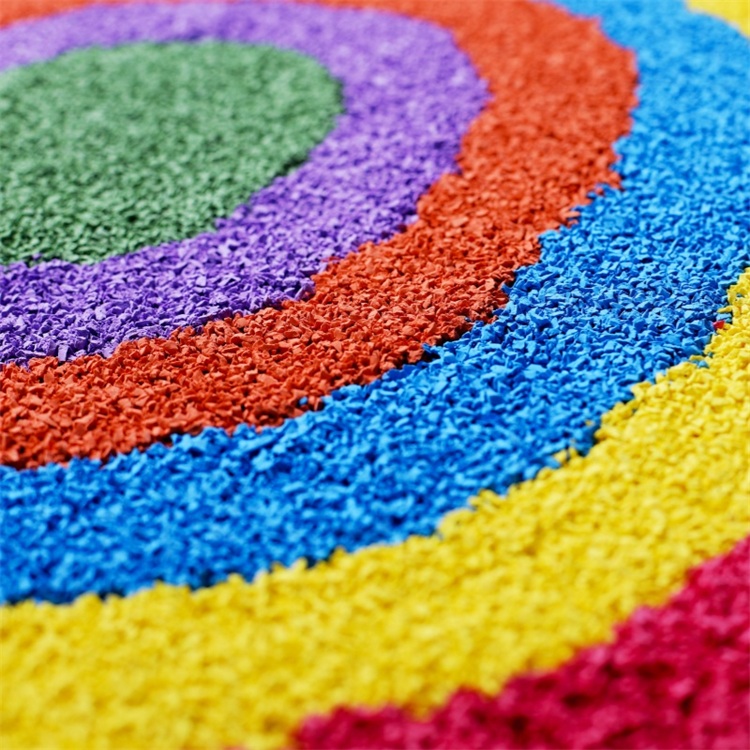
EPDM stands for Ethylene Propylene Diene Monomer, a synthetic rubber that has become the global standard for outdoor safety surfacing. Unlike natural rubber or recycled tire crumb, EPDM is engineered for one primary purpose: to withstand the elements while providing critical fall protection.
In practical terms, these granules are mixed with a polyurethane (PU) binder and troweled onto prepared substrates to create a seamless, shock-absorbing surface. You will find them in wet-pour playground systems, running tracks, multi-sport courts, and landscape applications.
But here is where the industry often misleads buyers: not all EPDM granules are created equal. The chemistry behind the vulcanization (curing) process fundamentally determines performance. This is where our proprietary sulfur-free, peroxide-cured technology represents a paradigm shift.
The Applications: Where Safety Surfacing Actually Matters
Understanding the application is the first step in selecting the right material. Different environments impose vastly different stresses.
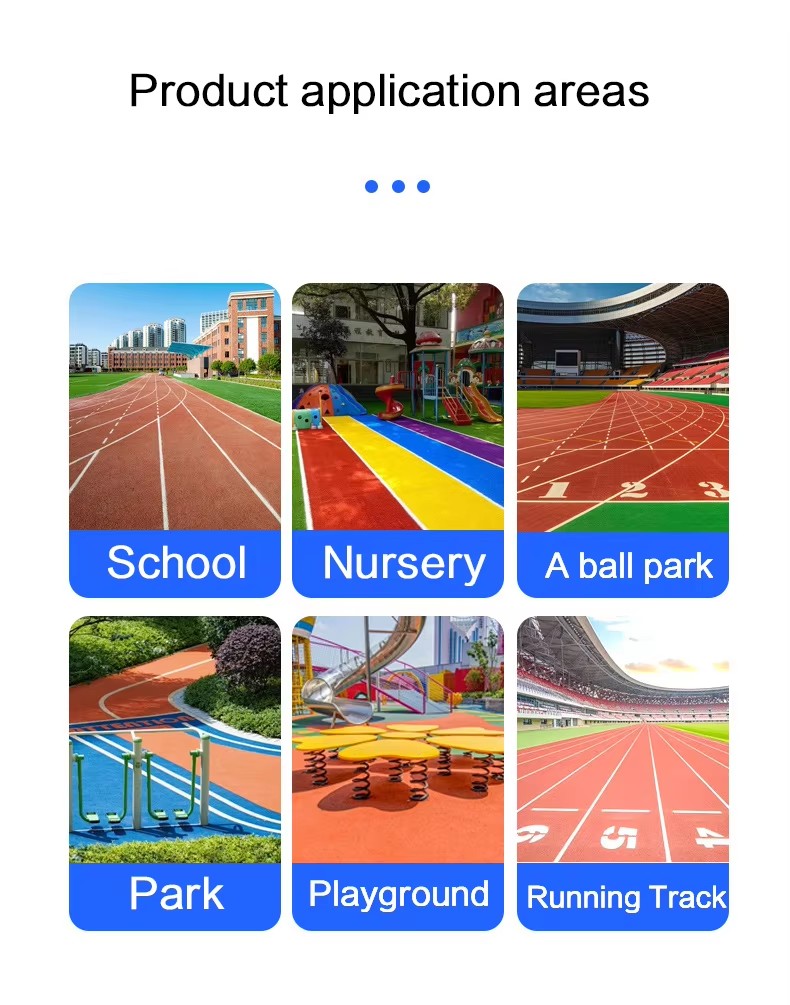
Playgrounds (Critical Fall Height Protection)
This is the most safety-critical application. EPDM safety surfacing must comply with international standards like EN 1177 for impact attenuation. The thickness of the system dictates the critical fall height—typically ranging from 30mm to 80mm depending on the equipment height . We often see contractors struggle here because they focus on thickness but ignore the elasticity retention of the granules. A granule that hardens over time will lose its shock-absorbing properties, rendering the safety rating void.
Sports Tracks and Multi-Sport Courts
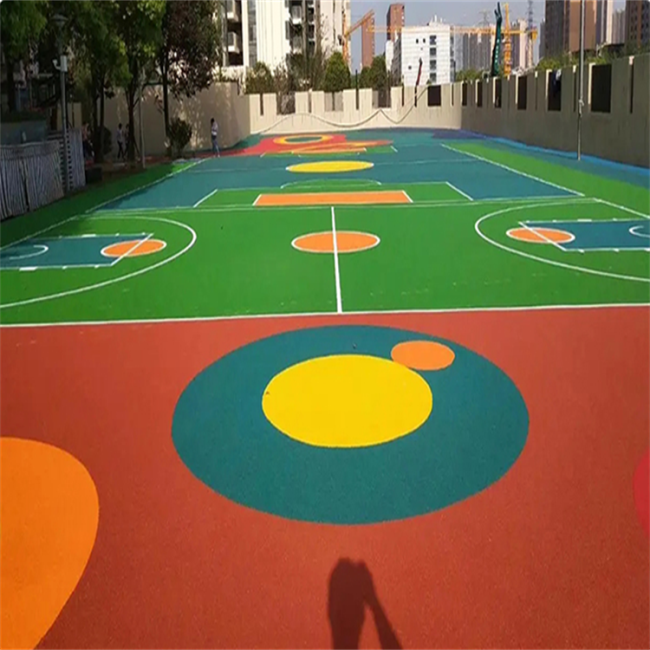
Here, the demands shift to traction, rebound, and wear resistance. The granules need to offer consistent friction for athletes while maintaining dimensional stability. We have seen cases where poor-quality granules with high ash content become slippery when wet or "dusty" as they degrade, creating hazardous playing conditions.
Landscape and Municipal Projects
This is where UV resistance becomes the primary concern. Municipal projects often have a 5-to-10-year maintenance cycle; if the color fades or the surface crumbles in 2 years, it is a political and financial disaster.
Prefabricated Tiles and Rolled Goods
Increasingly, manufacturers are using high-quality EPDM granules to produce tiles and rolls for modular installations. The granules in these products must maintain flexibility during storage and installation .
The Hidden Costs of "Cheap" EPDM: Why You Are Actually Losing Money
Let us address the elephant in the room. I have spoken with Purchasing Managers who look only at the price per kilogram. This is a mistake that costs millions in the long run.
Here is what happens when you choose low-quality granules:
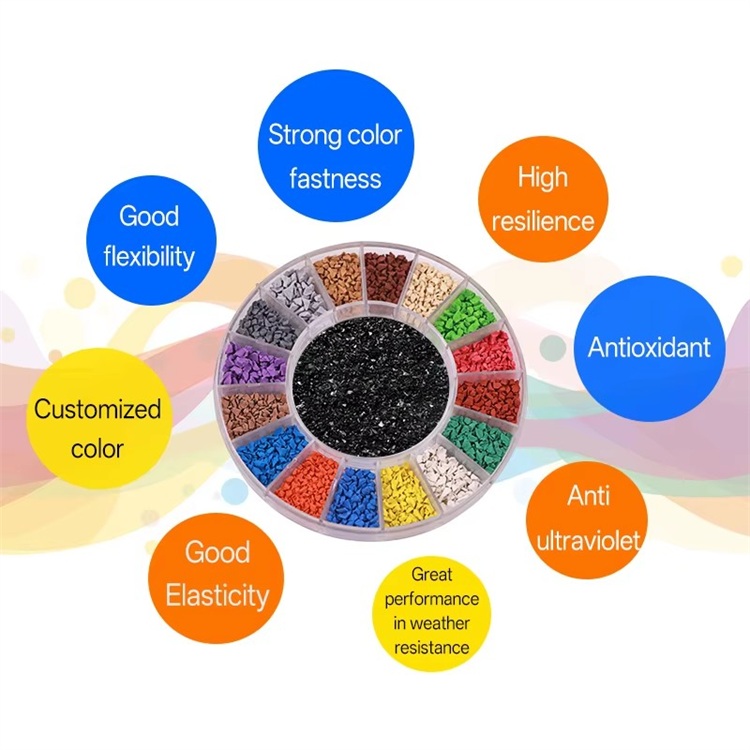
1. Fading within 6–12 months: If the granule does not have sufficient UV stabilizers, the pigments break down. You get a patchy, ugly surface that requires complete replacement. Our sulfur-free technology enhances antioxidant properties, ensuring that color retention is extended by over 5 times compared to conventional granules .
2. Odor Issues in Heat: Many traditional EPDM granules contain sulfur compounds used in the vulcanization process. Under high heat and UV exposure, these release sulfuric acid gases—creating that "rotten egg" smell that is not just unpleasant but potentially harmful. We designed our granules to be completely sulfur-free, meaning no odor, even in 50°C+ temperatures.
3. Poor Tensile Strength: Tensile strength (measured in MPa) determines how much stress the material can take before tearing. Standard granules might test at 1.5–2 MPa. Our sulfur-free formulations achieve 4 to 7 MPa . This means the surface resists tearing from high-heel shoes, sports cleats, and heavy maintenance equipment.
4. Bonding Failure: If the granule is dirty or poorly compounded, it will not bond properly with the PU glue. You get delamination, cracks, and "popping" granules. Our granules feature a more stable molecular structure with strong adhesion properties, ensuring a monolithic, durable surface.

How to Select EPDM Granules: The Technical Checklist for Contractors
When evaluating suppliers, do not just look at a sample. Demand data.
1. Verify the Vulcanization Process
Ask: Is this sulfur-cured or peroxide-cured?
- Sulfur-cured: Cheaper, but prone to odor, poor heat resistance, and embrittlement over time.
- Peroxide-cured (Sulfur-Free): Higher cost, but stable, odorless, and boasts a service life 3 times longer.
Our process uses peroxide crosslinking, which creates a more stable carbon-carbon bond in the polymer chain. This drastically improves resistance to thermal oxidation and UV degradation .
2. Demand Physical Property Reports
Do not rely on vague marketing claims. Look for:
- Tensile Strength: Should be at least 3.5 MPa for sports surfaces, but premium grades exceed 4.5 MPa .
- Elongation at Break: Indicates flexibility. Premium grades exceed 450%.
- Ash Content: Lower is better. A high ash content (above 50%) means the granule is diluted with fillers like calcium carbonate. This kills elasticity. Our specifications maintain a tight control over ash content to ensure performance.
3. Check Color Stability Testing
Ask for QUV weathering test results. How many hours of accelerated UV exposure does the color withstand?
- Standard granules often fade after 1,500 hours.
- High-stability granules, like our new formulations, maintain color stability for over 5,000 hours .
4. Assess Compatibility with Binders
A granule that repels the polyurethane binder will fail. High-quality EPDM has a surface energy that promotes adhesion. If you have had issues with the PU glue "balling up" or not wetting the granule, the granule is the problem, not the glue.
5. Consider the "Loose Bulk Density"
Lower bulk density means the granule is porous and lightweight, which is better for impact absorption and covers more area per kilogram. It indicates a high-quality, airy structure rather than a dense, heavy pellet.

Why the "Sulfur-Free" Revolution is Changing the Industry
In my years as a technology engineer, I have watched the industry slowly shift toward sulfur-free formulations. The reason is simple: the environment and health standards are getting stricter.
Schools, hospitals, and public parks are now subject to VOCs (Volatile Organic Compounds) regulations. A sulfur-based granule in a hot, sunny location is a liability.
- Health: Sulfur-free means food-grade sanitary standards. It is safe for barefoot play, and safe for children who might put their hands in their mouths.
- Durability: The absence of sulfur prevents the molecular chain from breaking down under heat. This is why we guarantee a 3x increase in lifespan.
- Aesthetics: The color remains vibrant. The "chalky" white surface that sometimes appears on aged rubber is oxidation; sulfur-free grades with high antioxidant content resist this "blooming" effect, keeping the finish looking fresh.
Common Pitfalls and How to Avoid Them
Pitfall 1: Ignoring Climate
If you are installing in Dubai, Arizona, or any high-heat environment, standard EPDM will cook. You must specify high-UV and high-heat resistant grades. Our granules feature enhanced antioxidant functionality specifically to tackle these extreme climates.
Pitfall 2: MOQ (Minimum Order Quantity) Constraints
If you are a small contractor or doing a custom residential job, big manufacturers often turn you away because of high MOQs. Our flexibility on MOQ means we support projects of all sizes, from tiny kindergarten refurbishments to massive Olympic track installations.
Pitfall 3: Color Variation
Nothing looks worse than a multi-colored court where the color patches don’t match. This happens when the manufacturer doesn’t control their pigment dispersion. Always ask for a "color masterbatch" guarantee. We ensure batch-to-batch color consistency via full production lines, unlike smaller blenders who just mix pigments manually.
Pitfall 4: Assuming All "Custom" is Expensive
If you want a specific Pantone or RAL color, many suppliers charge a premium. Because we produce in bulk and have custom milling capabilities, we can tailor colors without a massive cost increase—provided you plan your order lead time.
Frequently Asked Questions by Procurement Experts
Q: "Why do some surfaces get 'tacky' or sticky in the sun?"
A: That is a sign of plasticizer migration or the breakdown of the polymer. It is often caused by using the wrong type of oil extenders. Sulfur-free, high-purity EPDM does not bleed oils, so it remains "dry" to the touch even in extreme heat.
Q: "How does granule size affect installation?"
A: Size matters. 1–3mm is typical for playgrounds; it's smooth to the touch. 2–4mm is more aggressive, offering better traction for running tracks. If the size is inconsistent (too many fines), the surface will be dense and less permeable, leading to puddling. We offer precise size distribution control to ensure permeability and even coverage .
Q: "Is this product recyclable or sustainable?"
A: Our manufacturing process is designed for efficiency, and the product's extended lifespan means it does not end up in landfills as frequently. The material itself can be down-cycled, but we focus on making it last so long that replacement is a rare event—which is the most sustainable approach.
Q: "How do we guarantee compliance with international standards?"
A: We maintain strict internal controls to meet EN 1177, ASTM, and REACH standards. We recommend that contractors request the Certificates of Analysis (COA) with every batch.

Conclusion: Future-Proofing Your Surface Investments
The EPDM market has matured. The choice is no longer between "rubber" and "not rubber." It is between high-performance, engineered polymers and commodity rubber fillers.
For the contractor, the architect, and the procurement officer, the best advice I can give is to look 10 years ahead. Cheap granule costs you money in repairs, complaints, and legal liabilities.
Invest in sulfur-free, high-tensile, UV-stable EPDM granules. We are backed by over 25 years of industry experience and full-scale advanced production lines. We do not just sell granules; we provide technical support to ensure your surface is a benchmark for safety and durability.
When you are ready to move beyond the sample board and into real specifications, choose the partner who understands the science.


Contact us to discuss your custom color, custom size, and specific technical requirements. We deliver. No MOQ barriers. Just quality.
WOW(LYG) New Material Co Ltd is a manufacturer specializing in the production of EPDM rubber granules. We use sulfur-free vulcanization technology, it increases the service life by more than 3 times than traditional EPDM granules, and enhances the performance, including anti-aging, high-temperature resistance, and colorfastness.
We have over 25 years of production experience and offer customization for colors and granule sizes. NO MOQ.


