 注: 建议图片大小150px*50px
丨
注: 建议图片大小150px*50px Views: 0 Author: Site Editor Publish Time: 2026-07-22 Origin: Site


Choosing the right surfacing material can make or break a sports or playground project. For contractors, procurement managers, and importers, the decision often comes down to one critical material: EPDM rubber granules. This guide cuts through the marketing fluff to address the real-world concerns, technical specifications, and procurement pitfalls our industry has navigated for over 25 years.

What Are Rubber Granules for Sports Surfacing?
Rubber granules are small granules of synthetic or recycled rubber used to create seamless, durable, and safe surfaces for athletics and recreation. While there are different types, EPDM (Ethylene Propylene Diene Monomer) granules represent the premium tier in this market .
Unlike SBR (Styrene Butadiene Rubber) granules, which are typically made from recycled tires and are cost-effective but prone to fading, EPDM is a synthetic rubber engineered for superior performance . In technical terms, high-quality EPDM granules exhibit a tensile strength of 4 to 7 megapascals (MPa) and maintain a Shore A hardness around 60, providing an optimal balance of durability and shock absorption .

Why EPDM? Addressing Common Pain Points
Our clients—whether they are Sports Surfacing Contractors or Government Procurement officers—frequently ask why they should specify EPDM over cheaper alternatives. The answer lies in performance and total cost of ownership.
1. The Problem of Fading and UV Degradation
One of the biggest frustrations for Playground Contractors and Landscape Companies is color fading. Sunlight can turn a vibrant playground into a dull eyesore within months.
- The SBR Issue: Standard recycled granules (SBR) have poor UV resistance and fade rapidly .
- The EPDM Solution: EPDM is inherently UV-stable. However, even within EPDM, quality varies. While standard EPDM offers good color retention, Advanced formulations—such as our sulfur-free technology—take this a step further. By eliminating sulfur, the polymer chain remains more stable under UV and heat stress, preventing the surface from breaking down and "chalking." This ensures colors remain vibrant for years, significantly outperforming standard EPDM and SBR alternatives.
2. Odor Issues (Heat Decomposition)
Installer teams and end-users often complain about the "rubber smell" on hot days, which can be off-putting in schools or indoor facilities. This odor is often caused by sulfur outgassing .
- Our Advantage: Our EPDM granules are manufactured using a sulfur-free vulcanization process. Because there is no sulfur in the compound, they do not break down and release sulfuric gases under high temperatures. The result is a truly odorless surface, even under intense sunlight.
3. Bonding and Construction Failures
Construction Companies face liability when surfaces delaminate or crack. This is often due to the granules failing to bond with the PU binder or the binder itself degrading.
- Incompatible Binders: Using an aromatic (non-UV-stable) binder with light-colored granules leads to yellowing and eventual bond failure .
- Our Advantage: Our EPDM granules exhibit excellent compatibility with both aromatic and aliphatic binders. Furthermore, the elasticity of our granules (tensile strength up to 7 MPa) provides a 2-3 times improvement in flexibility, allowing the final surface to expand and contract with temperature changes without cracking .
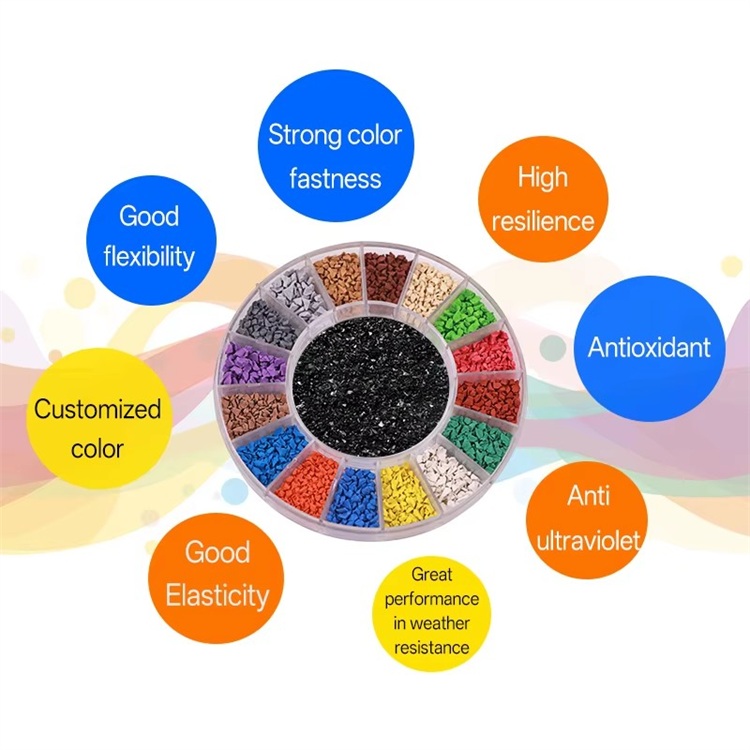
How to Select the Right EPDM Granules for Your Project
For Architects, Engineers, and Purchasing Managers, choosing the wrong specification leads to project delays and safety failures. Here is the technical checklist you need:
1. Understand granule Size and Application
The granule size dictates the finish, safety, and durability of the surface .
- 0.5 - 1.5 mm: Fine texture, ideal for high-end spray coatings and "sandwich" layer applications where a smooth finish is desired.
- 1.0 - 3.0 mm: The industry standard for general playground safety surfacing, providing excellent shock absorption without feeling spongy .
- 2.0 - 4.0 mm: Larger, more textured granules used for professional running tracks and "wear layers" to maximize durability .
2. Evaluate Material Quality and Purity
Importers and Distributors must be wary of "reclaimed" or blended EPDM. Testing has shown that some "EPDM" granules contain fillers (ash content) over 60%, with tensile strengths dropping below 2 MPa .
- The Standard: Virgin EPDM should have a polymer content exceeding 20%. Look for certifications like ROHS, REACH, or EN71 to ensure safety for children and environmental compliance .
- Our Advantage: We offer customizable size ranges from 0.5mm to 4mm. We ensure consistency in granule size distribution (sphericity), which is critical for even spreading and efficient binder coverage.
3. Sustainability
More municipal projects require "green" materials. The EPDM industry is moving toward sustainable options using bio-based or recycled raw materials without sacrificing performance .
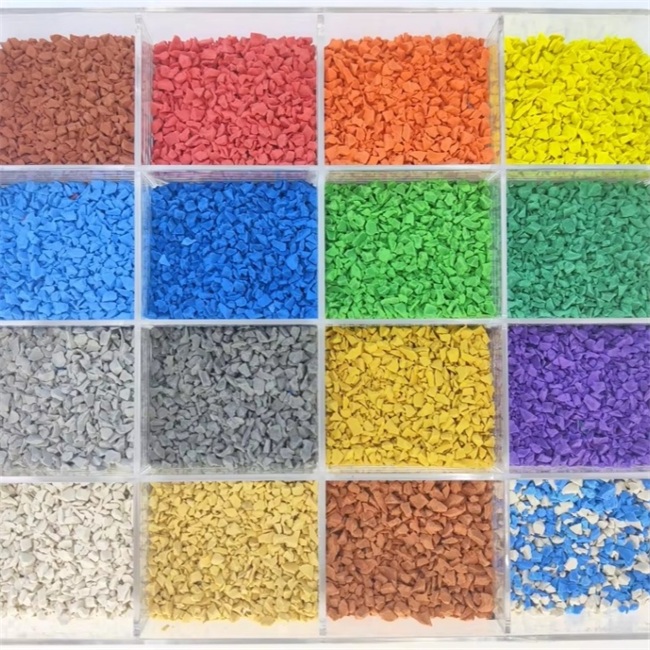
Avoiding the Most Common Procurement Mistakes
Purchasing Managers and Importers often fall into traps that cost thousands of dollars. Here is how to avoid them:
1. Falling for Cheap Pricing on SBR: Many suppliers offer "colored granules" that are actually EPDM-coated SBR (confetti). These are cheaper but fade faster.
2. Ignoring the Binder Compatibility: You must match your granule choice with the binder. If using bright colors (white, pink, light blue), an aliphatic binder is mandatory to prevent yellowing .
3. Missing Certification: Always request a Technical Data Sheet (TDS) for the specific batch. Verify the tensile strength (aim for >4 MPa for high-traffic areas) and ash content.
4. Overlooking MOQ: Many suppliers require high Minimum Order Quantities (MOQ) of 1-5 metric tons. This locks you into inventory that may not match your color or size specifications.

Our Commitment: The 25-Year Difference
With over 25 years of experience, we understand that your reputation depends on the materials you choose. Our manufacturing facility utilizes state-of-the-art machinery to ensure batch-to-batch consistency, eliminating the variance that plagues cheaper alternatives.
- No Minimum Order Quantity (No MOQ): We support projects of all sizes, from small playgrounds to large-scale municipal stadiums.
- Customization: We match any color (RAL or Pantone) and any size (0.5mm to 4mm).
- Global Shipping: As a major exporter, we manage logistics to ensure quick delivery, reducing your lead times.
> Our EPDM Granules Are Engineered For:
> Odorless Performance: Sulfur-free technology ensures no smell, even on hot days.
> Superior Strength: 4–7 MPa tensile strength (2-3x more elastic than standard).
> Lifespan: 3x longer lifespan due to enhanced molecular stability.
> Aesthetics: Permanent colorfastness against UVA exposure.

Frequently Asked Questions (FAQs)
Q: How long do rubber granules last?
A: With proper installation and quality EPDM granules (like our sulfur-free variant), you can expect a lifespan of 10-15 years. This is 3 times longer than SBR-based systems.
Q: Are EPDM granules safe for children?
A: Yes. Our EPDM meets stringent international standards, including EN71 (toy safety). They are non-toxic and free from heavy metals and sulfur, making them safe for schools and playgrounds .
Q: Does the color fade in the sun?
A: EPDM is designed for UV resistance. Our enhanced antioxidant technology ensures that colors stay bright for the lifetime of the surface, preventing the "chalking" or fading associated with lower-grade products.
Q: What is the difference between EPDM and PU surfaces?
A: EPDM is the actual colored material. Polyurethane (PU) is the binder used to glue the EPDM granules together. The combination creates the final shock-absorbent surface.
Q: What is the best binder for EPDM granules?
A: For outdoor projects, always use an aliphatic polyurethane binder. It is UV stable and will not turn yellow, ensuring the bright colors of the EPDM stay pure .

WOW(LYG) New Material Co Ltd is a manufacturer specializing in the production of EPDM rubber granules. We use sulfur-free vulcanization technology, it increases the service life by more than 3 times than traditional EPDM granules, and enhances the performance, including anti-aging, high-temperature resistance, and colorfastness.
We have over 25 years of production experience and offer customization for colors and granule sizes. NO MOQ.


