 注: 建议图片大小150px*50px
丨
注: 建议图片大小150px*50px Views: 0 Author: Site Editor Publish Time: 2026-07-20 Origin: Site


For over two decades, we’ve seen the same challenges repeat across the sports flooring industry. Playground contractors struggling with color fading within months. Importers receiving inconsistent batches that fail customs. Government procurement officers facing complaints about toxic odors at newly opened schools. This guide doesn’t just explain what Running Track EPDM is—it solves the problems that keep you up at night.

What Is Running Track EPDM?
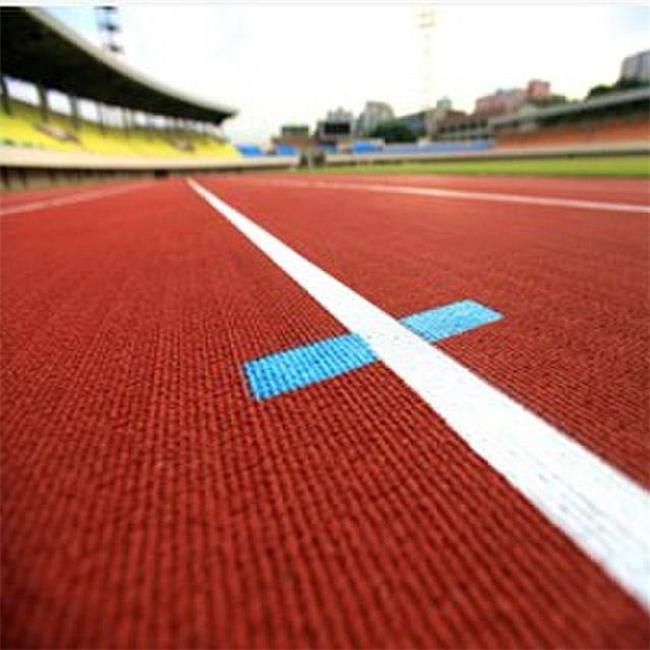
Running Track EPDM is not simply colored rubber. It is a high-performance, thermoset elastomer—ethylene propylene diene monomer rubber—engineered specifically as the wearing course for athletic surfaces . Unlike basic rubber granules, EPDM is formulated for extreme environmental resistance.
A standard running track system using EPDM consists of a layered structure: a base layer of black SBR rubber granules bound in polyurethane, a seal coat, and a top layer of colored EPDM granules cast into a polyurethane flood coat . This structure provides critical shock absorption, slip resistance, and energy return .
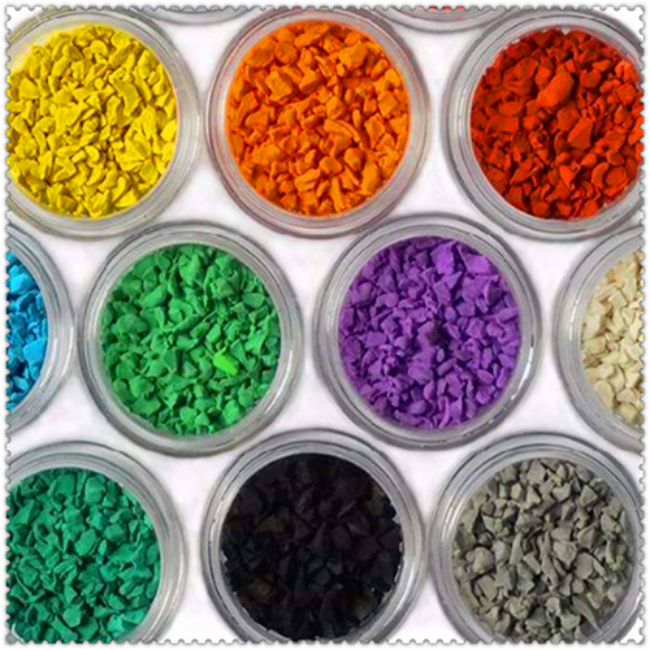
Standard specifications for EPDM granules are typically 0.5-1.5mm, 1-3mm, or 2-4mm. Professional-grade EPDM granules have a tensile strength of 4–7 MPa and elongation at break of up to 650% .
Applications: Where Running Track EPDM Is Used
EPDM granules serve a wide range of infrastructure and recreational projects:
- Athletic running tracks: Professional competition venues, school stadiums, and university tracks.
- Jogging trails: Community parks, housing developments, and municipal fitness paths.
- Playgrounds: Impact-absorbing safety surfaces for schools, kindergartens, and daycare centers .
- Multi-sport courts: Basketball, tennis, and volleyball court surfaces.
- Recreational areas: Fitness zones, swimming pool decks, and senior activity centers .

Why Use EPDM? Solving the Problem of Surface Failure
The fundamental question isn't "is EPDM good?" but "why do traditional surfaces fail?" Conventional rubber systems using sulfur-based vulcanization break down under UV exposure and heat, releasing sulfuric acid—the source of that "rubber smell" and premature degradation.
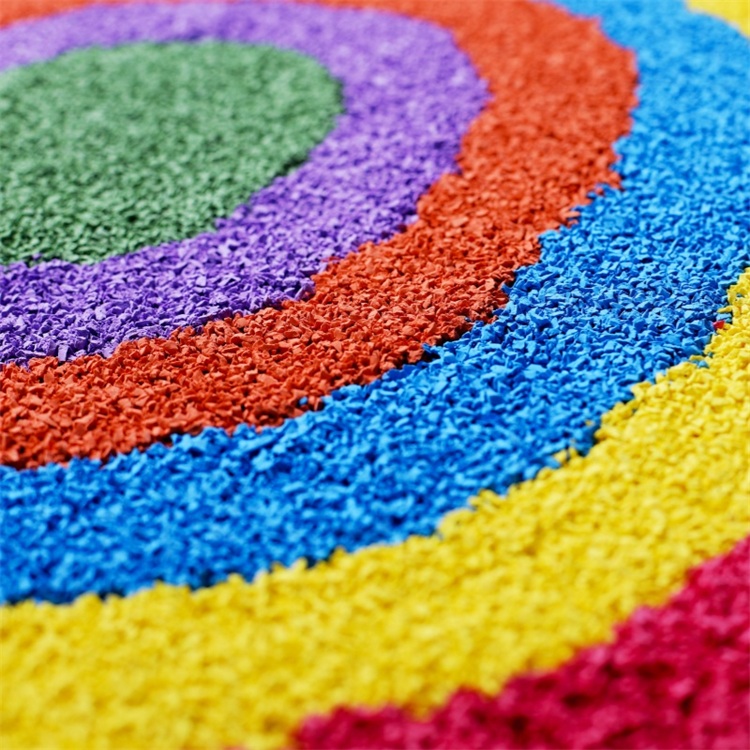
EPDM eliminates this problem through a sulfur-free curing process. Without sulfur in the molecular structure, there is no sulfuric acid byproduct to degrade the material or create odors. This produces a more stable polymer network that resists UV radiation, ozone, and thermal oxidation . EPDM tracks provide 8 to 12 years of service life under regular use .
Critical Advantages: What Sets Quality EPDM Apart
For contractors and purchasers, here are the performance metrics that matter:
1. Superior Weather Resistance
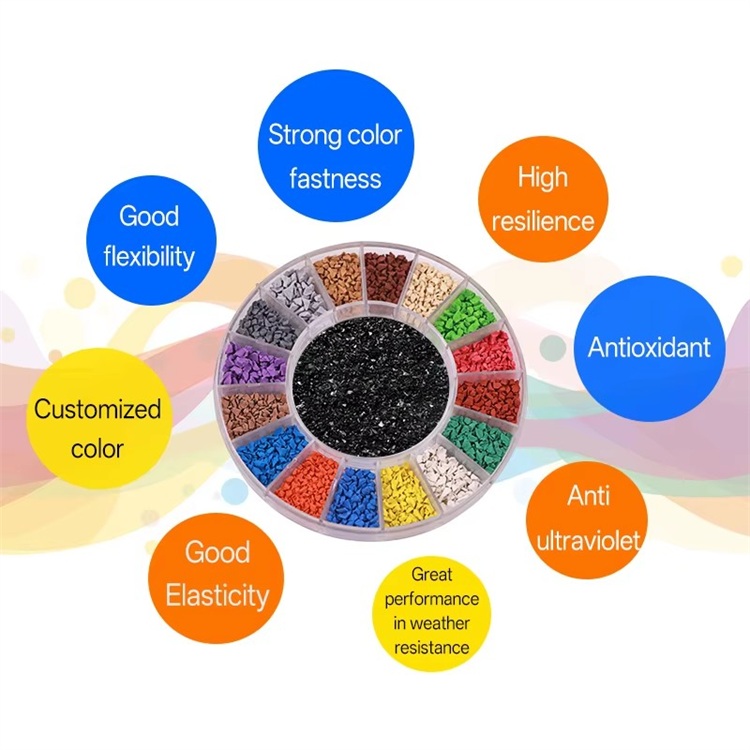
EPDM is inherently resistant to UV radiation, ozone, and temperature extremes. High-quality EPDM retains color vibrancy for 8 years or more without significant fading or chalking .
2. Enhanced Mechanical Properties
Professional EPDM granules deliver tensile strength of 4–7 MPa (industry standard is 3.5 MPa), elongation at break exceeding 550%, and Shore A hardness of 55–65 .
3. Odor-Free, Safe Formulation
Sulfur-free EPDM produces no odorous decomposition products, even under extreme heat. This is critical for enclosed stadiums and school environments . Premium EPDM complies with GB 36246-2018 (new national standard) for VOC emissions .
4. Lower Bulk Density with 3D granule Shape
Quality EPDM has a bulk density of 0.65–0.75 g/cm³ . The irregular, angular shape provides mechanical interlocking during installation, reducing adhesive consumption while improving surface cohesion.

Common Problems and How to Avoid Them
We’ve seen these costly mistakes repeatedly:
Problem 1: Color Fading and Chalking
- Cause: Low EPDM polymer content or sulfur-based curing agents. Materials with EPDM content below 20% are prone to rapid UV degradation .
- Solution: Specify EPDM content ≥20% with antioxidant additives. Confirm this through lab analysis (FTIR, TGA). Our sulfur-free EPDM maintains color stability 5 times longer than standard sulfur-cured products.
Problem 2: Inconsistent Granule Size
- Cause: Poor milling and screening processes. Irregular granule size creates voids and structural weaknesses.
- Solution: Request granule distribution analysis per EN 14955 .
Problem 3: PU Binder Compatibility Failure
- Cause: Using incompatible adhesive systems or incorrectly graded EPDM.
- Solution: Always procure EPDM and binder from the same manufacturer or certified compatible systems .
Problem 4: Unpleasant Odors
- Cause: Sulfur-based vulcanization produces sulfuric acid breakdown products under UV/heat.
- Solution: Demand sulfur-free EPDM. Our zero-sulfur formulation ensures no sulfuric acid emissions, even at high temperatures.
Problem 5: Supplier Inconsistency
- Cause: Lack of quality control or formulation changes between batches.
- Solution: Work with suppliers holding ISO 9001 certification. Request batch test reports.

How to Choose the Right Running Track EPDM Supplier
For importers, distributors, and contractors, these selection criteria are essential:
1. Technical Specifications: Verify tensile strength (4–7 MPa), elongation (>550%), and EPDM content (≥20%) .
2. Certifications: Look for SGS, TUV, REACH, RoHS, and EN 71-3 compliance .
3. Sulfur-Free Technology: Ensure the manufacturer uses peroxide or sulfur-free curing.
4. Production Capacity: Annual capacity should exceed 20,000 tons for supply stability .
5. Customization Capability: The supplier should support custom colors, sizes (0.5–4mm), and packaging.
6. Minimum Order Quantity: Flexible MOQ is critical for small-batch contractors and trial orders .

Why EPDM Is Increasingly the Specification of Choice
The global shift to EPDM is driven by three factors:
- Sustainability: EPDM is 100% recyclable and non-toxic.
- Cost-Effectiveness: Higher initial material cost is offset by extended lifespan and lower maintenance.
- Safety Compliance: Increasingly stringent regulations (GB 36246, EU REACH) mandate EPDM’s use in public and educational facilities .
Our Commitment: 25 Years of Innovation
With 25 years of industry expertise, we offer sulfur-free EPDM granules that deliver:
- Zero sulfur: No odor, even under extreme heat and UV.
- 3x longer service life: Enhanced molecular stability.
- 2-3x tensile strength: 4–7 MPa vs. industry average.
- 5x better performance retention and superior antioxidant properties.
- Brighter, longer-lasting colors with enhanced UV stability.
- Food-grade environmental compliance.
- Lower bulk density, reducing application cost.
- Full customization: Any color, any size.
- No MOQ: Flexible ordering to match project needs.
Our advanced production lines support fast, reliable fulfillment for projects of any scale.
Frequently Asked Questions(FAQ)
Q: How long does an EPDM running track last?
A: Quality EPDM tracks last 8–12 years outdoors and 12+ years indoors with regular maintenance .
Q: Is EPDM safe for schools and playgrounds?
A: Yes. Quality EPDM complies with stringent standards including GB 36246-2018, REACH, and EN 71-3 .
Q: Can EPDM be customized?
A: Yes. Reputable manufacturers support custom colors, granule sizes (0.5–4mm), and packaging .
Q: What causes EPDM to fade?
A: UV degradation, low polymer content, or sulfur-based curing agents. Quality EPDM uses antioxidants and UV stabilizers .
Q: Is EPDM expensive?
A: Budget between $1.50–$3.50 per kg for standard granules, and $80–$160 per square meter installed, depending on thickness and specification .


Ready to specify the right EPDM for your next project? Contact our technical team today for samples, custom color matching, and project-specific performance data.
WOW(LYG) New Material Co Ltd is a manufacturer specializing in the production of EPDM rubber granules. We use sulfur-free vulcanization technology, it increases the service life by more than 3 times than traditional EPDM granules, and enhances the performance, including anti-aging, high-temperature resistance, and colorfastness.
We have over 25 years of production experience and offer customization for colors and granule sizes. NO MOQ.


