 注: 建议图片大小150px*50px
丨
注: 建议图片大小150px*50px Views: 0 Author: Site Editor Publish Time: 2026-07-14 Origin: Site


You are planning a playground project, or perhaps you are in the middle of sourcing materials for a municipal park. You have your design, you have your budget, and now you are staring at a specification sheet with a line item that reads: EPDM Granules, Size:
It seems like a small detail. But in reality, selecting the correct EPDM granule size can determine whether your playground surface is a safe, durable, and beautiful success—or a costly maintenance nightmare. It impacts fall height safety ratings, drainage, material costs, and installation difficulty.
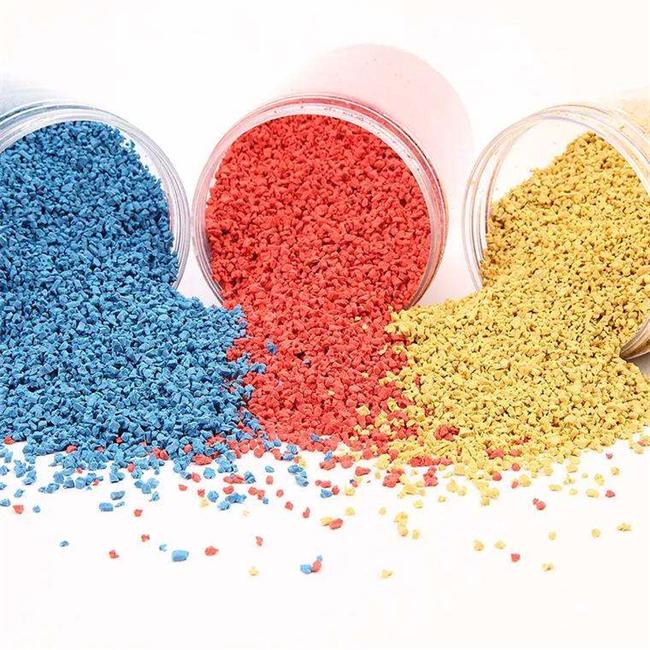
As a playground contractor, sports flooring installer, or procurement manager, you are not just buying a product; you are buying a solution to specific problems. You need to know: What is the best size for this specific job?
This guide provides the technical clarity needed to make that decision. We will look at the specific roles different sizes play, debunk common myths, and highlight the critical quality factors beyond the numbers, such as the revolutionary benefits of sulfur-free, no-odor EPDM technology that extends the life of your project by 3x.

The Three Main EPDM Granule Size Categories and Their Strategic Use
Not all granules are created equal. Generally, EPDM granules are classified into three primary categories. Each exists to solve a specific engineering or aesthetic problem .
Category 1: Fine Granules (0.5 – 1.5 mm) – The Surface Leveler
- The Use: These small granules are ideal for the top layer, especially in the "spray-granule" or "sandwich" system. They create a dense, smooth, and visually rich surface.
- Why It Matters: This size is best for wheelchair accessibility and high-end aesthetics. A 0.5–1.5 mm layer provides a tight seal and high friction coefficient, preventing slips.
- The Trade-off: While providing superior wear resistance for the surface, they do not offer the same impact absorption level as larger granules. They are often used as a top dressing over a thicker base layer.
Category 2: Medium Granules (1 – 3 mm) – The Goldilocks Zone
- The Use: This is the most versatile and commonly used size. It is often specified for general playground surfaces and running tracks.
- Why It Matters: It offers an exceptional balance between cushioning and stability. For a contractor, this size is easy to work with and achieves an optimal compaction rate. According to technical data sheets from industry suppliers, 1-3 mm EPDM exhibits a tensile strength of up to 6.5 MPa, providing the structural integrity needed for general play .
- The Sweet Spot: If the specification does not specifically require a specialized surface, 1–3 mm is often the safest default choice.
Category 3: Coarse Granules (2 – 4 mm) – The Impact Absorber
- The Use: This size is primarily used as an underlayment (base layer) or in areas requiring maximum impact attenuation, such as under the swings or at the bottom of slides .
- Why It Matters: For government procurement and municipal project contractors, critical fall height (CFH) ratings are non-negotiable. Large granules are more compressible, absorbing kinetic energy more effectively. Data shows EPDM systems can achieve critical fall height ratings up to 3.23 m when specified with the right granule size .
- The Strategy: A common engineering trick is to use a 2–4 mm layer for the base to promote drainage and elasticity, topped with a 1–2 mm layer for a smooth, safe finish . This "layering" approach solves the problem of wanting both high impact absorption and a smooth surface.

The Hidden "Why": Solving the Top 5 Customer Pain Points
When contractors or importers search for the best size, they are often masking their fear of a bigger problem. Here is how the right size addresses the industry's deepest frustrations:
Pain Point 1: The Fear of Fall Height Failure
- The Question: "Will this pass the HIC (Head Injury Criterion) test?"
- The Solution: If you need to meet high fall height standards, you cannot rely on a thin layer of 1-2 mm granules alone. You must specify a 2-4 mm base layer or increase the overall depth. The inter-particle voids in coarse granules provide the necessary "crumple zone."
Pain Point 2: The Nightmare of Color Fading and UV Damage
- The Question: "Will this look like a faded parking lot in 6 months?"
- The Solution: This is rarely about the size; it is about the chemistry. However, the size affects how UV stabilizers are dispersed. While 0.5–1.5 mm granules have more surface area per volume, making them potentially more susceptible to oxidation if the polymer is poor. Insist on sulfur-free, peroxide-cured EPDM. The absence of sulfur prevents the breakdown of the molecular structure under UV rays, ensuring that regardless of size, the color stays vibrant for years .
Pain Point 3: The Stench of Odor
- The Question: "Will the playground smell like a tire factory?"
- The Solution: Traditional EPDM granules use sulfur as a vulcanizing agent. Under heat, sulfur releases sulfuric gases. This is where sulfur-free technology is vital. Our granules maintain structural stability, meaning no odor even in high heat. This is crucial for school projects where children are sensitive to smell.
Pain Point 4: Poor Bonding and Delamination
- The Question: "Why is the top layer peeling off after one winter?"
- The Solution: This is a mechanical issue. If you use 2-4 mm granules in a thin top coat, there is less "surface area" for the polyurethane binder to grip. Smaller granules (0.5–1.5 mm) bond more tightly with the adhesive due to higher surface area contact, reducing the risk of delamination.
Pain Point 5: High Costs and Shipping
- The Question: "How do I cut costs without losing quality?"
- The Solution: Bulk density matters. EPDM produced with a high polymer content and low ash content has a lower density. A lower density means you get more coverage per kilogram . Using a high-quality 1-3 mm granule with a polymer content of 20-25% can reduce the total tonnage required.

How to Avoid Costly Procurement Mistakes (The Checklist)
As an importer or purchasing manager, you are not on site mixing the glue. You are managing supply chains. Here is how to avoid common ordering errors:
1. Do Not Assume "One Size Fits All": Verify if the project requires a "two-layer" system. Often, distributors think they need 20 tons of 1-3mm, but the contractor actually needs 15 tons of 2-4mm for the base and 5 tons of 1-3mm for the top.
2. Verify "EPDM Content": Many suppliers sell "EPDM granules" that are mostly filler (calcium carbonate). Look for a polymer content of 20–25% minimum for standard play areas . If the price is too cheap, the polymer content is likely low, meaning the granules will crumble.
3. Insist on Particle Shape: The shape should be "irregular" with "cubical" characteristics . A high-quality granule should have a "cubic shape" with clear "edges" (not too rounded) to interlock properly . Dusty or flat granules lead to weak surfaces.
4. Sulfur-Free Requirement: Ensure the technology used is peroxide-cured, not sulfur-cured . This guarantees the "No Odor" claim and increases the product lifespan from 3-5 years to 8-10+ years.
5. Flexibility on MOQ: As a wholesaler or contractor, you don't want to be forced to buy 50 tons to get a custom color. Modern engineering companies offer No MOQ (Minimum Order Quantity) flexibility to allow you to secure small specialty jobs or test new colors before bulk ordering .

The Technical Edge: Why Sulfur-Free EPDM is Superior
Standard EPDM is often produced using sulfur to cross-link the polymers. However, this creates sulfur byproducts that, over time, cause the granule to "burn" from the inside out, resulting in cracking, hardening, and loss of elasticity.
Our advanced Sulfur-Free, Peroxide-Cured technology changes the game.
- No Odor: Because there is no sulfur content, there is no decomposition into sulfuric acid or gas, even under high-heat UV exposure.
- 3x Longer Life: The molecular structure is stable, offering an increase in service life by more than 300%.
- Enhanced Mechanicals: Tensile strength is boosted to 4–7 MPa (exceeding the standard 4 MPa requirement) , and elasticity is increased to over 400% elongation .
- Bulk Density: Lower density provides more volume per kilogram (approx. 680g/l) , offering better coverage and lower shipping costs.

Summary: Your Decision Matrix
High-Traffic Playgrounds (Under 1.5m fall height): 1 – 3 mm, Best balance of safety, durability, and cost-efficiency.
Critical Fall Height Zones (Swings, Slides): 2 – 4 mm (Base Layer) + 1-2 mm (Top), High impact absorption with a smooth, safe surface finish.
Accessibility/Wheelchair Routes: 0.5 – 1.5 mm, Tight, smooth surface providing high stability and low rolling resistance.
Sporting Runways/Tracks: 1 – 4 mm, Typically 3-4mm for strength and drainage, ensuring consistent "bounce"
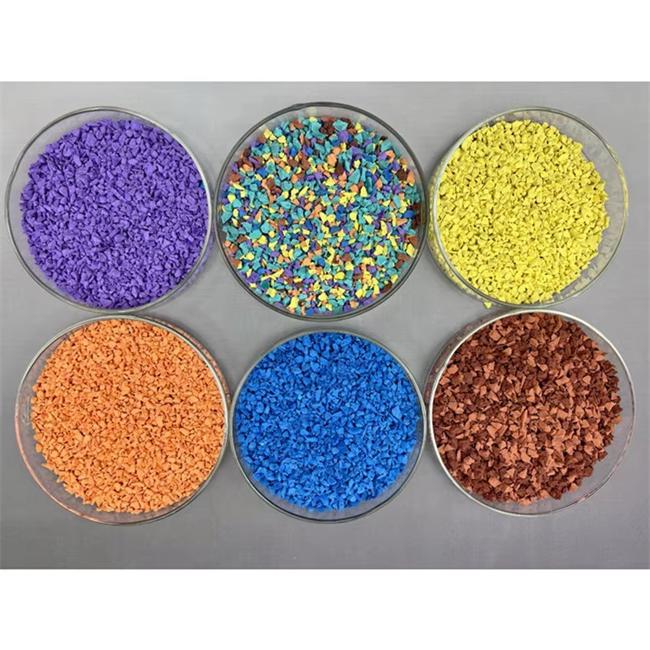
Choosing the "best" EPDM granule size is not about picking one number; it is about solving the engineering challenge of the site. For most general playgrounds, the 1-3 mm size serves as a robust, reliable jack-of-all-trades. For projects requiring peak safety, the 2-4 mm base layer is non-negotiable.
However, a successful project goes beyond the granule size. It requires high polymer content (20%+), a "no-odor" sulfur-free guarantee, and a supplier who understands the contractor's pain points—from low MOQ flexibility to fast, reliable shipping.

Partner with Experience
With over 25 years in the industry, we offer the full spectrum of EPDM granule sizes (0.5–4mm) with custom color matching. Because we operate a full-scale production line and utilize sulfur-free technology, our granules are resistant to fading, odorless, and built to last three times longer than standard alternatives. We are committed to supporting international contractors, importers, and government procurement officers with low minimum order quantities and swift delivery.
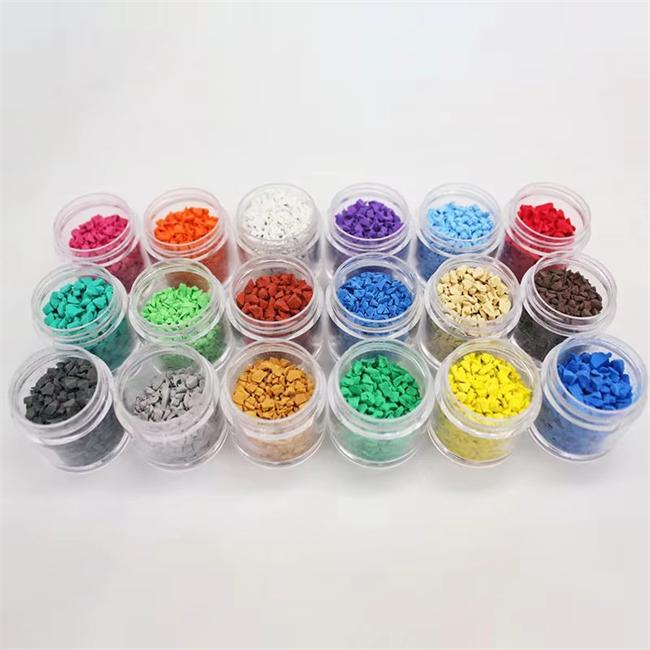
Contact our engineering team today to find the exact technical specification for your next project.
WOW(LYG) New Material Co Ltd is a manufacturer specializing in the production of EPDM rubber granules. We use sulfur-free vulcanization technology, it increases the service life by more than 3 times than traditional EPDM granules, and enhances the performance, including anti-aging, high-temperature resistance, and colorfastness.
We have over 25 years of production experience and offer customization for colors and granule sizes. NO MOQ.


