 注: 建议图片大小150px*50px
丨
注: 建议图片大小150px*50px Views: 0 Author: Site Editor Publish Time: 2026-09-01 Origin: Site


For a standard wet pour rubber surface, you will typically need approximately 5–7 kg of EPDM granules per square meter for a 10 mm wearing course, and about 10–14 kg per square meter for a 20 mm wearing course. If you are calculating for a full two-layer wet pour system — a shockpad base layer plus a wearing course — the total EPDM granule requirement will depend on the thickness of both layers, the target density, and the specific granule size used.
This means that for a 100 m² playground area with a 20 mm EPDM wearing course, you should expect to use roughly 1,000–1,400 kg of EPDM granules for the top layer alone. The base layer, if made with larger SBR or EPDM granules, will require a separate calculation.
The exact amount can vary because wet pour coverage is not determined by granule weight alone. Layer thickness, granule size, binder ratio, compaction, substrate condition, and project wastage all affect the final material requirement.
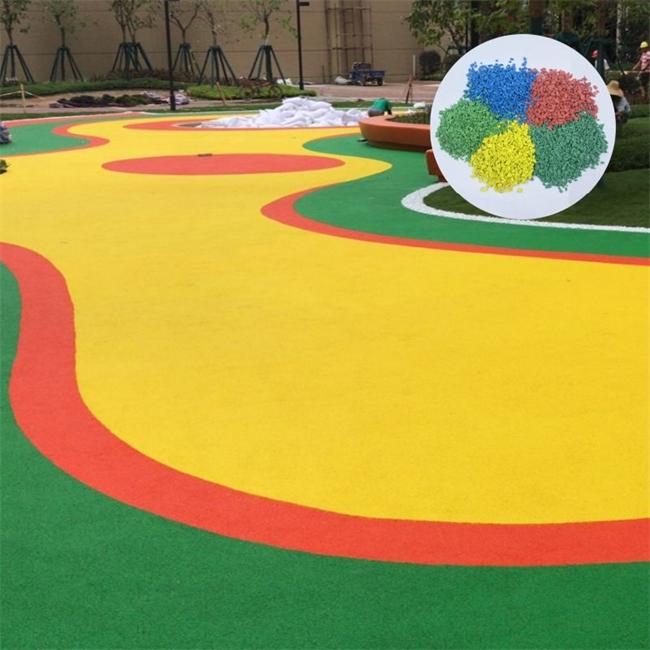
Why EPDM Granule Consumption Varies in Wet Pour Projects
Wet pour rubber flooring is installed by mixing EPDM granules with a polyurethane binder and pouring the mixture onto a prepared base. Once the material is spread, leveled, and compacted, it forms a seamless, impact-absorbing rubber surface. Because the final thickness and density are controlled during installation, the amount of EPDM granules needed is not a fixed number for every project.
Layer Thickness
The most important factor is the thickness of the EPDM wearing course. A thicker layer naturally requires more granules per square meter.
Common wet pour wearing course thicknesses include:
10 mm EPDM layer: often used for lighter-use areas, decorative zones, or projects with a thicker shockpad base
13 mm EPDM layer: frequently used in playgrounds and general recreational areas
15–20 mm EPDM layer: used where higher durability, better impact absorption, or longer service life is required
25–40 mm total system thickness: common in playgrounds, school areas, and sports-related flooring, where the total thickness is usually split between a base layer and a wearing course
If the wearing course is increased from 10 mm to 20 mm, the EPDM granule requirement per square meter will roughly double, assuming the same granule size and installation density.
Granule Size
EPDM granules for wet pour are usually available in different particle sizes, such as 1–4 mm, 2–4 mm, or similar ranges, depending on the supplier and application.
Smaller granules tend to pack more tightly, which can affect:
surface smoothness
binder consumption
material density
coverage per kilogram
final texture and appearance
Larger granules may create a more open structure, which can change how much binder is needed and how the surface compacts. For this reason, granule size should always be considered when estimating material quantities.
Binder Ratio
EPDM granules are mixed with binder before installation. A typical binder ratio may range between 15% and 25%, depending on the granule size, surface requirements, binder type, and installer preference.
If the binder ratio increases, the proportion of EPDM granules in each kilogram of mixed material decreases. This means that binder ratio directly affects how many kilograms of EPDM granules are needed per square meter.
Compaction and Installation Method
Wet pour surfaces are usually screeded and compacted to achieve a uniform thickness. If the surface is compacted more firmly, the same area may require slightly more material to reach the target thickness.
Factors that influence compaction include:
installer technique
troweling method
weather conditions
substrate flatness
target surface density
whether the area has curves, slopes, or detailed patterns
Substrate Condition
A smooth, well-prepared base will generally allow more consistent material distribution. An uneven substrate may require additional material in low areas to achieve a uniform finished thickness.
In some cases, contractors may need to allow extra material for:
surface leveling
edge detailing
pattern work
thickness correction
small losses during mixing and handling
Color Patterns and Design Complexity
If the wet pour surface includes multiple colors, logos, game lines, or decorative patterns, material calculation becomes less straightforward. Patterned areas often require separate mixing batches, and some material may be lost during color changes, tool cleaning, or edge trimming.
For simple single-color areas, estimation is more predictable. For multi-color playground designs, it is usually practical to include a small additional allowance.
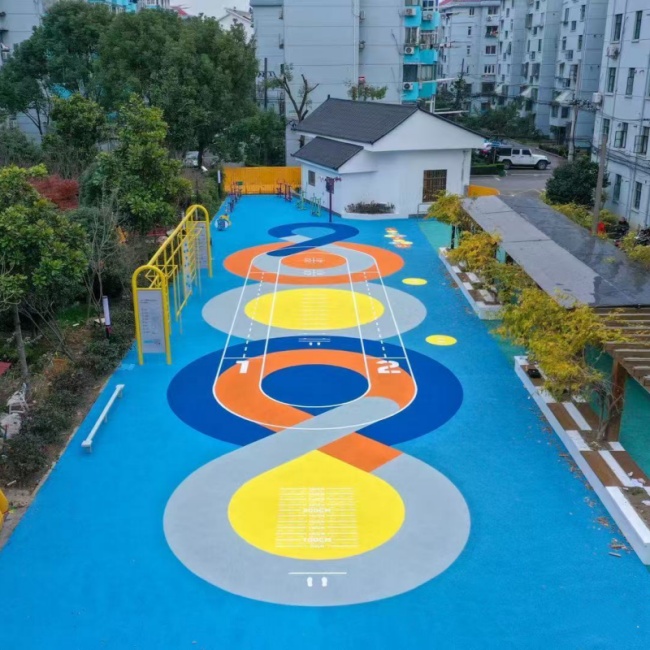
Practical Considerations for Estimating EPDM Granules
When planning a wet pour project, it is better to calculate material needs by area, thickness, and expected density rather than relying only on a single “kg per m²” figure.
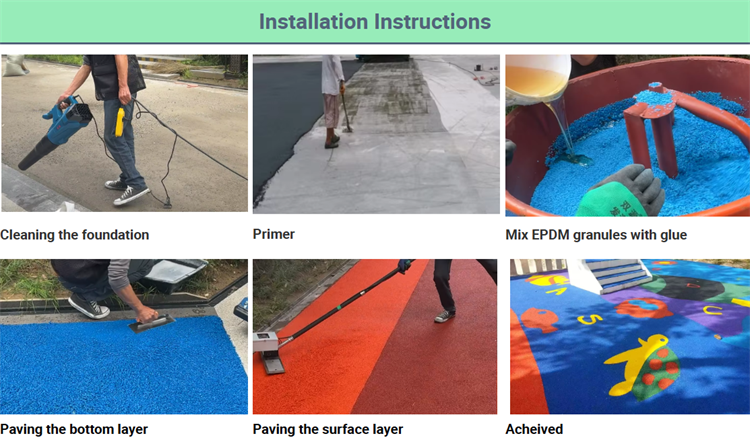
Step 1: Calculate the Total Area
Measure the total surface area in square meters. For irregular shapes, divide the area into smaller rectangles or sections and add the results together.
Step 2: Confirm the Wearing Course Thickness
Decide whether the EPDM layer will be 10 mm, 13 mm, 15 mm, 20 mm, or another thickness. The wearing course is the colored top layer that provides appearance, UV resistance, impact absorption, and surface performance.
Step 3: Check the Granule Size and Specification
Different EPDM granule sizes will produce different coverage rates. Always confirm the particle size range with the supplier before making a final calculation.
Step 4: Confirm the Binder Ratio
The binder ratio should be based on the installer’s system, the granule size, and the performance requirements of the project. This should be confirmed before ordering materials.
Step 5: Add a Wastage Allowance
For most wet pour projects, it is reasonable to include a small wastage allowance. The exact percentage depends on site conditions, pattern complexity, installer experience, and whether the material is being transported and stored on-site.
Step 6: Separate the Base Layer and Wearing Course
If the project uses a full wet pour system, calculate the base layer and wearing course separately. The base layer may use different granule types, sizes, or densities, so it should not be combined with the EPDM wearing course calculation.
How to Choose EPDM Granules for Wet Pour Applications
The amount of EPDM granules needed is only one part of the calculation. The granule specification also affects surface performance, appearance, and long-term durability.
Choose the Right Particle Size
For wet pour wearing courses, the particle size should match the required surface smoothness and layer thickness. Smaller granules are often preferred where a finer, more uniform surface is needed, while slightly larger granules may be suitable for thicker impact-absorbing layers.
Consider Color Stability and UV Resistance
Wet pour surfaces are often used outdoors in playgrounds, school yards, running tracks, sports areas, and recreational spaces. The EPDM granules should be able to maintain color appearance after prolonged exposure to sunlight, rain, and temperature changes.
EPDM rubber is generally valued for its weather resistance and color stability, but performance can vary depending on the raw material quality, pigment system, and manufacturing process.
Check Odor and Environmental Suitability
For schools, nurseries, playgrounds, and indoor-outdoor recreational areas, low-odor EPDM granules are often preferred. Materials produced without sulfur-based components may help reduce odor issues, especially in warm weather or high-UV environments.
Evaluate Elasticity and Impact Absorption
The elasticity of EPDM granules affects the comfort and safety performance of the finished surface. For playgrounds and sports-related areas, the granules should support adequate shock absorption while maintaining surface stability.
Confirm Consistency of Supply
For large projects or phased installations, consistent granule size, color batch, and material performance are important. If different batches vary significantly, the finished surface may show differences in texture, color tone, or installation behavior.
Frequently Asked Questions
How do I calculate EPDM granules for a wet pour playground?
Start by calculating the total area in square meters, then multiply by the expected kg per square meter for your chosen wearing course thickness. For example, a 10 mm EPDM layer may require around 5–7 kg/m², while a 20 mm layer may require around 10–14 kg/m². Always confirm the exact rate with your installer and granule supplier, as binder ratio, granule size, and compaction can change the final requirement.
Does granule size affect how much EPDM is needed?
Yes. Different granule sizes have different packing density and surface area, which can affect binder consumption, layer density, and coverage per kilogram. Always use the consumption rate that matches the specific granule size and installation system.
Should I include wastage when ordering EPDM granules?
Yes. It is practical to include a small wastage allowance for mixing losses, edge trimming, pattern work, substrate leveling, and handling. The exact allowance depends on site conditions and project complexity.
How much EPDM granule is needed for a multi-color wet pour design?
Multi-color designs usually require separate calculations for each color area. You should also allow extra material for color changes, cleaning, and small adjustments. Complex patterns are best calculated by the installer or contractor based on the actual design layout.
Is the base layer calculated the same as the EPDM wearing course?
Not necessarily. The base layer is often thicker and may use different granule types or sizes. It should be calculated separately based on its own thickness, density, and material specification.
Can I estimate wet pour EPDM granules without knowing the binder ratio?
You can make a rough estimate, but the calculation will not be precise. The binder ratio affects how much EPDM granule is included in each mixed batch, so it should be confirmed before final ordering.
What affects EPDM granule consumption most in wet pour installation?
The main factors are wearing course thickness, granule size, binder ratio, compaction, substrate condition, installation method, and design complexity. Among these, layer thickness and granule specification usually have the largest impact.
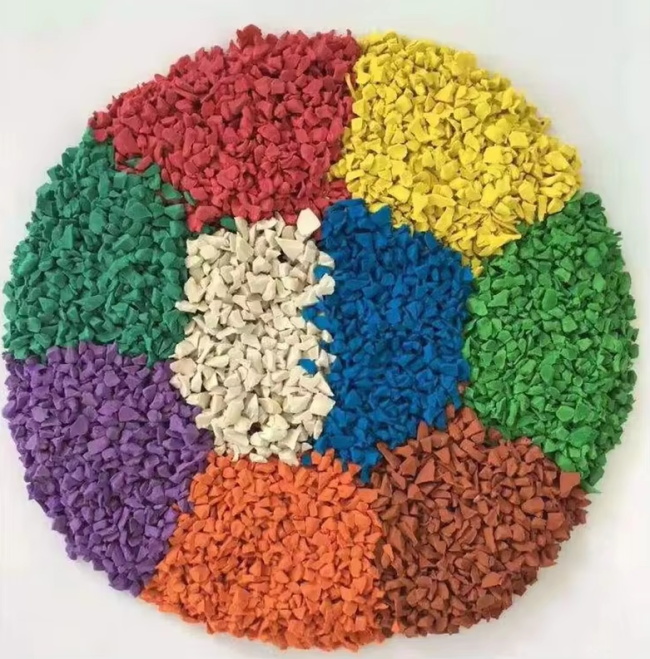
Estimating EPDM granules for wet pour is not just about choosing a single kg/m² figure. The correct quantity depends on the wearing course thickness, granule size, binder ratio, installation method, substrate condition, and whether the surface includes patterns or multiple colors.
For planning purposes, a 10 mm EPDM wearing course typically requires around 5–7 kg/m², while a 20 mm wearing course may require around 10–14 kg/m². These figures should be confirmed with your installer and material supplier before ordering, especially for large or multi-color projects.
If you are planning a playground, sports area, running track, school surface, or other wet pour project and need EPDM rubber granules in a specific particle size, color, or specification, contact us to discuss your project requirements and get a suitable material recommendation.

WOW(LYG) New Material Co Ltd is a manufacturer specializing in the production of EPDM granules. We use sulfur-free vulcanization technology, it increases the service life by more than 3 times than traditional EPDM granules, and enhances the performance, including anti-aging, high-temperature resistance, and colorfastness.
We have over 25 years of production experience and offer customization for colors and granule sizes. NO MOQ.


