 注: 建议图片大小150px*50px
丨
注: 建议图片大小150px*50px Views: 0 Author: Site Editor Publish Time: 2026-08-27 Origin: Site


The EPDM granule size you choose depends on the layer it will be used in and the performance requirements of the project.
For most wet pour rubber surfacing systems:
1–3 mm or 1–4 mm granules are commonly used in the top wearing layer, because they provide a smoother surface, better color consistency, and improved abrasion resistance.
2–5 mm or larger granules are often used in the base or shockpad layer, where thickness, cushioning, and cost efficiency are more important than surface finish.
Smaller granules are preferred for playgrounds, nursery areas, and decorative patterns.
Larger granules are more suitable for running tracks, sports areas, and thicker impact-absorbing layers.
There is no single "best" EPDM granule size. The right choice depends on application, layer function, surface smoothness, safety requirements, binder consumption, and project specification.

Why EPDM Granule Size Matters
EPDM granule size affects both installation performance and finished surface quality. It is not only a visual choice — it influences how the rubber surface behaves over time.
Surface Smoothness
Smaller granules, such as 1–3 mm, create a more even and uniform surface. This is important for areas where children play, walk, or fall, because a smoother surface reduces unevenness and improves comfort underfoot.
Larger granules create a more textured surface. This can be acceptable in sports or running track applications, but may be less suitable for nursery zones or areas requiring a fine decorative finish.
Color Appearance
Granule size affects how color appears on the finished surface.
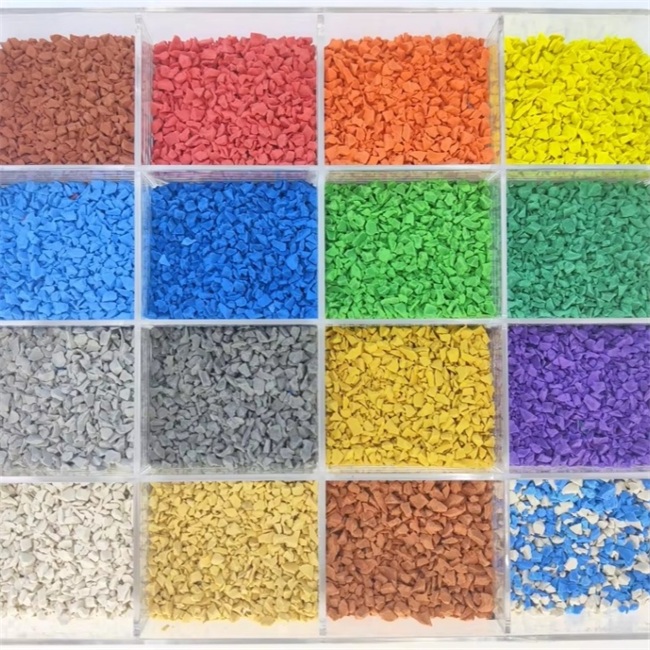
Smaller granules usually give a more consistent and uniform color because there are more particles per square meter. This makes them a better choice for:
Playground safety surfacing
Decorative wet pour designs
Nursery and kindergarten areas
Multi-color patterns and logos
Areas where visual consistency matters
Larger granules may show more natural texture and variation. In some sports applications, this is acceptable or even preferred.
Binder Consumption
Smaller granules have more surface area relative to their volume, so they may require more binder to achieve full coating and proper adhesion.
Larger granules may use less binder per kilogram, but they can create a rougher surface and may not be suitable for fine top layers.
This means granule size should not be chosen based on price alone. The total system cost depends on granule size, binder ratio, layer thickness, mixing method, and installation conditions.
Shock Absorption and Layer Function
In a two-layer wet pour system:
The base layer mainly provides cushioning, shock absorption, and thickness.
The top layer mainly provides wear resistance, color, UV stability, and surface finish.
Because of this, many projects use different granule sizes in different layers rather than one size for the whole system.
Durability and Wear Resistance
The durability of the finished surface depends on more than granule size alone. It also depends on:
EPDM rubber quality
Color stability
UV resistance
Weather resistance
Binder compatibility
Mixing ratio
Installation quality
Site conditions
However, granule size still plays a practical role. A well-graded top layer with consistent particle size usually performs better in high-traffic areas than a surface with irregular or oversized particles.
Practical Considerations When Selecting EPDM Granule Size
If you are specifying EPDM granules for a project, focus on these points rather than choosing a size in isolation.
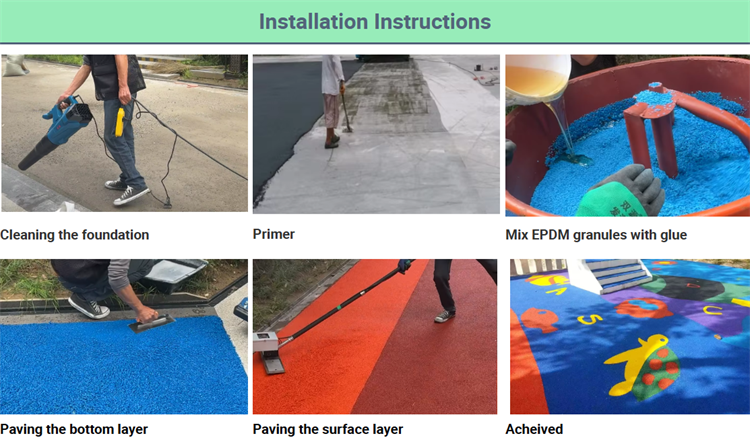
Match the Granule Size to the Layer
Top wearing layer: 1–3 mm or 1–4 mm granules are commonly used here. Their main purpose is to deliver a smooth finish, consistent color, and strong wear resistance.
Base or shockpad layer: 2–5 mm or larger granules are often selected for this layer. Their main purpose is to provide cushioning, build layer thickness, and improve cost efficiency.
Decorative or nursery areas: 1–3 mm granules are usually preferred. They allow fine surface detail, clear pattern definition, and visual uniformity.
Sports or running track areas: 2–5 mm or project-specific granule sizes are typically used. Their main purpose is to meet durability, texture, and performance requirements.
These ranges are common starting points. The final choice should be confirmed based on your project specification and installation system.
Consider the End Use
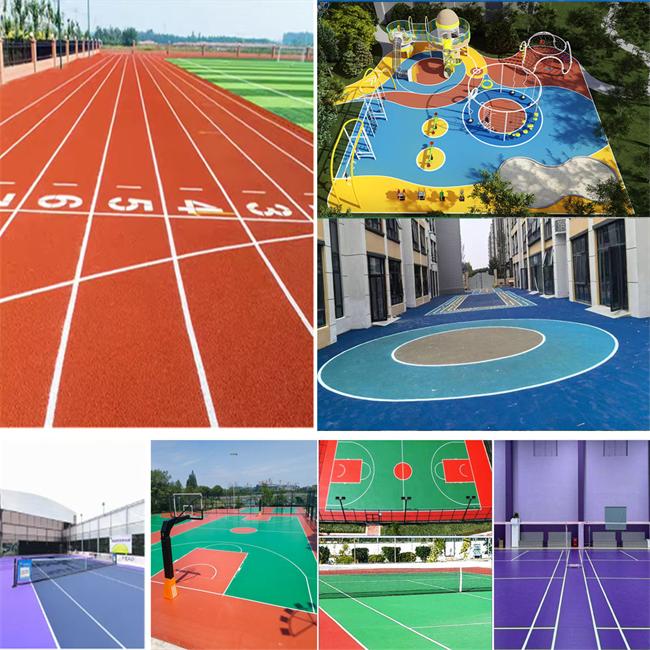
For playgrounds, the surface usually needs to be smooth, safe, colorful, and resistant to UV exposure and foot traffic. Smaller granules are often preferred in the top layer.
For running tracks or sports surfacing, the surface may need more texture, resilience, and durability. Larger granules can be suitable in the base layer, while the top layer should still meet performance and safety requirements.
For wet pour decorative surfacing, smaller granules usually give better pattern definition and color clarity, especially when multiple colors are used.
Check Particle Size Consistency
Consistent granule size helps create a more predictable surface. If the particle size range is too wide or inconsistent, it may affect:
Surface smoothness
Color uniformity
Binder distribution
Mixing efficiency
Installation quality
For procurement purposes, ask for the actual particle size range, not only a general label such as "1–3 mm."
Confirm Color Stability and UV Resistance
Granule size affects appearance, but material quality determines whether that appearance lasts.
Outdoor EPDM surfaces are exposed to sunlight, rain, temperature changes, and foot traffic. For long-term performance, pay attention to:
Color retention
UV resistance
Weather resistance
Oxidation resistance
Elasticity
Odor performance
Compatibility with the binder system
EPDM granules used outdoors should maintain their color and physical performance over time, especially in playgrounds, schools, parks, and sports areas.
Balance Performance, Appearance, and Cost
Choosing the smallest granule is not always the best solution. Choosing the largest granule is not always the most economical one either.
The best choice balances:
Required surface finish
Layer thickness
Safety and performance needs
Color design
Binder consumption
Installation method
Project budget
How to Choose EPDM Granules by Application
Playground Safety Surfacing
For playgrounds, the top layer usually requires:
Smooth surface
Good color consistency
UV and weather resistance
Comfortable underfoot performance
Clear decorative patterns if needed
A common approach is to use 1–3 mm or 1–4 mm EPDM granules in the top layer and a coarser granule in the base layer for shock absorption.
Running Tracks and Sports surfacing
Sports surfaces often require a balance between durability, elasticity, and texture. The base layer may use larger granules to build thickness and cushioning, while the top layer should meet the required performance and wear standards.
The exact granule size should follow the project specification, because sports surfacing requirements can vary significantly.
Wet Pour Decorative surfacing
For decorative wet pour surfacing, smaller granules are usually preferred because they allow:
Cleaner color separation
Better pattern detail
Smoother visual appearance
More consistent surface texture
This makes them suitable for schools, kindergartens, parks, commercial landscapes, and recreational areas.
Nursery and Kindergarten Areas
In nursery environments, surface smoothness, color clarity, and low odor are often important. Smaller EPDM granules help create a fine, even surface, while material quality helps ensure long-term color and performance stability.
EPDM Granules Selection Checklist
Before ordering EPDM granules, confirm the following:
Application type: playground, running track, sports floor, wet pour decorative area, or other
Layer function: top layer, base layer, or single-layer system
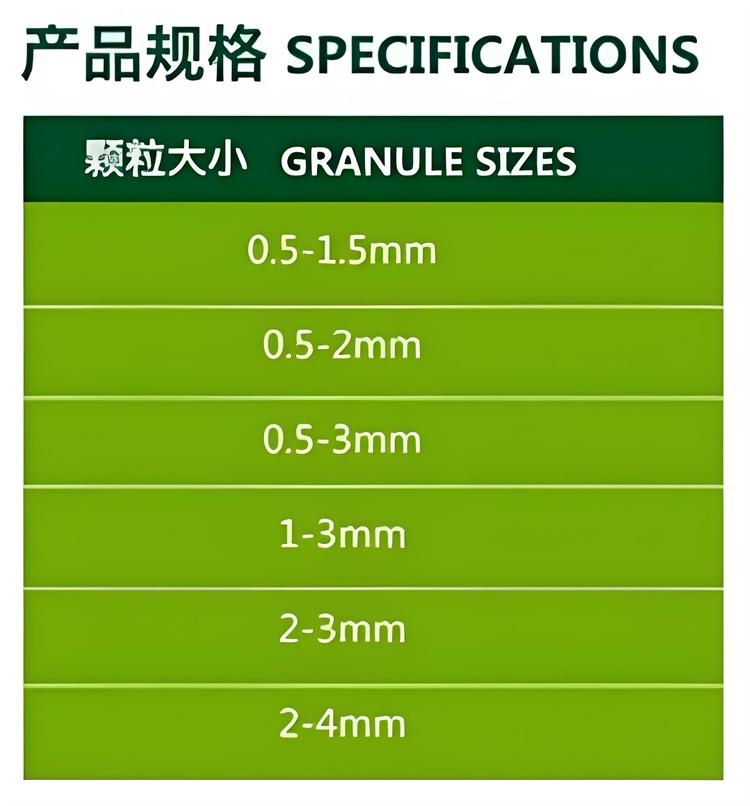
Granule size range: for example, 1–3 mm, 1–4 mm, 2–5 mm, or custom range
Color requirements: single color, multi-color, or custom color matching
Particle size consistency: whether the size distribution meets installation needs
Performance requirements: UV resistance, color stability, elasticity, weather resistance, and odor control
Installation system: binder type, mixing ratio, layer thickness, and site conditions
Project specification: any required safety, performance, or design standards
If you are sourcing EPDM granules for a specific project, it is helpful to share the application, required granule size, color, thickness, and expected usage conditions. This allows the supplier to recommend a more suitable specification instead of selecting granule size alone.
FAQ
Can I use the same EPDM granule size for both the top layer and base layer?
It is possible in some systems, but it is not always the best choice. The top layer usually needs smaller granules for surface smoothness and color consistency, while the base layer often uses larger granules for cushioning and thickness. The final decision should depend on the project specification and installation system.
Does smaller EPDM granule size always mean better quality?
No. Smaller granule size does not automatically mean better quality. It mainly affects surface finish, color uniformity, and texture. Material performance depends on EPDM quality, color stability, UV resistance, elasticity, and installation workmanship.
Which EPDM granule size is best for playgrounds?
For playground top layers, 1–3 mm or 1–4 mm EPDM granules are commonly used because they provide a smoother surface and better color consistency. The base layer may use larger granules for shock absorption.
Does granule size affect binder consumption?
Yes. Smaller granules generally have more surface area, which may increase binder consumption. However, the actual binder ratio depends on granule size, binder type, mixing method, layer thickness, and installation conditions.
Can EPDM granule size be customized?
Many suppliers can provide different particle size ranges depending on the application. If your project requires a specific size distribution, confirm the exact range and tolerance before ordering.
Will granule size affect color fading?
Granule size affects how color appears on the surface, but long-term color fading is mainly related to material quality, UV resistance, color stability, and outdoor exposure. For outdoor projects, color performance should be confirmed separately from granule size.
How do I know if the granule size is suitable for my project?
Check the required surface smoothness, layer function, color design, safety needs, and installation method. If the project has a specification, follow the required granule size range. If not, request samples and confirm suitability before large-scale installation.

Choosing the right EPDM granule size is about matching the particle size to the layer function, application, and performance requirements. For wet pour rubber surfacing, smaller granules such as 1–3 mm or 1–4 mm are usually preferred for the top layer, while larger granules such as 2–5 mm are more suitable for base layers or sports applications.
However, granule size is only one part of the selection process. Surface smoothness, color consistency, UV resistance, weather resistance, elasticity, and installation compatibility are equally important for long-term performance.
If you are selecting EPDM rubber granules for a playground, running track, sports surfacing, or wet pour decorative project, send us your required granule size, color, application, and layer structure. We can help you choose a suitable specification based on your project needs.

WOW(LYG) New Material Co Ltd is a manufacturer specializing in the production of EPDM rubber granules. We use sulfur-free vulcanization technology, it increases the service life by more than 3 times than traditional EPDM granules, and enhances the performance, including anti-aging, high-temperature resistance, and colorfastness.
We have over 25 years of production experience and offer customization for colors and granule sizes. NO MOQ.


