 注: 建议图片大小150px*50px
丨
注: 建议图片大小150px*50px Views: 0 Author: Site Editor Publish Time: 2026-07-19 Origin: Site


You are responsible for specifying or sourcing a playground, sports, or safety surface. Your challenge is ensuring that the final installed surface delivers on safety, durability, and aesthetics, while avoiding project delays, budget overruns, and safety failures. This guide addresses the technical realities, procurement pitfalls, and supplier evaluation criteria for Poured-In-Place (PIP) rubber surfacing, tailored for contractors, importers, distributors, and government procurement officers.

What is PIP Rubber Surfacing?
PIP rubber surfacing is a seamless, in-situ installed two-layer system, comprising a shock-absorbing base layer and a durable, colorful top wearing course.
The base layer typically consists of recycled SBR (styrene-butadiene rubber) buffings bound with polyurethane, providing the critical fall height (CFH) protection. The top wearing course uses high-performance EPDM (ethylene propylene diene monomer) granules bound with a UV-stable resin to create the final slip-resistant, accessible, and aesthetically finished surface.
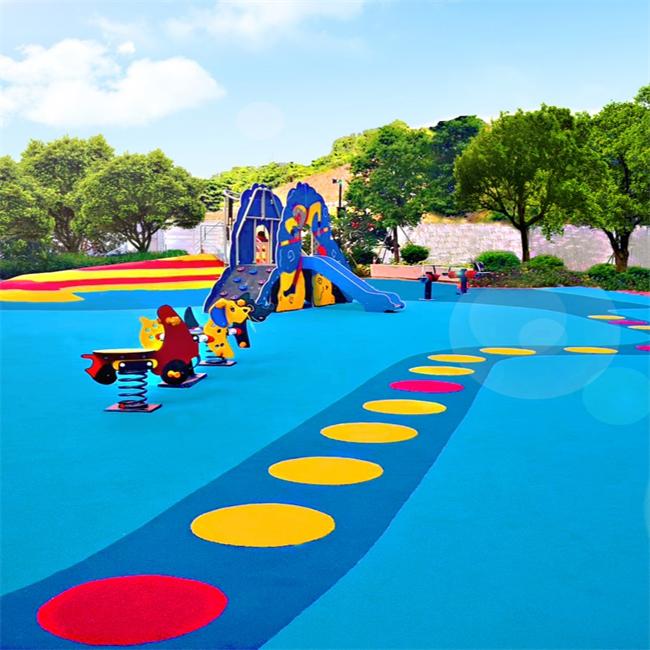
Why PIP Rubber Surfacing? Solving the Core Challenges
The selection of PIP surfacing is often driven by several key project requirements. It stands apart from alternatives like loose-fill mulch or rubber tiles.
Superior Safety Performance: PIP is designed to meet stringent ASTM F1292 standards for impact attenuation. The base layer provides critical fall height protection up to 3.23m (approx. 10.6 feet), reducing the risk of severe injury from falls. Unlike loose-fill materials like wood fiber or sand, which displace and compact over time, PIP maintains a consistent, unitary safety surface.
Guaranteed Accessibility: PIP creates a smooth, stable, and seamless surface that meets ADA accessibility guidelines and ASTM F1951 standards. This is critical for government projects and public spaces, ensuring full accessibility for wheelchairs, walkers, and strollers without the instability of loose-fill materials.
Exceptional Durability and Longevity: A properly installed PIP system can last 10 to 15 years or more, significantly outlasting loose-fill options. Its resistance to weathering, UV radiation, and heavy use makes it a sound long-term investment for public and commercial projects.
Low Maintenance and Total Cost of Ownership: While the initial cost may be higher than some alternatives, the total cost of ownership is highly competitive. PIP requires minimal maintenance—no raking, refilling, or costly repairs common with loose-fill surfaces, which can degrade quickly and require frequent replenishment.
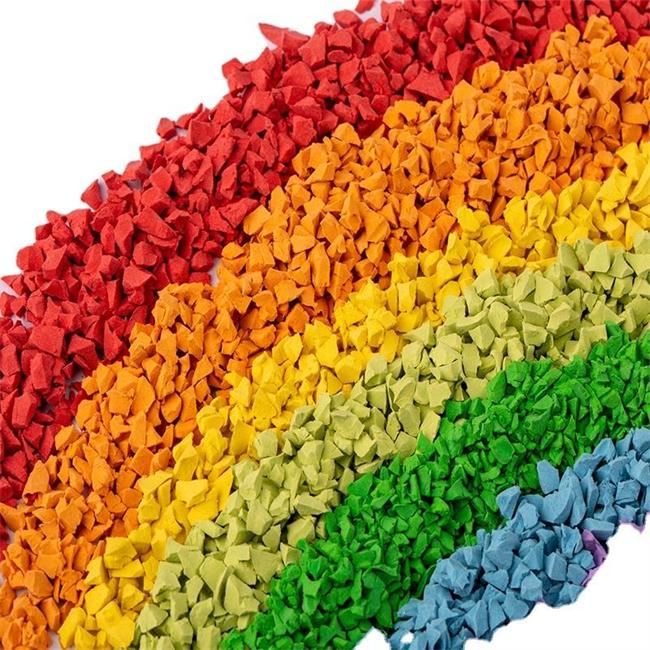
Understanding the Core Components: EPDM, SBR, and Binders
A crucial technical distinction lies in the materials used. The top wearing course must be specified from high-grade EPDM granules.
EPDM (Top Layer): Provides the color, UV resistance, and wear resistance. It is not a single product; its properties are defined by the polymer content and the vulcanization (curing) system used. The color stability and physical longevity of EPDM depend heavily on these factors.
SBR (Base Layer): The recycled rubber base layer is typically black and is designed for impact attenuation and structural support.
Binders: The PU binder can be aliphatic (UV-stable, ideal for lighter colors) or aromatic (more cost-effective for darker colors). Your choice should be dictated by the environmental conditions and desired color longevity.

7 Critical Technical Specifications for EPDM Surfacing
When evaluating bids or issuing RFQs, specification accuracy is non-negotiable. Use these key metrics as your benchmark.
1. UV Resistance & Colorfastness – Standard EPDM often fades within 1-2 years under intense UV exposure. This is a common contractor and project owner complaint. Some advanced EPDM formulations, using non-sulfur curing systems, demonstrate up to 5 times better UV resistance, maintaining color vibrancy and structural integrity over a significantly longer period, virtually eliminating the common concern of surface degradation and aesthetic failure.
2. Tensile Strength & Elasticity – This measures the material's resistance to tearing and its flexibility. Industry standards for high-performance EPDM call for a tensile strength of 4 MPa and an elongation at break of 400%. These properties are critical for the surface to withstand heavy foot traffic, extreme temperature fluctuations, and daily wear without cracking or crumbling.
3. Service Temperature Range – Outdoor surfaces face extreme environments. Choose EPDM that withstands a continuous range of -50°C to 115°C (and up to 150°C intermittently). This ensures the surface remains stable and performs under scorching summer heat or freezing winter conditions, preventing premature failure.
4. Grain Size & Shape – The aesthetics and performance of the surface are influenced by the EPDM granules. Common sizes range from 1mm to 4mm. A lower stacking density and a three-dimensional grain shape provide better interlocking, improving surface cohesion and providing a richer, more textured visual effect.
5. Polymer (EPDM) Content – This determines the amount of pure rubber content in the granule. A specification around 20% polymer content indicates a high-quality granule, ensuring superior durability, elasticity, and longevity.
6. Moisture Permeability – A permeable surface is essential for outdoor applications. Properly designed PIP allows water to drain through, eliminating puddles, reducing slip hazards, and allowing the surface to be used again quickly after rain.
7. Environmental Compliance & Volatile Organic Compounds (VOCs) – For indoor environments or projects with high environmental standards, ensure the product is low-VOC and has no toxic off-gassing. Some advanced EPDM formulations are sulfur-free, achieving near-food-grade safety standards and emitting no odor, which is critical for childcare centers and indoor facilities.

Procurement Strategy: How to Avoid Common Sourcing Mistakes
Buyers face significant risks when sourcing PIP materials. A strategic approach, like the ones detailed in recent supplier guides, is essential.
1. Supplier Verification & Audits
Do not rely on marketing claims. Request:
Third-Party Test Reports: Verify compliance with ASTM, EN, and ISO standards.
Factory Audits: Confirm in-house mixing and curing, material traceability, and quality control processes. Many reputable Chinese manufacturers now offer virtual tours or welcome on-site inspections.
Performance Metrics: Look for objective KPIs like an on-time delivery rate of ≥98% and a client reorder rate above 20%, which indicates satisfaction and reliability.
2. The High Cost of Low Quality
The cheapest quote is often the most expensive in the long run. Low-quality granules can fail in service.
Odor: Products with sulfur-based curing agents can decompose under UV heat, releasing sulfuric gases and creating a persistent, unpleasant odor.
Brittleness: Poor oxidation resistance leads to early embrittlement, cracking, and crumbling, forcing costly repairs or replacement within 2-3 years.
Fading: Inadequate UV stabilizers cause color to fade unevenly within months, degrading the aesthetic value of the installation.
3. Project-Specific Sourcing
Your supplier selection should be guided by your specific needs.
High-Volume & Scalability: For large public infrastructure projects, evaluate suppliers like those in China's Zhejiang and Guangdong provinces, known for mature industrial clusters and high-volume capacity.
Flexibility & Customization: For specialized or pilot projects requiring specific colors, custom granule sizes, or low MOQs, consider suppliers with demonstrated agility and willingness to accommodate lower-volume trials.

Unmatched Performance: The Technical and Commercial Advantages
The EPDM granules offered by advanced manufacturers address the core technical pain points of the industry. These are not just incremental improvements; they represent a significant leap in material science.
No Odor: Through sulfur-free curing technology, the granules do not decompose to release sulfuric gases under heat or UV light. This is a game-changer for indoor applications and high-temperature regions.
3x Longer Lifespan: The stable molecular structure from sulfur-free crosslinking delivers an operational lifespan at least three times longer than conventional sulfur-cured EPDM, ensuring your project meets long-term performance expectations.
2-3x Higher Tensile Strength & Elasticity: Achieving tensile strength in the range of 4–7 MPa, significantly above typical commercial requirements, the material is much more resilient to high-impact forces, heavy foot traffic, and wear.
Superior Antioxidant & UV Resistance: The unique formulation is designed for superior antioxidant properties, ensuring color brilliance and structural integrity for years, regardless of the climate.

For buyers, contractors, and specifiers, the choice of PIP rubber surfacing materials is a critical decision affecting safety, liability, and project ROI. By focusing on precise technical specifications—such as UV stability, tensile strength, and environmental compliance—you can avoid the common pitfalls of premature failure, fading, and costly repairs.

Ready to source premium, high-performance EPDM granules for your next project? Contact us to receive customized quotes, technical data sheets, and samples.
WOW(LYG) New Material Co Ltd is a manufacturer specializing in the production of EPDM rubber granules. We use sulfur-free vulcanization technology, it increases the service life by more than 3 times than traditional EPDM granules, and enhances the performance, including anti-aging, high-temperature resistance, and colorfastness.
We have over 25 years of production experience and offer customization for colors and granule sizes. NO MOQ.


