 注: 建议图片大小150px*50px

丨
注: 建议图片大小150px*50px 


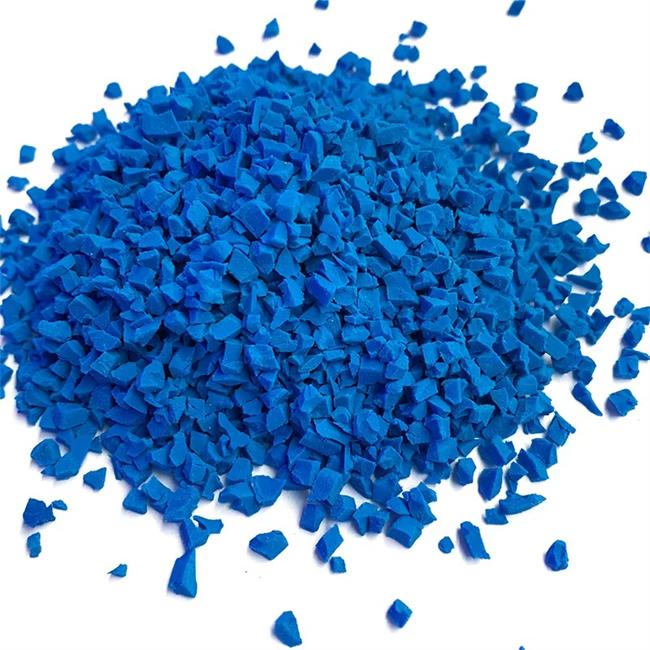
RAL 5017 is a standard Traffic Blue in the RAL color system and one of the high-demand shades in the EPDM granule market, widely used in sports surfaces, playgrounds, and artificial turf infill systems. As a specialized EPDM granule manufacturer, we provide precise customization for RAL 5017 and the full RAL color range. Our EPDM granules are produced using peroxide vulcanization technology. There is no sulfur in our EPDM granules, so they do not decompose into sulfuric acid under high temperatures or intense UV exposure. As a result, they produce no odor, cause no pollution, and are harmless to the human body. Our EPDM granules have excellent property of weather resistance, and are more healthy because we use the method of peroxide sulfidation. There is no sulfur in our EPDM granules, hence it doesn't produce sulfides when exposed to sunlight, no pollution to environment, no odor and no harm to human body. We are one of the highest-quality and most cost-effective EPDM granules in China and the world. We'd like to send free samples for you to test. With over 25 years of industry experience, we focus exclusively on EPDM granule production and do not engage in installation. All of our capacity and R&D resources are dedicated to improving the quality of the granules themselves.
What Core Problems Can EPDM Granules Solve for Users
In the actual operation of sports surfaces and playgrounds, users typically face three core pain points: fading, safety, and maintenance costs. Traditional SBR granules or low-quality EPDM granules visibly lose color within 1–2 years under prolonged UV exposure, causing the surface to look aged, with severe color differences that can even fail to meet competition-level visual standards. As a highly saturated shade in the blue spectrum, RAL 5017 places even stricter demands on color fastness — blue granules made with ordinary processes tend to turn gray or white after outdoor exposure.
Our EPDM granules fundamentally solve this problem. The saturated backbone structure formed by peroxide vulcanization gives the granules outstanding UV and oxidation resistance, with color retention significantly superior to conventional products. At the same time, improved elasticity and tensile strength mean the granules are less likely to pulverize under long-term foot traffic, equipment rolling, and temperature changes, reducing surface hardening and drainage layer clogging caused by granule powdering. For artificial turf systems, the stability of infill granules directly affects the turf's rebound performance and athletic safety. Fine powder formed after low-quality granules pulverize can compact at the base of the grass filaments, disrupting the cushioning consistency of the turf.
Another often-overlooked issue is odor and environmental compliance. Sulfur-containing vulcanization systems may release sulfur compounds under high temperatures and intense UV exposure, producing unpleasant odors — particularly sensitive in indoor venues or semi-enclosed spaces with poor ventilation. Our sulfur-free formula eliminates this concern at the source and meets the strict requirements of international environmental regulations such as REACH for restricted hazardous substances.
Applications and Core Advantages
Main Application Scenarios
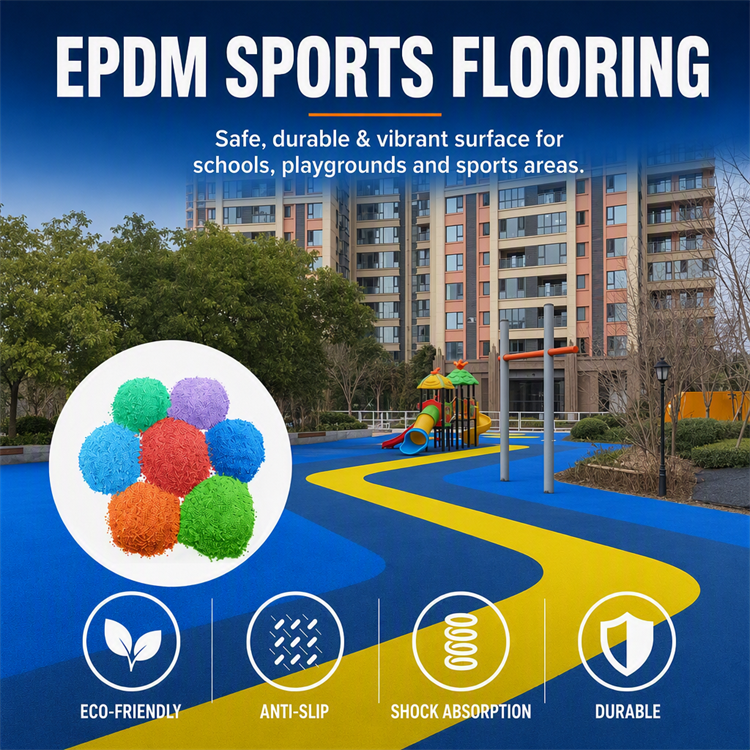
EPDM granules have long moved beyond traditional running tracks. Current mainstream applications include:
Sports surface systems. RAL 5017 blue granules are commonly used for running track surfaces, basketball courts, tennis courts, and color zoning on multi-purpose sports fields. The 1–4 mm particle size is a common specification for surface spray coatings.
Playgrounds and children's activity areas. RAL 5017 blue is often used for safety mats or zoning markers on playground equipment due to its soft visual tone and high visibility. The 2–4 mm particle size provides good impact absorption.
Artificial turf systems. This is a rapidly growing infill application in recent years. Artificial turf requires infill granules to support grass filaments in an upright position, provide foot stability, and regulate surface hardness. With better weather resistance and color durability than SBR, EPDM granules are becoming the preferred infill material for mid-to-high-end artificial turf systems. Football artificial turf typically uses 2–4 mm granules with an infill rate of approximately 6 kg/m². RAL 5017 blue can also be used for zoning on multi-purpose artificial turf courts or decorative turf areas.
Landscaping and municipal engineering. For pathways, rooftop gardens, and tree pit covers, long-term requirements for weather resistance and color performance make EPDM granules a preferred alternative to traditional covering materials.

Core Advantages
Climate Adaptability — Durable Performance Across Different Global Regions
The saturated hydrocarbon backbone of EPDM gives it intrinsic weather resistance. Specifically, across different climate zones:
In the high-temperature and intense UV regions of the Middle East and Africa, granules face dual pressure from extreme thermal aging and photo-oxidation. Our peroxide vulcanization system, combined with high-efficiency UV stabilizers, delivers color fastness levels far exceeding standard requirements in accelerated aging tests. In the hot and humid environments of Southeast Asia and South Asia, EPDM's low water absorption and hydrolysis resistance ensure granules do not degrade or develop mold from prolonged moisture, with color and elasticity recovering fully after the rainy season. In the high-latitude regions of Northern Europe and North America, where winter temperatures can drop below -30°C, EPDM's extremely low glass transition temperature keeps it flexible at low temperatures, preventing embrittlement and cracking that can occur with certain elastomers. For the temperate maritime climate of Northwestern Europe, frequent rain and mild but continuous UV exposure pose a long-term challenge to color stability. Our high color consistency control system ensures minimal color difference between batches, preventing visibly distinguishable color patches during large-area installation.
The Technical Value of Peroxide Vulcanization
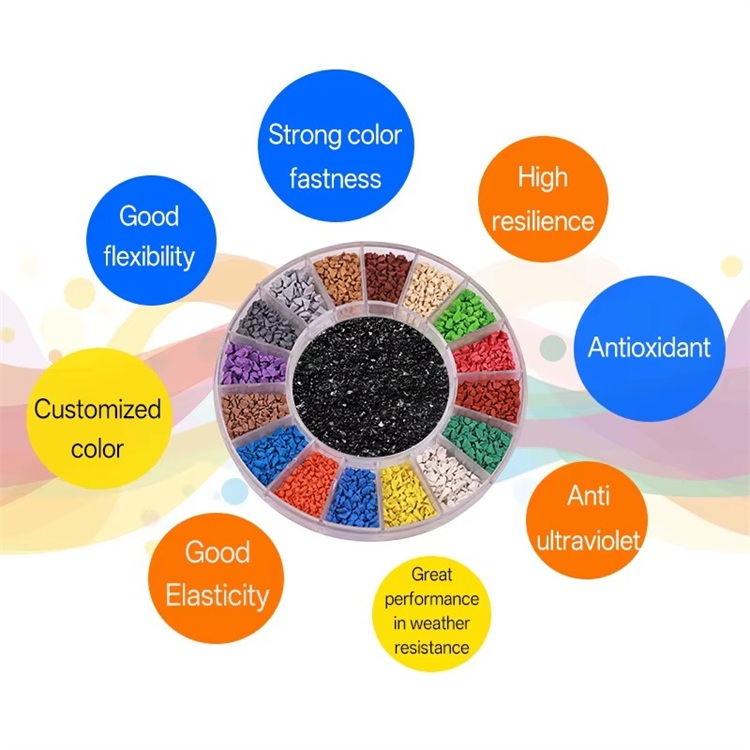
The sulfur-free formula offers more than just environmental and odor advantages. At the molecular level, the C-C bonds formed by peroxide crosslinking have higher bond energy than the C-S bonds of sulfur crosslinking, meaning a lower probability of chain scission under heat, oxygen, and UV exposure. The direct results are: longer service life, higher elasticity retention, and enhanced aging resistance. For users, this translates to lower long-term replacement costs and more stable athletic performance.
Color Customization Capability
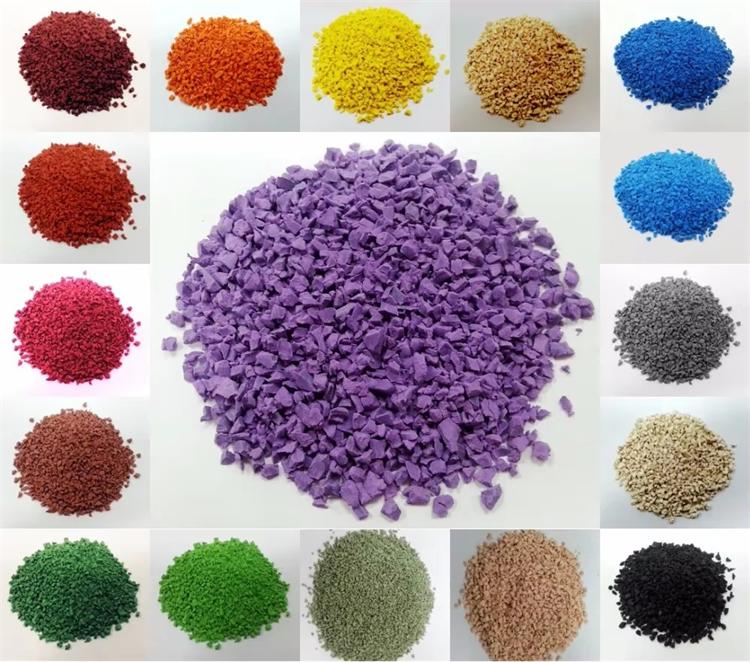
RAL 5017 is just one point in our color system. We support full RAL color range customization, Pantone color matching, customer sample color matching, and multi-color blend solutions. High color consistency control ensures the same color code remains stable across different batches, which is critical for projects requiring phased installation or later repairs.
Frequently Asked Questions
What is the difference between RAL 5017 and Pantone blue? Can RAL color codes be precisely matched?
RAL is a European industrial color standard system, and 5017 is its standard definition of Traffic Blue. We produce according to the RAL color card, with color deviation controlled within commercially acceptable limits. If your project specifies a Pantone color code, we also support Pantone matching. Sample-based customization is also available — you send a color sample, and we produce after color matching confirmation.
How long can EPDM granules last in extremely cold or extremely hot climates?
EPDM has an applicable temperature range of approximately -50°C to 150°C. Under proper installation conditions, the outdoor service life of peroxide-vulcanized EPDM granules can exceed 10 years, with performance retention far superior to conventional products. Specific lifespan is affected by usage intensity, cumulative UV dose, and base layer design. We can provide durability assessment references based on your target region.
What particle sizes do you offer? Can you customize blends?
Standard particle sizes include 0.5–1.5 mm, 1–3 mm, 1–4 mm, and 2–4 mm. Other special specifications can be customized. Different particle sizes suit different processes — fine particles for spray coatings, coarse particles for elastic base layers or artificial turf infill. We also support multi-size blend solutions.
What are the advantages of EPDM granules for artificial turf infill?
Compared to SBR infill granules, EPDM offers better color durability, lower odor release, and superior environmental performance. For high-end football fields, school sports fields, and multi-purpose courts, EPDM infill granules better maintain consistent athletic performance of the turf system and reduce surface hardening caused by granule pulverization.
What is the minimum order quantity? What is the lead time?
We offer flexible MOQs, supporting small trial orders and full-container or LCL shipments. Lead time for standard colors and specifications is relatively short, with slight extensions for special custom colors depending on color-matching complexity. We maintain stable supply capability and support OEM, ODM, and Private Label cooperation models.
How do you ensure batch-to-batch color consistency?
We have established a full-process color control system covering raw material batch management, standardized color-matching processes, and finished product spectrophotometric testing. Samples are retained from each batch for comparison, ensuring visual consistency of the same color code across different orders. For large-area projects, we recommend using the same batch within one area, or following our batch-mixing guidance for installation.
How can I get free samples?
We provide free samples to global customers for testing and evaluation. Simply provide your target color code, particle size specification, and intended use, and we will arrange sample shipment. Physical sample testing is the most direct way to verify color, elasticity, and weather resistance.
Why Choose Us
We are a manufacturing enterprise focused exclusively on EPDM granule production and do not undertake installation work. This means our entire technical accumulation, production line investment, and quality control system are built around one goal: making the granules themselves as good as they can be.
Over 25 years of industry experience has given us deep insight into the differentiated needs of different markets for EPDM granules — European customers' requirements for environmental compliance and color consistency, Middle Eastern customers' demands for extreme weather resistance, and North American customers' expectations for supply chain stability and OEM flexibility. We have a complete set of advanced production lines, with full-process independent control from raw material mixing to vulcanization and granulation, enabling us to be accountable for the elasticity and color of every batch.
On the service side, we support a complete customization chain from RAL/Pantone color customization to different particle size combinations, custom packaging, and full-container or LCL shipments. High color consistency, excellent UV stability, and aging resistance are not marketing slogans but quality control standards embedded in every production stage. We do not make products that are "roughly acceptable" — we only make EPDM granules that withstand third-party testing and long-term outdoor verification.
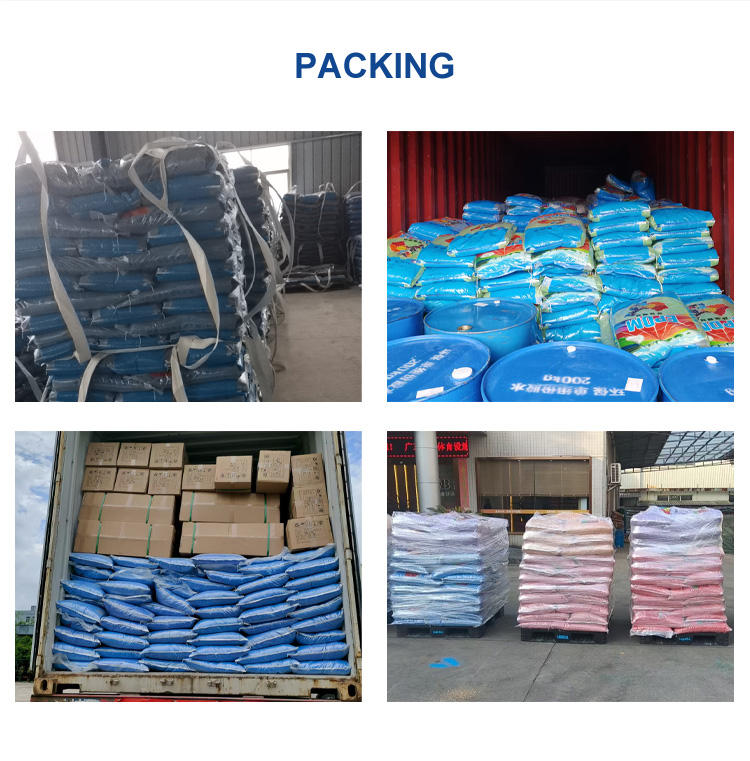
Whether you need bulk procurement of standard RAL 5017 or custom solutions for special colors, particle sizes, or packaging, contact us for free samples and a quotation. We are ready to provide professional and stable EPDM granule supply for your next project.


WOW(LYG) New Material Co Ltd is a manufacturer specializing in the production of EPDM granules. We use the method of peroxide sulfidation technology, it increases the service life by more than 3 times than traditional EPDM granules, and enhances the performance, including anti-aging, high-temperature resistance, and colorfastness.
We have over 25 years of production experience and offer customization for colors and granule sizes. NO MOQ.


