 注: 建议图片大小150px*50px
丨
注: 建议图片大小150px*50px 


Why Every Contractor Is Rethinking Their Running Track Surfacing Strategy
The global running track surfacing market is undergoing a paradigm shift. For decades, project decision-makers—from Playground Contractors to Government Procurement Officers—focused primarily on upfront cost. Today, the conversation has evolved. The real question isn't "how much per square meter?" but "what is the true lifecycle cost of this surface, and will it fail the new environmental standards?"
Every year, poorly executed running track surfacing projects lead to costly litigation, premature replacement, and reputational damage for contractors and suppliers. Clients now demand surfaces that withstand intense UV radiation, extreme temperature fluctuations, and heavy usage—all while meeting stringent global VOC and heavy metal regulations.
This guide, informed by over 25 years of industry expertise, addresses the critical concerns of Sports Surfacing Contractors, Rubber Surfacing Installers, Importers, Distributors, Wholesalers, Purchasing Managers, Construction Companies, Landscape Companies, Municipal Project Contractors, Architects, and Engineers. We will dissect the technology, identify common pitfalls, and provide a framework for selecting a running track surfacing solution that delivers performance, compliance, and profitability.

What Is Running Track Surfacing? Defining the Modern Standard
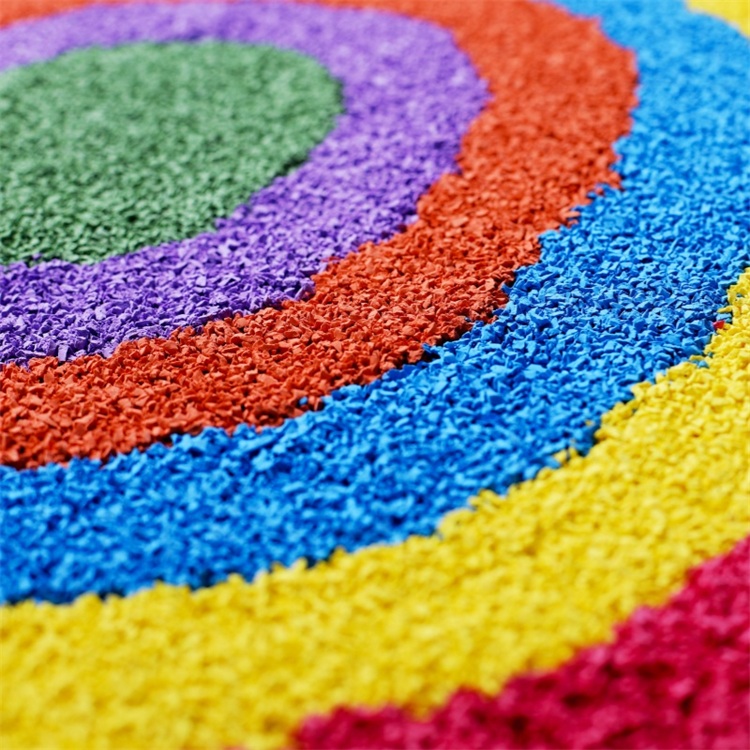
Running track surfacing refers to the layered synthetic system applied over asphalt or concrete bases to create athletic running surfaces. The critical performance layer—the one that interacts with athletes and the elements—is almost universally composed of EPDM (Ethylene Propylene Diene Monomer) rubber granules. These granules are mixed with polyurethane binders and applied as a seamless, shock-absorbing, and slip-resistant wearing course .
While traditional systems often utilized black rubber granules (from recycled tires) for the base layer, modern high-performance running track surfacing employs colorful EPDM granules for the top surface. This is not merely aesthetic. EPDM's molecular structure—a saturated polymer backbone—provides inherent resistance to ozone, UV radiation, and weathering, making it the gold standard for outdoor applications .
The Critical Applications: Where Running Track Surfacing Is Deployed
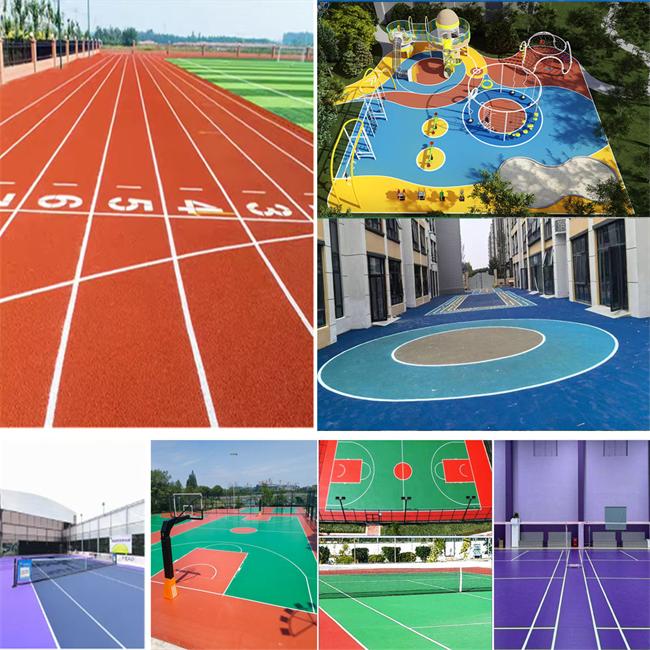
Understanding the application is crucial to selecting the correct product. Different environments impose distinct demands on the surfacing system.
Professional Athletic Tracks & Stadiums
Here, performance and precision are paramount. Running track surfacing must conform to international standards for shock absorption (35%-50%), vertical deformation, and rebound resilience . These surfaces endure high-intensity training and competition spikes, demanding exceptional tensile strength.
School and University Playgrounds
The majority of projects fall into this category. The primary concern is safety coupled with cost-effectiveness. Surfaces must pass GB 36246-2018 (or similar regional standards) with zero tolerance for toxic byproducts. These tracks require surfaces that are durable enough to handle daily physical education classes and community use .
Municipal and Community Parks
Municipal Project Contractors and Landscape Companies often require running track surfacing that integrates with multi-use recreational areas. Here, aesthetics and accessibility matter. The surface must be visually appealing, slip-resistant, and integrated into the broader landscape design.
Playgrounds and Childcare Centers
This is the most demanding application regarding safety and toxicity. Running track surfacing here is not just about running; it's about fall protection. It must provide high impact absorption to prevent injuries in case of falls. The materials must be 100% non-toxic, as children frequently have skin contact with the surface .
Why Use EPDM for Running Track Surfacing? The Case for Performance
The industry's pivot toward EPDM is driven by clear performance advantages over alternatives (like polyurethane or recycled rubber). It is not just "good enough"—it's engineered for longevity.
Unmatched UV Resistance
The primary enemy of outdoor surfacing is ultraviolet radiation. Standard sulfur-vulcanized rubbers degrade under UV, forming sulfuric acid byproducts that cause discoloration, odor, and molecular breakdown . This is the main reason why many tracks lose their vibrant color and flexibility within a few years.
Superior Thermal Stability
EPDM offers excellent resistance to high temperatures, maintaining physical properties even under continuous thermal load . This ensures the track doesn't become "spongy" in summer heat or brittle in winter cold.
Chemical and Ozone Resistance
Unlike natural rubber, EPDM is inherently resistant to ozone cracking, a common failure mode for outdoor rubber products .

The Unseen Advantage: The Power of Sulfur-Free Technology
The quality of EPDM granules varies dramatically. The single biggest differentiator in the market is the vulcanization system. While many manufacturers use sulfur-based curing, advanced manufacturers utilize a sulfur-free, peroxide-cured technology. This is not a minor detail; it fundamentally changes the product's lifecycle.
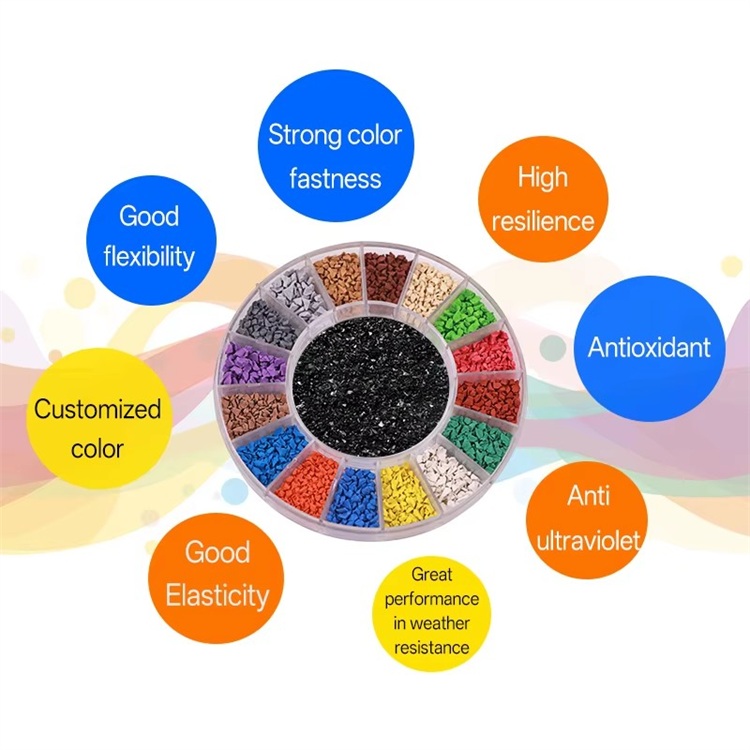
- Zero Odor: Because our sulfur-free EPDM contains no sulfur, it does not decompose to emit sulfuric acid or sulfur dioxide gases when exposed to high temperatures or UV radiation. This eliminates the infamous "rubber track smell" that plagues school playgrounds .
- Enhanced Stability and Longevity: The molecular structure of sulfur-free EPDM is more stable. The carbon-carbon crosslinks formed by peroxide curing are stronger than the sulfur-sulfur bonds in traditional systems. This translates to a lifespan 3 times longer than conventional EPDM granules.
- Exceptional Mechanical Properties: Our granules achieve a tensile strength of 4-7 MPa, which is 2-3 times higher than standard products. This ensures the surface resists tearing, shearing, and heavy foot traffic .
- Color Fastness: The absence of sulfur eliminates a primary cause of chemical reaction with pigments. Our granules maintain color vibrancy up to 5 times longer, with anti-oxidation properties that preserve the aesthetic appeal of the track for decades.
Addressing the Pain Points: Common Problems with Running Track Surfacing
Based on decades of consulting with Contractors and Purchasing Managers, here are the most common failures encountered in the field.
1. Color Fading and Chalking
The Problem: Within 6-12 months, a beautiful red or blue track becomes pale and powdery.
The Cause: Often due to low-quality pigments or sulfur-based polymers that degrade under UV. The powder on the surface is actually degraded polymer.
The Solution: Choose sulfur-free EPDM with high UV stabilizer content and pigment load. Our product retains color vibrancy significantly longer .
2. Premature Delamination and Blistering
The Problem: The surface bubbles or peels away from the base.
The Cause: Moisture vapor transmission from the base layer. If the base is wet or the system isn't breathable, vapor pressure builds up and causes delamination.
The Solution: Proper base construction (asphalt or concrete with adequate curing/drying time) and using a breathable, porous surfacing system .
3. Inconsistent Granule Size and Appearance
The Problem: The track looks patchy or has rough spots.
The Cause: Low-quality manufacturing leads to poor quality control over granule size. Our uniform "cubic" granule shape, combined with low bulk density, ensures a smooth, consistent application and superior aesthetic appeal .
4. Hardening and Loss of Elasticity
The Problem: The track loses its shock-absorbing properties, becoming hard and causing athlete injuries.
The Cause: Material aging due to oxidation and UV degradation, often accelerated by sulfur vulcanization.
The Solution: A high-elasticity, sulfur-free system retains its performance for years, reducing the risk of impact injuries .

How to Choose the Right Running Track Surfacing System
Selecting the correct system involves evaluating your project's specific requirements against the material's performance metrics.
Step 1: Determine Application Requirements
- Professional Use: Demand higher tensile strength (≥ 0.5 MPa) and specific shock absorption. Look for certifications like IAAF (World Athletics) or equivalent local standards .
- School/Community: Prioritize GB 36246-2018 compliance. Check for the absence of PAHs, heavy metals, and other toxins .
- Playgrounds: Focus on safety and non-toxicity. Materials should meet food-grade or similar stringent health standards.
Step 2: Evaluate Material Fundamentals
- Color: Examine the granules. True high-quality EPDM has consistent color throughout the granule. If you cut a granule, the interior should match the exterior .
- Odor: A strong chemical smell indicates high sulfur content or recycled additives. Good EPDM should have almost no odor.
- Elasticity: Squeeze the granules or perform a simple tensile test. They should stretch and rebound instantly, not crumble or break .
Step 3: Verify Supplier Capabilities
- Look for a "Factory" not a "Trader": Ensure the supplier is the manufacturer with "EPDM production" as their core business. This ensures quality control and supply chain stability.
- Check Flexibility: Can they customize colors and sizes (0.5-1.5mm, 1-3mm)? Do they have a Minimum Order Quantity (MOQ)? If you’re a Distributor or smaller Contractor, rigid MOQs can be a deal-breaker. Our model offers flexibility with no MOQ requirements.
- Request Samples: Always request a physical sample. Perform "burn tests" (high-quality EPDM burns slowly with black smoke, leaving a residue; low-quality burns fast ) and test adhesion with your chosen binder.

How to Avoid Costly Procurement Mistakes
Mistakes in procurement often stem from focusing solely on price per kilogram rather than performance per lifecycle year.
Mistake 1: Ignoring the "Hidden" Costs
A cheap granule often requires significantly more polyurethane binder to achieve the same mechanical strength. The cost of the binder is substantial. A cheap granule with high oil absorption can increase your material costs by 20-30% . Furthermore, a 15-year lifespan vs. a 5-year lifespan means significantly higher replacement costs.
Mistake 2: Overlooking Sulfur Content
As outlined above, sulfur-based products will "gift" you with foul odors and rapid fading. Always ask: "Is your EPDM sulfur-free?" If the supplier hesitates, walk away.
Mistake 3: Misunderstanding Density
EPDM granules with a high bulk density are often filled with cheap materials like calcium carbonate. This makes them heavy and often leads to poor dispersion in the mix. Our granules offer lower bulk density with strong "angularity," providing excellent coverage per kilogram and reducing shipping costs.
Mistake 4: Accepting Batch Variation
When buying in bulk, ask if the color will be consistent across batches. We operate automated production lines to ensure ΔE (color difference) is minimal, ensuring your track is a uniform color, not a patchwork of different shades .
Why Increasingly More Projects Choose Advanced EPDM
The shift in the industry is undeniable. It's driven by a combination of factors that savvy contractors and engineers are prioritizing.
The EEAT Factor: Regulators and architects are looking for materials with a proven track record. Our 25+ years of industry experience, combined with full-scale production lines, tell a story of reliability and technical depth. We aren't a trading company; we are engineers who understand the chemistry of long-lasting surfaces.
Sustainability: Longer lifespan means less material goes to landfill. A surface that lasts 15 years is inherently more sustainable than one replaced every 5. Our sulfur-free products also reduce the environmental burden associated with emissions and toxic runoff.
Global Compliance: For Importers and Wholesalers handling international projects, having a product that easily meets global standards (RoHS, REACH, etc.) simplifies logistics and compliance.
Return on Investment (ROI): For Municipal Project Contractors and Government Procurement, the decision isn't just about capital expenditure; it's about public safety and asset management. A superior surface reduces maintenance costs and protects the public from injury, delivering an exceptional ROI for the taxpayer.

The Definitive Checklist for Running Track Surfacing Procurement
For ease of reference, here is a checklist for your next project:
1. Specify Sulfur-Free:
2. Require Tensile Strength ≥ 4 MPa:
3. Demand Color Stability:
4. Request a Physicochemical Data Sheet:
5. Verify the Manufacturer:
6. Negotiate MOQ:
7. Establish a Sample Testing Protocol:
8. Schedule a Factory Visit (or Virtual Tour):

Partnering for Success
The selection of running track surfacing is a decision that impacts athletes, children, communities, and your company's reputation. By understanding the intricacies of EPDM technology—particularly the vital importance of sulfur-free systems—you can ensure your project stands the test of time, the elements, and the scrutiny of regulatory bodies.
We provide solutions tailored to the needs of Playground Contractors, Importers, and Government Agencies. With no minimum order quantity and full customization capabilities, we are positioned to help you win and deliver your next project successfully.

WOW(LYG) New Material Co Ltd is a manufacturer specializing in the production of EPDM rubber granules. We use sulfur-free vulcanization technology, it increases the service life by more than 3 times than traditional EPDM granules, and enhances the performance, including anti-aging, high-temperature resistance, and colorfastness.
We have over 25 years of production experience and offer customization for colors and granule sizes. NO MOQ.


