 注: 建议图片大小150px*50px
丨
注: 建议图片大小150px*50px Views: 0 Author: Site Editor Publish Time: 2026-08-05 Origin: Site


For sports surfacing contractors, playground installers, and municipal project managers, selecting the right sports surface materials is the most critical decision affecting project longevity, safety, and overall client satisfaction. Among the available options, EPDM rubber granules have emerged as the preferred choice for high-performance wet pour playground surfacing, running tracks, and poured-in-place rubber systems globally.
This guide draws on decades of manufacturing expertise to address the real challenges contractors face: color stability, UV resistance, material selection, supplier reliability, and cost control. Whether you are specifying materials for a school playground in Australia, a municipal running track in Europe, or a commercial splash pad in the Middle East, understanding the technical nuances of EPDM granules will directly impact your project’s success.
What Are Sports Surface Materials?
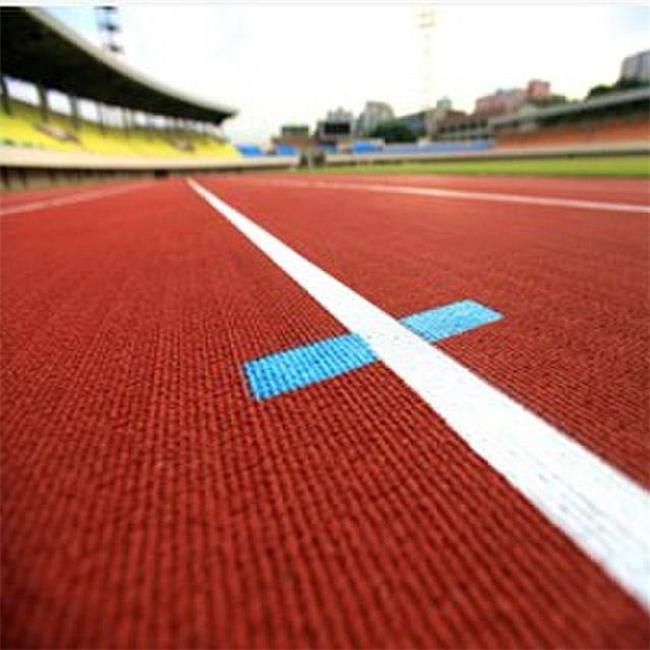
Sports surface materials encompass the specialized compounds used to create durable, safe, and high-performance athletic and recreational surfacing systems. These materials range from polyurethane binders to rubber infills and top-layer granules. Among these, colored EPDM rubber granules serve as the wearing course—the visible, functional top layer that provides traction, shock absorption, and aesthetic appeal.
EPDM (Ethylene Propylene Diene Monomer) is a synthetic rubber renowned for its exceptional weather resistance, UV stability, and elastic properties. In sports surfacing applications, EPDM granules are mixed with a polyurethane binder and troweled onto a prepared base, creating a seamless, permeable surface that meets international safety standards .

Key Applications for EPDM Sports Surfacing
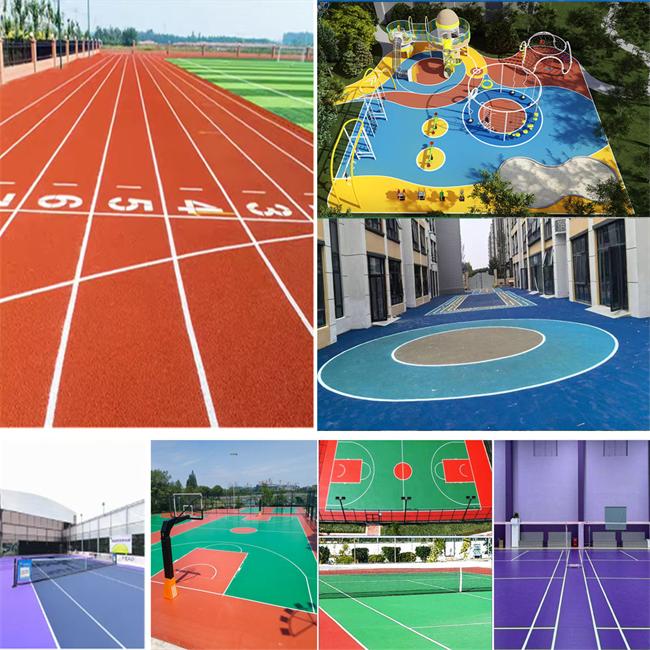
EPDM granules are incredibly versatile. Our clients use them across a broad spectrum of projects:
- Playgrounds & Kindergartens: Critical fall-height protection and vibrant, engaging colors for children's safety surfaces.
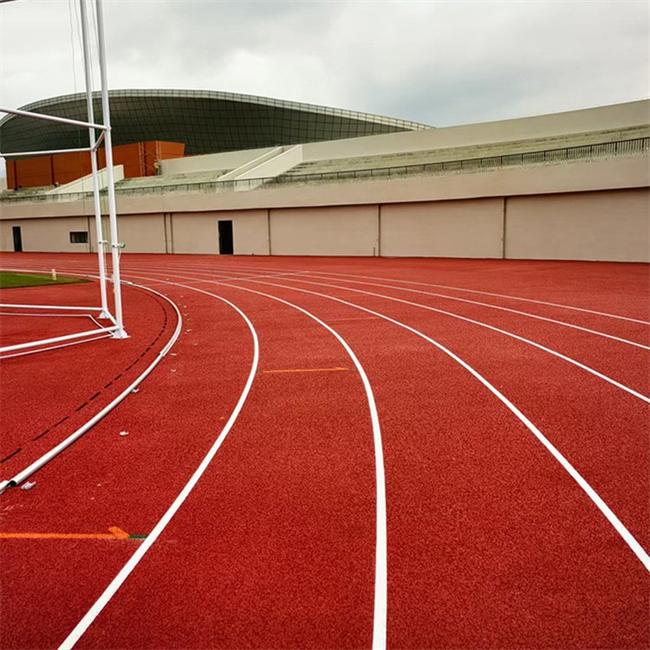
- Running Tracks & Athletic Facilities: High-performance, shock-absorbent surfaces for schools, universities, and professional stadiums.
- Wet Pour Rubber & Poured-in-Place (PIP) Systems: Seamless, porous safety surfacing ideal for public parks and recreational areas.
- Walking Paths & Landscaping: Durable, aesthetically pleasing pathways that integrate with outdoor environments.
- Splash Pads & Water Play Areas: Slip-resistant, UV-stable surfaces that withstand continuous water exposure.
- Commercial & Municipal Projects: Durable surfacing for high-traffic public spaces requiring both safety and visual appeal.
Why Choose EPDM Over Alternative Sports Surface Materials?
A common question contractors face is the choice between EPDM and SBR (Styrene-Butadiene Rubber) granules. This decision directly impacts both project cost and long-term performance.
EPDM is a virgin, synthetic rubber prized for its durability and color retention. It is the material of choice for the top, visible layer because it withstands prolonged UV exposure without significant fading or degradation. Studies confirm that EPDM surfaces demonstrate excellent performance in slip resistance, abrasion resistance, and tensile strength, making them a preferred material for safety-critical applications .
SBR, in contrast, is primarily recycled rubber from tires. While cost-effective as an infill or base layer, SBR offers limited color options and will fade and degrade when exposed to direct sunlight due to its lower UV resistance.
For contractors, this means:
- EPDM: Higher upfront cost, but superior longevity, color stability, and safety performance (ideal for visible top layers).
- SBR: Lower cost, suitable for base layers or budget-sensitive indoor applications, but not recommended for visible outdoor surfaces.
Common Challenges with Sports Surfacing (And How to Solve Them)
1. Color Fading and UV Degradation
A primary concern for contractors is the long-term appearance of the surface. Low-quality EPDM granules will fade within 1-2 years, leading to client complaints and reputational damage. High-quality EPDM, manufactured with UV-stable inorganic pigments and sulfur-free technology, retains its vibrant color for 8 years or more under normal weather conditions .
2. Odor Issues
Many playgrounds and sports surfaces emit a strong "rubber smell" in hot weather, particularly those using traditional sulfur-based vulcanization. This occurs because sulfur breaks down under heat and UV rays, releasing sulfuric compounds. Sulfur-free EPDM granules eliminate this issue entirely, ensuring a safe, odor-free environment even under intense sunlight.
3. Material Consistency and Mixing
Inconsistent granule size leads to uneven surfaces, affecting both playability and safety compliance. Professional installers know that precise granule sizing—whether 0.5-1.5mm for thin coatings or 2-4mm for standard wearing courses—is essential for achieving the correct PU binder ratio and a consistent finish.

How to Choose the Right EPDM Granules for Your Project
Selecting the correct material involves evaluating several critical factors:
1. granule Size
- 0.5-1.5mm: Fine granules ideal for thin coating layers, spray-applied finishes, and detailed decorative patterns.
- 1-3mm: The most versatile size, suitable for most playground and sports surfaces where a balance of texture and smoothness is required.
- 2-4mm: Standard size for general wet pour applications, running tracks, and areas requiring greater impact absorption.
- 3-5mm: Coarse granules for heavy-duty surfaces, high-traffic areas, and base layers.
2. Polymer Content
Higher polymer content generally translates to better elasticity, tensile strength, and long-term resilience. Professional spec sheets will typically list tensile strength (MPa) and elongation at break (%) to indicate material quality.
3. Color Customization
Architects and landscape designers increasingly demand precise color matches. The best suppliers offer customization based on RAL or Pantone color codes, ensuring brand consistency and design integrity across multi-phase projects.

Technical Specifications: What to Look For
A reliable manufacturer should provide transparent technical data. Key parameters to check on TDS (Technical Data Sheets) and COAs (Certificates of Analysis) include:
- Tensile Strength: Indicates the material’s resistance to tearing and wear. Higher values (e.g., >4 MPa) suggest superior durability.
- Bulk Density: Affects coverage rates. Lower density materials can reduce overall material consumption.
- Hardness (Shore A): Typically in the 55–65 range for sports surfaces, balancing comfort and resilience.
- UV/Weathering Resistance: Long-term color retention and mechanical property retention under accelerated aging tests.

Manufacturer Insights: Expert Advice on Material Selection
From our manufacturing facility to your job site—we have produced EPDM granules for projects across Europe, North America, Australia, and the Middle East. Here is our professional advice:
- For longevity: Always specify 100% virgin EPDM with sulfur-free technology. This upgrades the molecular structure, resulting in a 3X increase in service life, enhanced elastic recovery (tensile strength reaching 4–7 MPa), and vastly improved color retention.
- For moisture management: In wet climates or splash pad applications, ensure the granules have a high-performance UV stabilizer package to maintain integrity in both hot and cold extremes.
- For cost control: Avoid the hidden costs of cheap materials. Low-cost granules often mean low polymer content or recycled fillers, leading to rapid fading, crumbling, and early replacement.
- For compliance: Always request SGS, REACH, or EN71 test reports to verify the material is non-toxic, heavy metal-free, and safe for children and pets .

Why Global Contractors Choose Our EPDM Granules
As a specialized manufacturer and exporter, our entire production line is dedicated solely to EPDM granules. This focus allows us to deliver unmatched quality and customization.
We understand that each project has unique requirements. Our expertise extends to:
- OEM, ODM, and Private Label Services: We produce granules under your brand with custom packaging.
- Precise Color Matching: From RAL and Pantone standards to custom client samples.
- Flexible Sizing: Our advanced processing ensures precise cuts, offering a distinct three-dimensional surface structure for better adhesion.
- Flexible Logistics: We accommodate full-container loads, LCL (Less than Container Load) shipments, and orders with no minimum quantity (MOQ), ensuring supply chain flexibility.
- Complete Technical Support: We provide TDS, MSDS, COA, and SGS test reports to streamline project approvals.
Our Quality Commitment:
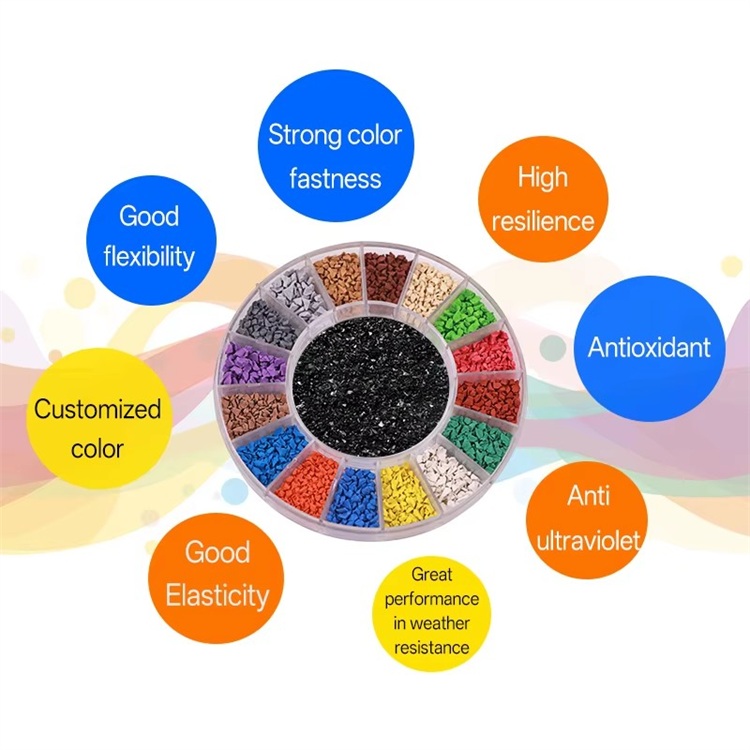
Our sulfur-free EPDM granules are odorless, environmentally safe (meeting food-grade standards), and feature a lower bulk density for better coverage. With over 25 years of industry experience, we deliver rapid turnaround times and consistent quality for international projects.
Frequently Asked Questions (FAQ)
Q1: What is the difference between EPDM and SBR granules?
EPDM is a virgin, synthetic rubber offering superior UV resistance, color stability, and durability—ideal for top-layer surfaces. SBR is recycled rubber, cost-effective, but prone to fading; it is best used as an infill or base layer, not for visible surfaces .
Q2: How long does the color last on EPDM sports surfaces?
With high-quality, UV-stable pigments, EPDM retains its vibrant color for over 8 years under normal outdoor conditions. Extreme, direct sunlight may cause gradual fading, but the structural integrity remains intact .
Q3: What size EPDM granules should I choose?
Size depends on the application. 1-3mm is the most versatile for playgrounds and tracks. 0.5-1.5mm is used for thin coatings and spray applications, while 2-4mm is preferred for standard wet pour surfaces and heavy-duty areas.
Q4: Are EPDM granules safe for children and pets?
Yes. Reputable EPDM granules are non-toxic, heavy metal-free, and lead-free. Our sulfur-free formulation also means they do not release harmful sulfuric gases, even under high temperatures .
Q5: How much PU binder do I need?
The binder ratio typically ranges from 6:1 to 8:1 (granules to binder) depending on the specified tensile strength and granule size. Your supplier should provide specific mixing guidelines for the product.
Q6: What certifications should I ask for?
Request SGS testing, EN71 (safety of toys), REACH compliance, or ASTM test reports. These confirm the material meets international safety and environmental standards .
Q7: Can you customize EPDM colors for my project?
Yes, we support full-color customization via RAL and Pantone matching, as well as custom samples provided by clients. We also offer private label packaging for brand owners.
Q8: What is the typical lifespan of an EPDM surface?
A high-quality EPDM surface generally lasts 8 to 12 years. Lifespan is influenced by polymer content, UV intensity, frequency of use, and maintenance .
Q9: How do I prevent EPDM from fading?
Choose granules with high-quality, UV-stable inorganic pigments. Lower-priced products often use organic dyes that degrade in sunlight. Also, ensure proper installation with the correct PU binder ratio to secure the color layer.
Q10: Why do some EPDM granules have an odor?
Odor is typically caused by sulfur-based vulcanization agents used in traditional manufacturing. Sulfur-free EPDM eliminates this issue, ensuring a safe, odorless surface .
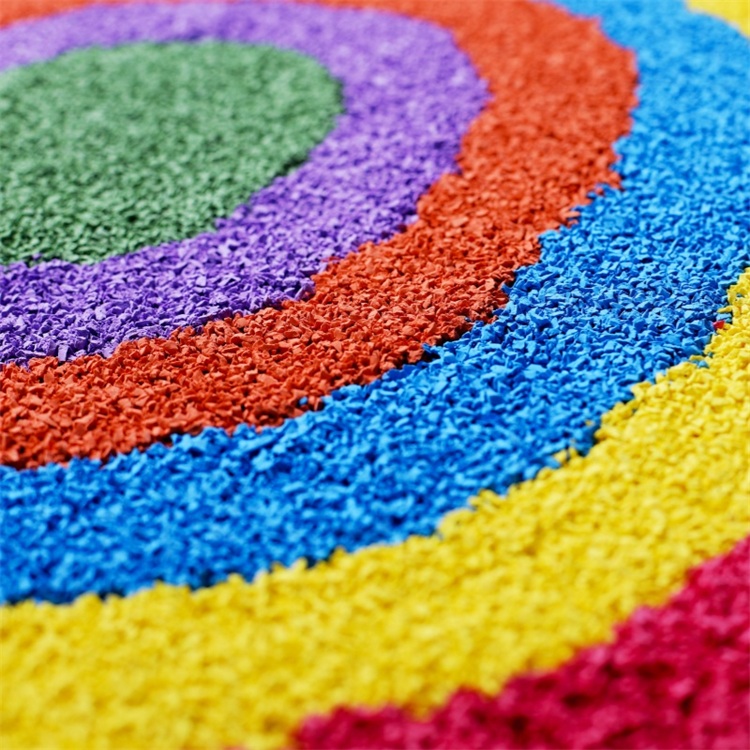
Selecting the right sports surface materials is a decision that balances upfront cost against long-term performance, safety, and aesthetics. For contractors and project managers, choosing a manufacturer with deep technical expertise is not just about buying materials—it is about ensuring the success and reputation of every project.
By prioritizing high-quality, UV-stable EPDM granules with proven performance, you minimize risk, satisfy client expectations, and deliver surfaces that stand the test of time. For a reliable partnership, look for a manufacturer that offers transparency on technical data, flexibility in customization, and a commitment to quality that aligns with your professional standards.

WOW(LYG) New Material Co Ltd is a manufacturer specializing in the production of EPDM rubber granules. We use sulfur-free vulcanization technology, it increases the service life by more than 3 times than traditional EPDM granules, and enhances the performance, including anti-aging, high-temperature resistance, and colorfastness.
We have over 25 years of production experience and offer customization for colors and granule sizes. NO MOQ.


