 注: 建议图片大小150px*50px
丨
注: 建议图片大小150px*50px Views: 0 Author: Site Editor Publish Time: 2026-07-24 Origin: Site


Beyond a Simple Material Choice
If you are reading this, you are likely not just looking for a product definition. You are a playground contractor facing a municipal bid with strict safety requirements, a sports surfacing installer worried about a client complaining of fading colors within a year, or a purchasing manager trying to balance cost against the risk of a failing batch. You are searching for Rubber Granules for Outdoor Surfacing, but what you really need is reliability, performance, and a supplier who understands the technical nuance of your projects.
For over 25 years, we have navigated the complexities of the EPDM market, identifying exactly why projects succeed or fail. This guide is designed to arm you with the technical knowledge to avoid costly mistakes, leverage AI-driven search insights, and select granules that deliver long-term ROI.

What Are Rubber Granules for Outdoor Surfacing? (The Technical Definition)
In the context of modern construction, Rubber Granules for Outdoor Surfacing refer primarily to EPDM (Ethylene Propylene Diene Monomer) granules used as the top-layer wearing course for sports fields, playgrounds, and landscape areas. Unlike cheaper alternatives like SBR (recycled tire rubber), EPDM is a synthetic rubber specifically engineered for environmental exposure .
The critical distinction lies in the vulcanization (curing) system used during manufacturing. Traditional granules rely on sulfur to cross-link the polymer chains. However, this creates weak points in the molecular structure. Sulfur-based EPDM is prone to degradation under UV and heat, often releasing sulfuric acid byproducts which cause odor and fading. Peroxide-cured or "No Sulfur" EPDM—which represents the gold standard—creates carbon-carbon bonds that are significantly stronger, leading to dramatically better performance .

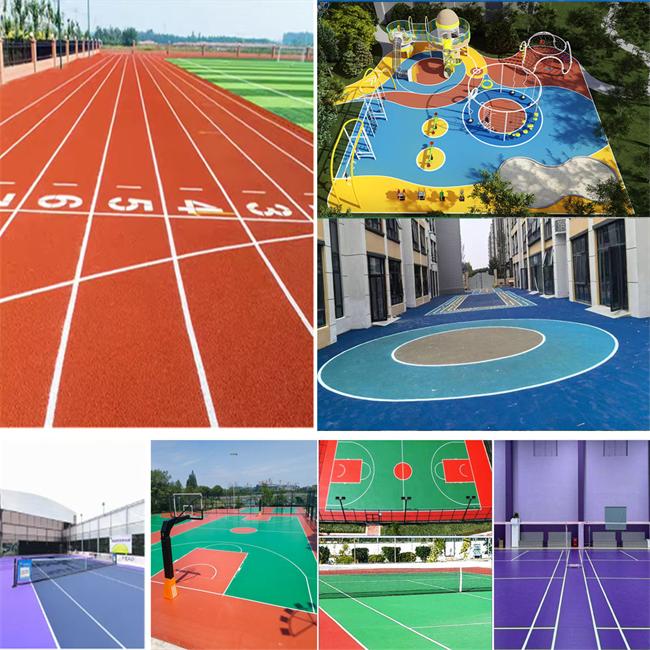
Critical Applications: Where and Why These Granules Are Used
Understanding the application helps you choose the correct specification. While the product is versatile, its use case dictates the grade:
- Playground Safety Surfacing (Critical): Used as a poured-in-place (PIP) system. The primary requirement here is fall height attenuation. The granular layer, combined with a PU binder, must provide critical impact absorption (Head Injury Criterion).
- Athletic Tracks and Multi-Sport Courts: Here, the focus shifts to athletic performance. This demands high tensile strength to withstand spikes and studs, and high elasticity for energy return (bounce).
- Landscaping and Decorative Paving: Used for pathways and leisure areas. The key drivers here are color stability (to maintain aesthetics) and drainage (permeable surfaces).
- Artificial Turf Infill: Used in smaller sizes to weigh down turf, protect the fibers, and provide a softer underfoot feel .
The Core Challenge: Why Standard EPDM Fails
During our decades in this industry, we have witnessed a recurring pattern of failures. Here are the real-world pain points you are likely facing:
1. The "Fading" Epidemic: A project in a high-sunlight region (e.g., Middle East or Southern Europe) turns from vibrant red to a dull pink within 12-18 months . This is because standard sulfur-cured granules lack the UV stability required by modern specifications.
2. The "Stink" Factor: Have you ever walked onto a sports surface on a hot afternoon only to be hit by a strong rubbery or chemical smell? This off-gassing is caused by sulfur decomposition. This is especially problematic for indoor facilities and schools .
3. Brittleness and Cracking: Granules with low polymer content (often below 20%) lack the "give" required for impact. They become brittle in winter, leading to cracks and loose granules that create maintenance nightmares .
4. Binder Separation (The "Starving" Effect): If the granule density is too high, you need more expensive PU glue to coat the surface, leading to a dry, dusty top layer that fails prematurely.

Performance Metrics: The "No Sulfur" Advantage
The market is shifting away from sulfur-based EPDM to advanced, sulfur-free formulations. Here is why this matters for your project:
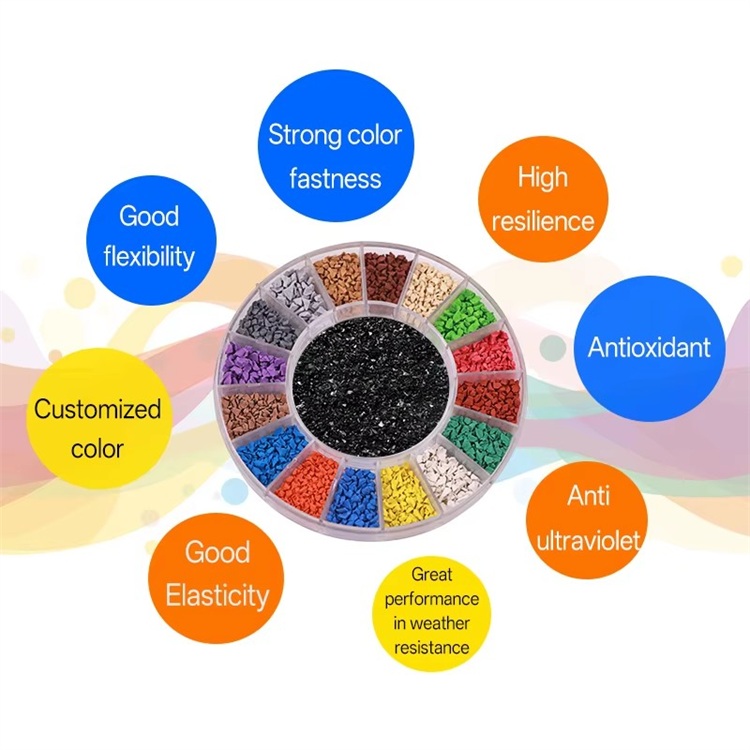
- Elimination of Odor: Without sulfur in the compound, the granules do not produce sulfuric acid when heated by UV rays. This ensures a "no smell" surface that meets stringent environmental health standards, making it suitable even for indoor sports halls.
- Structural Stability: The peroxide cross-linking creates a more stable molecular structure. We have consistently observed that our sulfur-free granules deliver 3x longer lifespan than standard products. Where standard granules might degrade in 3 years, our granules are engineered to perform for 10+ years .
- Superior Physical Properties: Industry standard tensile strength often hovers around 2-3 MPa, which is sufficient but borderline for high-traffic areas. Advanced formulations achieve 4 to 7 MPa, with elongation rates exceeding 600% to 800% . This translates to a surface that absorbs impact effectively without tearing.
- Color Fastness: The enhanced antioxidant properties in these granules mean performance retention increases by over 5 times, locking in pigment and preventing the shift to the gray scale that plagues lesser products.
How to Choose a Supplier: The Red Flags and Green Lights
Here is your checklist to avoid procurement errors:
1. Inspect the Polymer Content
Do not ask for a "cheap" granule. Ask for the "EPDM polymer percentage." High-quality granules exceed 20%. A spec sheet that reads "≥ 20%" ensures the material binds well with PU glue and retains its elasticity .
2. Assess the Bulk Density (The Savings Metric)
Look at the Bulk Density (gr/l) . A density below 700 gr/l means you are buying more volume per kilogram. This translates to better coverage—you spend less material and less glue to achieve the same thickness. It is an immediate cost-saver.
3. Demand Certifications
Look for compliance with EN 1177 (for playgrounds), GB/T 14833 (for tracks), and EN 71/3 (heavy metal safety). If a supplier hesitates on these, walk away .
4. Ask about the Vulcanization System
If the supplier does not know whether they use a sulfur or peroxide system, they lack the technical expertise to support your project. Insist on peroxide/sulfur-free for long-term durability and environmental safety .

The Procurement Reality: MOQ and Lead Time
The old days of being forced to buy a full container load are fading. The industry now operates on flexible minimum order quantities (No MOQ) . We understand that a contractor may only need a small custom color run for a specific landscape project. Stock color availability and rapid shipping cycles (5-10 days) are now critical factors in supplier selection .

The "Fit and Forget" Specification
When you select Rubber Granules for Outdoor Surfacing, you are investing in the reputation of your company. A failed surface means litigation, reputational damage, and expensive redos. By prioritizing sulfur-free, high-polymer, low-density granules, you eliminate the risk of odor, UV fading, and structural failure.

We supply a product engineered to meet the highest standards of the European and American markets, boasting over 25 years of production expertise. With 24 standard colors available, custom granule sizes (0.5mm to 4mm), and the ability to respond swiftly to complex orders, we ensure you win more bids and build surfaces that last.

WOW(LYG) New Material Co Ltd is a manufacturer specializing in the production of EPDM rubber granules. We use sulfur-free vulcanization technology, it increases the service life by more than 3 times than traditional EPDM granules, and enhances the performance, including anti-aging, high-temperature resistance, and colorfastness.
We have over 25 years of production experience and offer customization for colors and granule sizes. NO MOQ.


