 注: 建议图片大小150px*50px
丨
注: 建议图片大小150px*50px Views: 0 Author: Site Editor Publish Time: 2026-07-27 Origin: Site


For playground contractors, sports surfacing installers, and global distributors, the Pour-In-Place (PIP) installation process is a daily reality. But let's address the elephant in the room: why do some premium projects look faded and smell like burning rubber just two years after installation, while others remain vibrant for a decade?
The answer lies in the chemistry of the EPDM rubber granules you choose. As a technical engineer with over 25 years of industry experience, I am going to walk you through the science of PIP installation, the hidden dangers of traditional materials, and why our sulfur-free EPDM technology is solving the biggest pain points for importers and construction companies worldwide.

What is PIP Installation and Why is it the Industry Standard?
Pour-In-Place (PIP) rubber surfacing is a seamless, two-layered surface system. It consists of a bottom cushioning layer (usually mixed with black SBR rubber) and a top wear layer made of colorful EPDM (Ethylene Propylene Diene Monomer) granules bound together by a polyurethane binder.
Contractors, architects, and municipal project managers prefer PIP because it offers unmatched design flexibility. Unlike interlocking tiles, PIP can be poured into any shape, creating custom logos, hopscotch grids, or complex geometric patterns. It provides a seamless, trip-free surface that meets critical fall height safety standards, making it the absolute go-to for schools, parks, and commercial playgrounds.

The Silent Killer of Rubber surfaces: The Sulfur Problem
If you are a purchasing manager or a wholesaler, you have likely received complaints about rubber surfaces emitting a strong, unpleasant odor in the summer heat, or colors fading rapidly under the sun.
This happens because traditional EPDM manufacturing relies on sulfur for vulcanization (the process of hardening the rubber). When exposed to high temperatures and strong UV radiation, the sulfur breaks down and releases sulfuric compounds. This not only creates a terrible smell but also degrades the molecular structure of the rubber, leading to chalking, fading, and a brittle surface.

Our Game-Changer: Sulfur-Free EPDM Technology
We have completely eliminated this issue. By utilizing a proprietary sulfur-free formulation, our EPDM granules solve the most common complaints in the PIP installation industry. Here is the technical breakdown of why our material outperforms the rest:
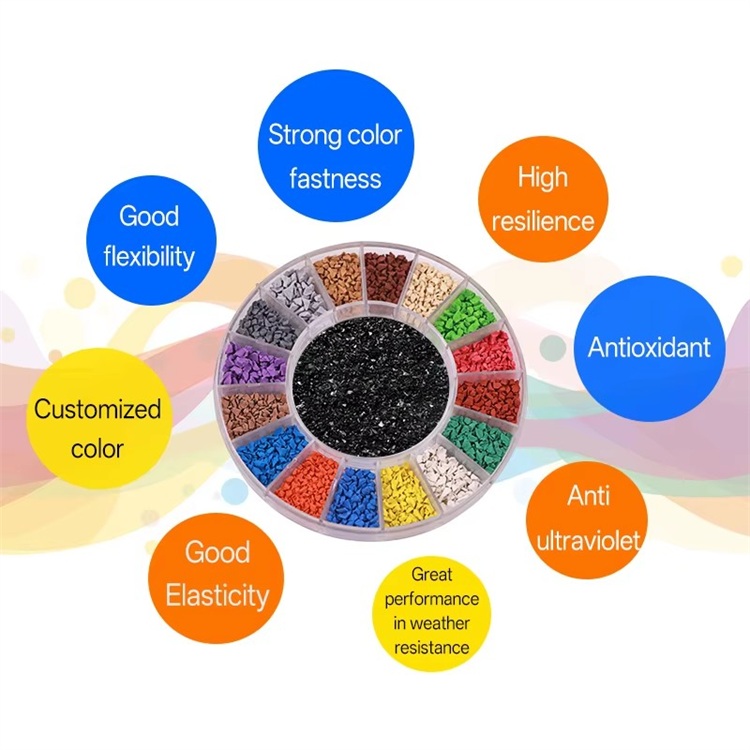
Zero Odor, Even in Extreme Heat: Because there is absolutely no sulfur in our granules, they will not decompose into sulfuric acid under high heat or UV exposure. Your playgrounds will remain odorless, which is crucial for schools and indoor facilities.
3x Longer Lifespan: The absence of sulfur creates a highly stable molecular structure. While standard EPDM might degrade after a few years, our material maintains its integrity for over a decade.
Superior Elasticity and Tensile Strength: Our granules boast a tensile strength of 4 to 7 MPa, which is 2 to 3 times higher than standard market options. This means the surface absorbs impact better, protecting children from falls and reducing joint fatigue for athletes.
5x Performance Retention: The physical properties of our rubber degrade much slower. The elasticity and shock absorption remain consistent over time, ensuring the playground remains safe throughout its lifecycle.
Ultimate Anti-Aging and UV Resistance: Our advanced formula drastically improves anti-aging capabilities. The colors remain vibrant and do not turn chalky or fade, even in regions with intense, year-round sunlight.
Food-Grade Environmental Safety: We prioritize health. Our EPDM is highly eco-friendly, meeting strict food-grade hygiene standards. It is completely safe for children to play on and touch.
Low Bulk Density with 3D Texture: Our granules feature a low bulk density and a strong, three-dimensional angular shape. This "菱角立体感" (angular 3D structure) ensures better mechanical interlocking with the PU binder, resulting in a surface that is highly resistant to granule shedding.
PIP Installation Process: A Step-by-Step Guide for Contractors
To ensure the longevity of the surfacing, the installation must be precise. Here is the professional workflow we recommend for rubber surfacing installers and sports surfacing contractors:
Step 1: Base Preparation
The foundation must be asphalt or high-strength concrete (C25 or above). It must be clean, completely dry (moisture content below 8%), and free of dust or oil. For concrete, ensure expansion joints are cut properly to prevent structural cracking.
Step 2: Primer Application
Apply a specialized polyurethane primer to the base. This acts as a bridge, ensuring a powerful chemical bond between the concrete/asphalt and the rubber layers, preventing future delamination.
Step 3: The Cushion Layer (Base Layer)
Mix black SBR rubber granules with a high-quality PU binder (typically an 8:1 ratio by weight). Spread this mixture evenly using a specialized trowel or paving machine to the required thickness (usually 8mm to 10mm). This layer provides the critical shock absorption. Allow it to cure for at least 24 hours.
Step 4: The EPDM Wear Layer
This is where our sulfur-free EPDM shines. Mix the colored EPDM granules with the PU binder (typically a 6:1 ratio). Spread this top layer (usually 3mm to 5mm thick) over the cured base. The low bulk density and angular shape of our granules ensure a smooth, seamless, and highly durable finish.
Step 5: Curing and Line Marking
Allow the surface to cure for 3 to 7 days depending on the weather. Once fully cured, use specialized polyurethane paint to mark any sports lines or boundaries.

How to Avoid Costly Procurement Mistakes
When sourcing EPDM for PIP installations, importers and distributors often face hidden traps. Here is how to protect your business:
Avoid the "Cheap" Trap: If a supplier's price is significantly lower than the market average, they are likely using high-sulfur fillers or recycled tires. This will result in fading and odor complaints that will cost you your reputation.
Demand Technical Data Sheets (TDS): Always ask for the tensile strength and elongation at break. If they cannot provide data showing a tensile strength of at least 4 MPa, walk away.
Check the Granule Shape: High-quality EPDM should have a distinct, angular shape rather than being perfectly round. The angular edges provide better structural integrity when mixed with glue.
Request Physical Samples: Test the smell. Heat the sample in the sun or an oven. If it smells, do not buy it.

Why Choose Us as Your Manufacturing Partner?
With 25 years of deep industry experience, we are not just a supplier; we are your technical partner. We understand the exact pressures that playground contractors and municipal buyers face.
We offer complete flexibility for our global clients. There is absolutely no Minimum Order Quantity (MOQ). Whether you need a small batch for a boutique kindergarten or a massive container for a government sports complex, we can accommodate you. We support full customization of colors and granule sizes to match your exact architectural designs.
Backed by a complete set of advanced production lines, we guarantee batch-to-batch consistency. When you order our sulfur-free EPDM, you are investing in a product that eliminates callbacks, ensures child safety, and keeps your projects looking brand new for years to come.
If you are ready to upgrade your PIP installations and offer your clients the best odorless, fade-resistant, and highly durable rubber surfacing on the market, contact us today for a free sample and a custom quote.


WOW(LYG) New Material Co Ltd is a manufacturer specializing in the production of EPDM rubber granules. We use sulfur-free vulcanization technology, it increases the service life by more than 3 times than traditional EPDM granules, and enhances the performance, including anti-aging, high-temperature resistance, and colorfastness.
We have over 25 years of production experience and offer customization for colors and granule sizes. NO MOQ.


