 注: 建议图片大小150px*50px
丨
注: 建议图片大小150px*50px Views: 0 Author: Site Editor Publish Time: 2026-07-17 Origin: Site


You are a Playground Contractor. You just finished a beautiful new play area for a municipal park. The colors were vibrant—a perfect match for the community's branding. Six months later, the red is now a dull pink, the blue has turned ashy grey, and the green looks like a faded olive. The council is unhappy. You're facing a warranty claim. Worse, your reputation is on the line.
What happened? The UV resistant rubber granules weren't actually UV resistant.
This scenario plays out far too often in our industry. For over 25 years, we've been troubleshooting these exact failures. From sports flooring contractors battling premature surface degradation to government procurement officers struggling with vague specifications, the core issue usually comes down to a misunderstanding of what genuine UV protection in EPDM actually entails. This guide is designed to help importers, distributors, engineers, and installers avoid these costly mistakes by understanding the technology, the pitfalls, and the right questions to ask.

What Are UV Resistant Rubber granules, Really?
When procurement documents call for "UV resistant rubber granules," they are usually referring to EPDM (Ethylene Propylene Diene Monomer) granules. EPDM is a synthetic rubber known for its exceptional resistance to weathering, ozone, and UV radiation . However, not all EPDM is created equal.
The "UV resistance" you're buying is a function of the material's base chemistry and the additives used. Traditional EPDM granules often use sulfur-based vulcanization (curing) systems. While effective in some regards, sulfur has a significant drawback: under prolonged UV exposure and heat, it can degrade, leading to the formation of sulfonic acids. This is the primary culprit behind fading colors, chalking (white powder on the surface), and that unpleasant odor you sometimes smell on older playgrounds .

Why "Standard" UV Resistance Fails: The Sulfur Problem
If you are specifying or purchasing UV resistant rubber granules, you need to understand that the sulfur curing system is your biggest enemy.
Here is the industry secret most suppliers won't tell you: The UV resistance test many suppliers use (often 500 to 1,000 hours in a lab) doesn't always translate to real-world performance over 5 or 10 years of continuous sun exposure . A project in Arizona or Australia faces vastly different UV loads than one tested in a lab in China or Germany.
The true measure of long-term UV performance is not just color retention, but structural integrity. When sulfur-based granules degrade:
- They lose elasticity: The surface becomes hard and brittle, losing its critical shock-absorbing properties .
- They release odors: Heat causes the breakdown products to gas off.
- They weaken: Tensile strength and elongation drop significantly, leading to cracks and areas of delamination from the PU binder .
This is why many contractors are forced to resurface or replace projects within 3-5 years, despite paying for a "premium" product.

The Technical Shift: Sulfur-Free vs. Sulfur-Based Systems
To meet the demands of modern infrastructure projects (like the recent 5,000-meter fitness trail in Dunhuang City which required rigorous UV standards), manufacturing has evolved .
We utilize a patented technology that completely eliminates sulfur from the EPDM formulation. Instead of relying on sulfur to bond the polymer chains, we use alternative cross-linking systems that create a much more stable molecular structure.
Here is the technical breakdown of why this matters for your project:
- Zero Odor Guarantee: Because there is no sulfur, there is nothing to break down into sulfuric acid. Even under the intense heat of a Middle Eastern summer or the reflective heat of a gymnasium floor, these UV resistant rubber granules remain odorless.
- Tensile Strength (4–7 MPa): Industry standards often require tensile strength above 0.7 MPa or 1.65 MPa depending on the specification . Our sulfur-free technology provides tensile strength and elasticity that is 2–3 times higher than standard EPDM. This means the binder holds better, and the surface resists wear from foot traffic and heavy equipment.
- Extended Service Life: By stabilizing the polymer chains, the aging process is dramatically slowed. The lifespan of the surface is extended by a factor of 3 compared to traditional sulfur-cured materials.

Performance Specifications: What to Look For
For engineers writing specifications and government procurement officers evaluating bids, you must look beyond the words "UV Resistant." The data matters.
When assessing suppliers, demand to see the technical data sheet (TDS) and the Third-Party Test Reports. Here are the benchmarks you should be using based on global industry standards:
1. UV Aging Test (EN 14836): This tests performance under artificial sunlight. The standard often requires 2,500 hours of UVA exposure. High-quality sulfur-free EPDM can exceed 5,000 hours of testing (equivalent to 9,600 kJ/m²) while maintaining a Grey Scale rating of ≥4, meaning virtually no visible change to the naked eye .
2. Tensile Strength (MPa): Look for values greater than 2.5 MPa. Our product achieves 4–7 MPa . This indicates a strong, durable granule that won't break down easily.
3. Abrasion Resistance: This is critical for high-traffic sports surfaces. How much material is worn away under friction?
4. Color Fastness: Ensure the test reports specify color change and graying after UV exposure .
5. Hardness (Shore A): Generally between 55-65 provides the optimal balance of safety cushioning and stability for the surface system .

Beyond UV: The Installation and Procurement Pain Points
The playground installers and sports flooring contractors on this page know that a failed project isn't just about fading. It's about the nightmare of installation.
- Inconsistent Particle Size: If the rubber granules aren't uniform, you get "birdbaths" (puddles) in the surface, lumps, or weak spots. Standard SBR is often inconsistent.
- High Dust Content: Cheap granules are dusty. The dust interferes with the PU binder's ability to bond, causing the top layer to peel up like a bad sunburn.
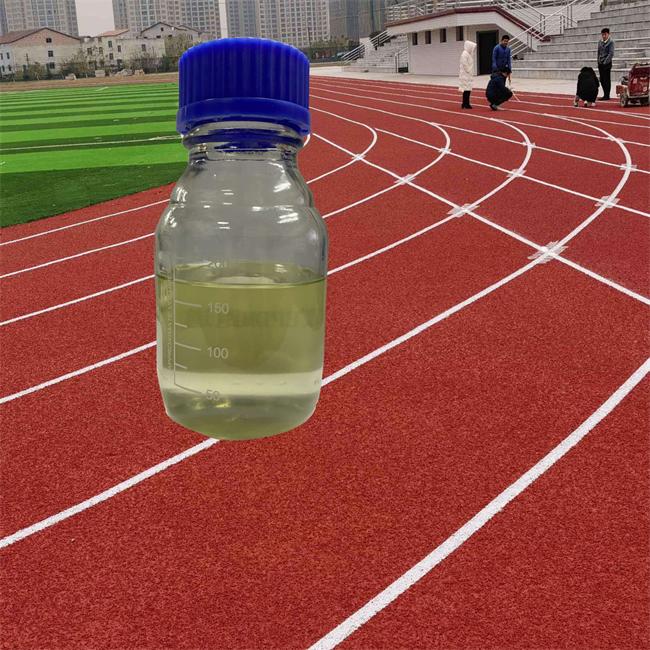
- PU Binder Compatibility: Did you know that your choice of binder is just as important as the granule? Aromatic PU binders are cheaper, but they lack UV stability. They will turn yellow when exposed to light, ruining the color of your surface. For light-colored granules (white, light blue, yellow), you must use an Aliphatic PU binder to prevent this yellowing effect .
Why Importers and Distributors Trust Our Supply Chain
As an importer or distributor, you need a reliable partner who understands logistics.
- No Minimum Order Quantity (MOQ): Unlike many manufacturers who force you to fill a 20ft container of a single SKU, we allow you to order any quantity you need to service your local market. We understand the needs of smaller contractors and large-scale projects alike.
- Bulk & Customization: We maintain massive inventory to support rapid fulfillment. Need a 1.0-2.5mm size for a tennis court surface? Or a 3-5mm size for a playground base layer? We can produce it . Need a specific RAL color to match a corporate logo? We can match it .
- Factory Direct Quality: We have over 25 years of industry experience and a full suite of advanced production lines. This ensures you receive a product with high bulk density (meaning it goes further per ton) and "three-dimensional" angular granules that interlock better for superior adhesion.

Frequently Asked Questions (FAQs) by Industry Professionals
Q: How do I know if my EPDM granules will fade?
A: Ask for the UV aging test report. Look specifically for the Grey Scale rating after 2,500 hours of UVA exposure. If the supplier provides a Grey Scale rating of 3 or less, expect visible color change. Our sulfur-free product maintains a rating of 4-5 even after 5,000 hours, ensuring color stability for years .
Q: Why does the EPDM smell bad when it's hot?
A: That smell is often a byproduct of sulfur degassing. If the EPDM is sulfur-cured, heat accelerates the breakdown, releasing sulfuric acid derivatives. Our sulfur-free technology ensures the material remains odorless even in high-temperature conditions, a requirement for many indoor sports halls and sensitive environments like daycare centers.
Q: What is the difference between SBR and EPDM for outdoor use?
A: SBR (Styrene-Butadiene Rubber) is a cheaper, recycled material. It has very poor UV resistance. Under sunlight, SBR hardens, becomes brittle, and turns black/grey as it degrades. EPDM is a virgin material specifically engineered for superior UV and ozone resistance, making it the only viable choice for outdoor sports and playground surfaces .
Q: Can I use any PU glue with EPDM granules?
A: No. For maximum durability, you need a PU binder designed for wet-pour systems and the specific EPDM color you are using. For bright or light colors, you must use an Aliphatic PU binder to avoid the yellowing effect of aromatic binders. This is crucial for achieving the aesthetic quality expected by architects and landscape designers .
Q: How do I ensure the project meets warranty requirements?
A: Track your batch numbers. Ensure the tensile strength of the granules meets your spec (ideally > 3.5 MPa). Ensure you have the test reports for UV stability and binder recommendations. We provide full traceability on all our products, ensuring consistency across batches and providing peace of mind to purchasing managers.

The choice of UV resistant rubber granules is often the deciding factor between a project that stands as a landmark for 15 years and one that becomes a liability in 5 years. For the contractor, it means fewer callbacks. For the engineer and architect, it means the design vision is preserved. For the importer and government agency, it means long-term value and public safety.
By moving away from traditional sulfur-cured systems and embracing advanced, sulfur-free technology, we provide a product that offers:
- Unmatched Color Retention
- Zero Odor
- 3x Longer Service Life
- 4-7 MPa Tensile Strength
- Sustainable & Food-Grade Safety Standards
- Flexible Ordering with Zero MOQ

Don't let a "low price" from a non-compliant supplier cost you your reputation. Contact our sales team to request a sample, a technical data sheet, or a custom color match for your next municipal or commercial project.
WOW(LYG) New Material Co Ltd is a manufacturer specializing in the production of EPDM rubber granules. We use sulfur-free vulcanization technology, it increases the service life by more than 3 times than traditional EPDM granules, and enhances the performance, including anti-aging, high-temperature resistance, and colorfastness.
We have over 25 years of production experience and offer customization for colors and granule sizes. NO MOQ.


