 注: 建议图片大小150px*50px
丨
注: 建议图片大小150px*50px Views: 0 Author: Site Editor Publish Time: 2026-08-14 Origin: Site


Selecting the right wet pour EPDM material is one of the most critical decisions a playground contractor, sports surfacing installer, or municipal project manager can make. The quality of EPDM rubber granules directly impacts safety compliance, project longevity, maintenance costs, and ultimately, the success of the entire installation.
With over 25 years of experience manufacturing and exporting colored EPDM rubber granules to Europe, North America, Australia, and the Middle East, we understand the challenges buyers face when specifying materials for poured-in-place rubber surfaces. This guide provides practical, technical insights to help you make informed decisions—whether you're sourcing for a school playground, running track, or public recreational area.
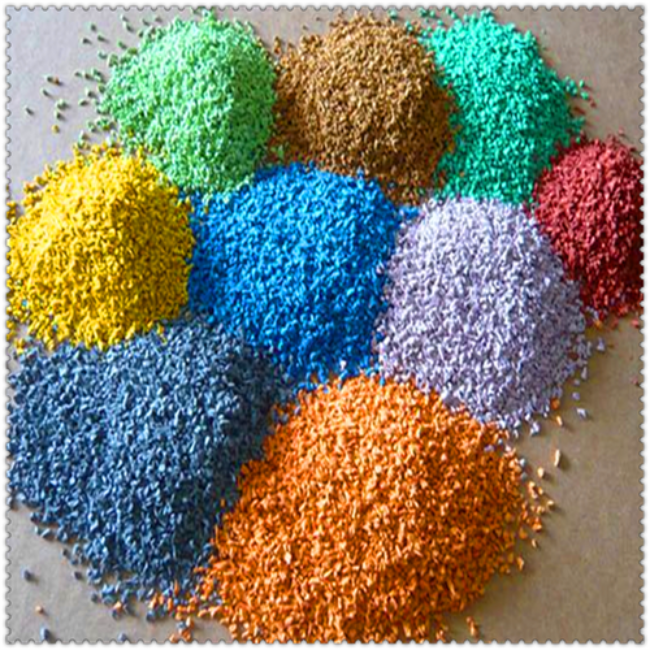
What Is Wet Pour EPDM Surfacing?
Wet pour, also known as poured-in-place (PIP) rubber, is a seamless safety surfacing system created by mixing EPDM rubber granules with a polyurethane (PU) binder on-site and troweling the mixture onto a prepared base .
The system typically consists of two layers :
1. Base Layer (SBR rubber): A shock-absorbing cushion made from recycled tire rubber, mixed with a PU binder (typically 6-8%), providing impact attenuation at a lower cost.
2. Top Wearing Layer (EPDM granules): A durable, UV-resistant colored surface made from virgin EPDM rubber, mixed with a higher ratio of PU binder (18-20%) to ensure granule retention and colorfastness .
The wet pour EPDM system is specified for its seamless finish, design flexibility, safety compliance, and long-term durability in high-traffic outdoor environments .
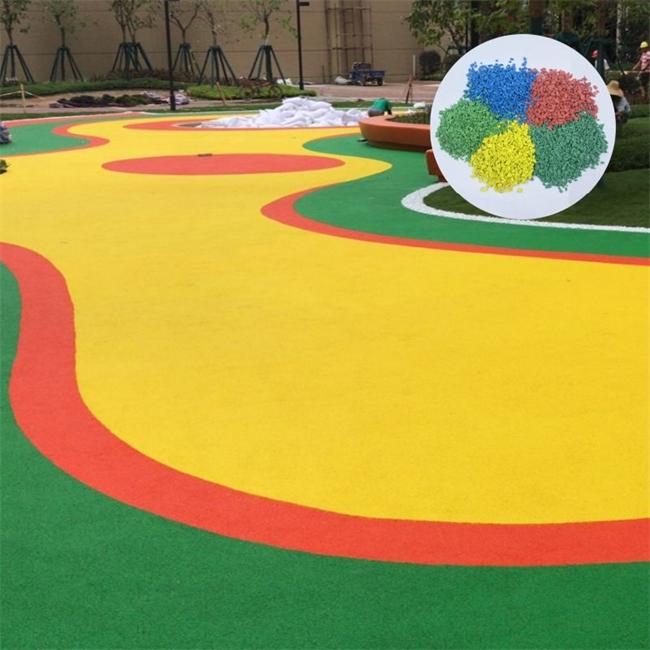
Key Applications for EPDM Granules
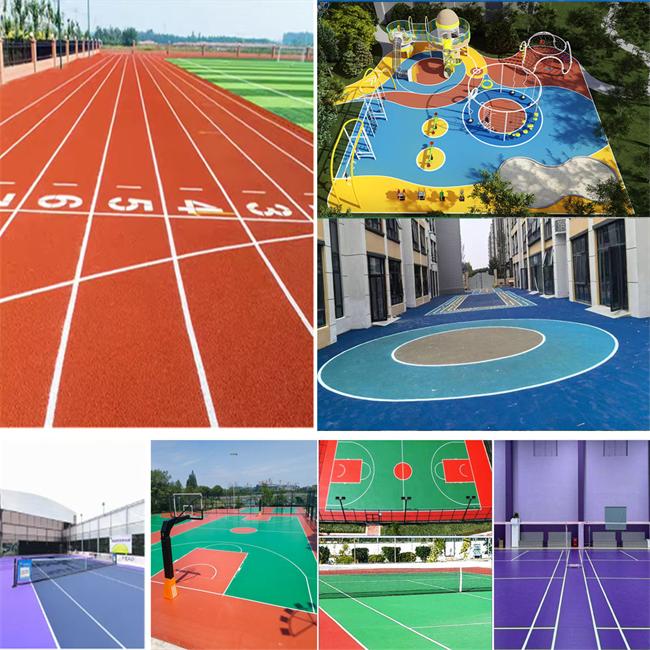
EPDM rubber granules are the material of choice for a wide range of surfacing projects, including :
- School Playgrounds and Kindergartens: Where safety, color, and accessibility are paramount
- Sports Facilities: Including running tracks, multi-use games areas, and tennis courts
- Public Parks and Recreational Areas: Including walking paths and fitness zones
- Commercial and Municipal Projects: Plazas, splash pads, and civic spaces
- Landscape and Themed Areas: Where design flexibility is required
Each application places different demands on the EPDM material, making proper selection essential.
The Challenge: Why Traditional EPDM Granules Fail Prematurely
Many EPDM playground surfaces experience premature failure due to material degradation. The primary culprit? Sulfur-based vulcanization.
Traditional EPDM granules are cured using sulfur, which remains in the material. Under high temperatures and UV exposure, sulfur decomposes into sulfuric acid. This causes :
- Pungent odors released from the surface
- Accelerated aging and molecular breakdown
- Loss of elasticity and tensile strength
- Color fading and surface degradation
- Significantly shortened service life
For contractors and buyers, this translates directly into: liability, costly repairs, and unhappy clients.
The Technical Solution: Sulfur-Free EPDM Granules
Sulfur-free vulcanization technology addresses these fundamental issues. By eliminating sulfur from the manufacturing process, the molecular structure of the EPDM granules becomes more stable, delivering measurable performance improvements .
Quantified Performance Advantages:
- Service Life: Extended by more than 3 times compared to traditional sulfur-cured granules
- Tensile Strength: Reaches 4–7 MPa, representing a 2–3 times improvement
- Performance Retention: Increases by over 5 times, maintaining physical properties longer
- Thermal Stability: Superior high-temperature resistance
- Color Stability: Enhanced anti-oxidation and UV resistance, keeping colors vibrant
- Odor Elimination: No sulfuric acid decomposition, meaning zero odor even under extreme conditions
- Environmental Safety: Achieves food-grade standards, critical for children's safety
This technology directly addresses the key concerns of specifiers: how to make EPDM last longer, perform better, and remain safe.
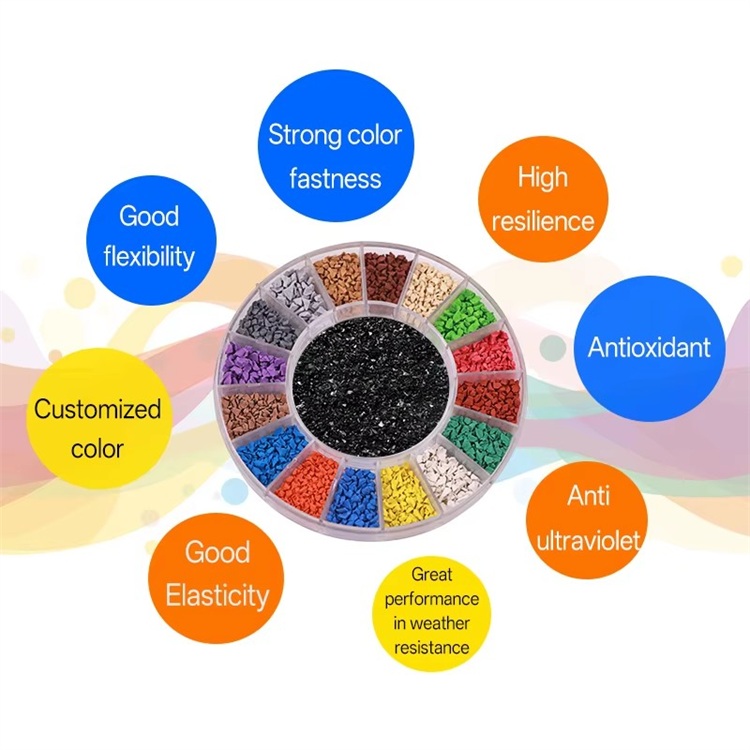
How to Choose the Right EPDM Granules for Your Wet Pour Project
1. Selecting the Correct Granule Size
The granule size of EPDM colored granules affects both surface texture and performance.
- 0.5–1.5 mm: Fine texture, ideal for running track wearing courses and spray coat systems
- 1–3 mm: The most versatile size, widely used for wet pour playgrounds, sports courts, and general safety surfacing
- 1–4 mm: Standard for playground safety surfaces, offering a good balance of durability and aesthetics
- 2–4 mm: Coarser texture for heavy-duty applications or where higher slip resistance is required
Manufacturer Insight: For most school playgrounds and public recreational areas, the 1–4 mm size range offers the best combination of safety, comfort, and durability. For high-performance running tracks, finer grades like 1–3 mm or 0.5–1.5 mm are preferable.
2. Color Selection and UV Stability
Color is not just aesthetic—it's a performance indicator. UV resistance determines how long the surface will retain its appearance. High-quality pigments and sulfur-free formulations prevent the fading and chalking seen in lower-grade materials .
Manufacturer Insight: For any outdoor project, specify an aliphatic PU binder to ensure long-term color integrity. For colors like pink, white, and turquoise, it is essential. For deeper tones like brown or dark green, an aromatic binder may be sufficient but will still show some yellowing over time .
3. Understanding Critical Fall Height (CFH) and Thickness
Safety compliance is non-negotiable. The wet pour surface thickness must be engineered to meet the Critical Fall Height (CFH) rating of the installed play equipment .
- Standard walkways: 15–20 mm total thickness
- Playgrounds (1.5 m fall height): 40–60 mm total thickness
- High structures (3.0 m+ fall height): Up to 100+ mm total thickness
Manufacturer Insight: "Thickness equals safety" is a guiding principle . Always specify a system with a certified CFH rating that meets or exceeds the highest fall height of the equipment. Do not rely on generic thickness recommendations; demand test certification (EN 1177 or ASTM F1292).

Why Global Buyers Choose Our EPDM Granules
As a dedicated EPDM colored rubber granules manufacturer, we differentiate ourselves through material science, customization, and reliability.
Our Unique Value Proposition:
1. Sulfur-Free Technology: Our proprietary process eliminates odors, triples service life, and delivers superior mechanical properties (4–7 MPa tensile strength) compared to standard granules .
2. Comprehensive Customization: We support OEM, ODM, and Private Label solutions, offering:
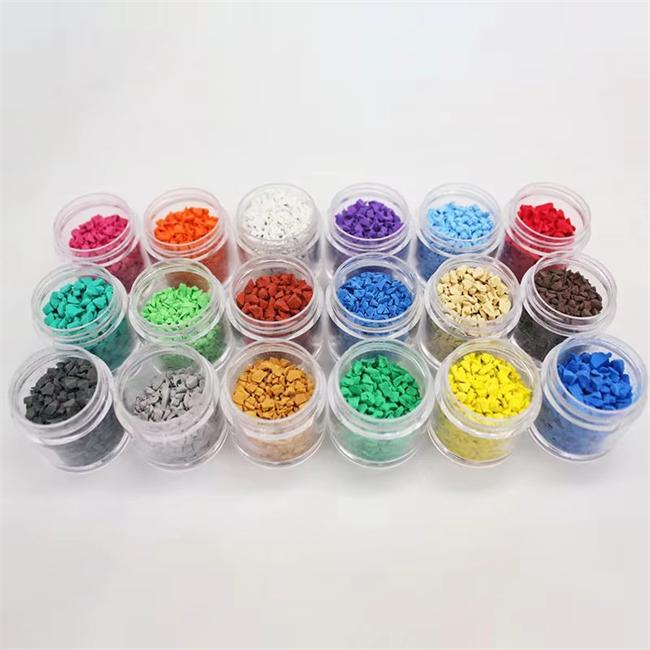
- Color Matching: RAL, Pantone, or bespoke color matching to your exact requirements
- Granule Sizes: Flexible production for any granule size, from 0.5–1.5 mm to 2–4 mm and beyond
- Packaging: Custom branding and packaging options
- No MOQ: Low minimum order quantities to support trial orders and small projects
3. Global Export Experience: With over 25 years in the industry, we reliably ship to Europe, North America, Australia, the Middle East, and other markets. We handle both FCL and LCL shipments with fast delivery.
4. Strict Quality Control: Our granules exhibit excellent color consistency, UV stability, and weather resistance, suitable for all global climates .
5. Comprehensive Support: We provide full documentation, including TDS, MSDS, and test reports, to facilitate smooth procurement and installation.

Manufacturer Insights: Expert Advice for EPDM Buyers
Drawing on decades of production experience, here is our practical advice for sourcing and using EPDM rubber granules.
How to Inspect EPDM Quality
- Visual Check: High-quality granules have a uniform color, a slight sheen, and sharp, "cubic" edges. Dull, dusty granules indicate a high filler content or poor production.
- Odor Test: Quality sulfur-free granules should have virtually no odor. A strong "rubber" or chemical smell can indicate sulfur-cured material or recycled content.
- Density: Our sulfur-free granules have a low bulk density, meaning you get more volume and coverage per kilogram.
How to Avoid Common Mistakes
- Don't assume all granules are the same: Always request a sample to test on-site.
- Don't match binder and granule colors without checking: Ensure the binder (aliphatic vs. aromatic) is compatible with your chosen granule color to prevent yellowing .
- Don't overlook certification: For safety-critical projects, require test reports for CFH, tensile strength, and abrasion resistance from an independent lab .
How to Choose a Long-Term Supplier
- Evaluate technical capability: Can they customize colors and sizes consistently?
- Assess production capacity: Can they reliably meet your volume requirements?
- Check traceability: Do they use virgin EPDM from reputable sources?
- Review support: Do they provide timely, comprehensive technical and logistics support?

Frequently Asked Questions (FAQ)
What size EPDM granules should I choose for a playground?
The most common and versatile size for wet pour playgrounds is 1–4 mm. It provides excellent durability and a safe, slip-resistant surface texture . For running tracks, a finer grade like 1–3 mm is often preferred.
Will EPDM rubber granules fade in the sun?
All colored EPDM granules will fade over time, but the rate depends heavily on pigment quality. Sulfur-free granules with high-quality pigments and antioxidants are engineered for superior UV resistance and colorfastness, significantly outperforming traditional materials .
How much PU binder is required for EPDM granules?
The ratio varies by layer. For the top wearing layer of colored EPDM, you typically need 18–20% PU binder by weight to ensure proper adhesion and prevent granule loss . The base SBR layer uses a lower ratio of 6–8%.
How long does a wet pour EPDM surface last?
With proper installation and maintenance, a high-quality wet pour surface using sulfur-free EPDM granules can last 10–15 years or more—over 3 times longer than surfaces made with standard sulfur-cured granules.
Can you customize the color of EPDM granules?
Yes. As a manufacturer, we can match RAL, Pantone, or custom samples. We produce a full spectrum of colors for consistent branding and design.
What certifications are available for your EPDM granules?
We can provide test reports from recognized institutions confirming performance parameters such as tensile strength (4–7 MPa), elongation at break, abrasion resistance, and compliance with relevant safety standards (e.g., EN 1177). Our materials also meet food-grade safety standards for environmental health.
What is the minimum order quantity?
We offer flexible production with no minimum order quantity (NO MOQ). This allows you to place trial orders, custom color samples, or small-batch projects without the constraint of large volumes.
Can I mix different colors of EPDM granules?
Absolutely. Mixing two or more colors is a popular way to create bespoke patterns, logos, and designs for themed play areas or sports courts, offering limitless creative possibilities.
How do I store EPDM granules before installation?
Store the granules in a dry area, out of direct sunlight and away from moisture to prevent the bags from sweating. Keep them off the ground on pallets and ensure they are used within a reasonable time frame to avoid contamination .

Selecting the correct wet pour EPDM material is a critical decision that affects the safety, longevity, and cost of your project. By understanding the differences between material technologies, choosing the right size and color for your application, and partnering with a reliable EPDM colored granules manufacturer, you can avoid costly mistakes and deliver high-quality results.
Contact us today to request a sample, technical data sheets, or a customized quotation for your next project. Let our expertise in EPDM rubber granules help you build safer, more durable, and more vibrant surfaces.

WOW(LYG) New Material Co Ltd is a manufacturer specializing in the production of EPDM rubber granules. We use sulfur-free vulcanization technology, it increases the service life by more than 3 times than traditional EPDM granules, and enhances the performance, including anti-aging, high-temperature resistance, and colorfastness.
We have over 25 years of production experience and offer customization for colors and granule sizes. NO MOQ.


