 注: 建议图片大小150px*50px

丨
注: 建议图片大小150px*50px Views: 0 Author: Site Editor Publish Time: 2026-09-17 Origin: Site


For most Brazilian sports projects, the best EPDM granule particle size depends on the application. For running tracks and athletic surfaces, 0.5–1.5 mm is the standard specification . For playgrounds and wet pour safety surfaces, 1.0–3.5 mm is commonly used, with many Brazilian installations specifying 1–3 mm or 2–4 mm for the wearing layer . For artificial turf infill, 0.5–2.5 mm is typical .
The right choice balances safety performance, surface texture, drainage, and installation cost. Brazil‘s intense UV radiation, high temperatures, and heavy rainfall make particle size consistency and material quality especially important — undersized or inconsistent granules can lead to compaction, poor drainage, or premature surface degradation .
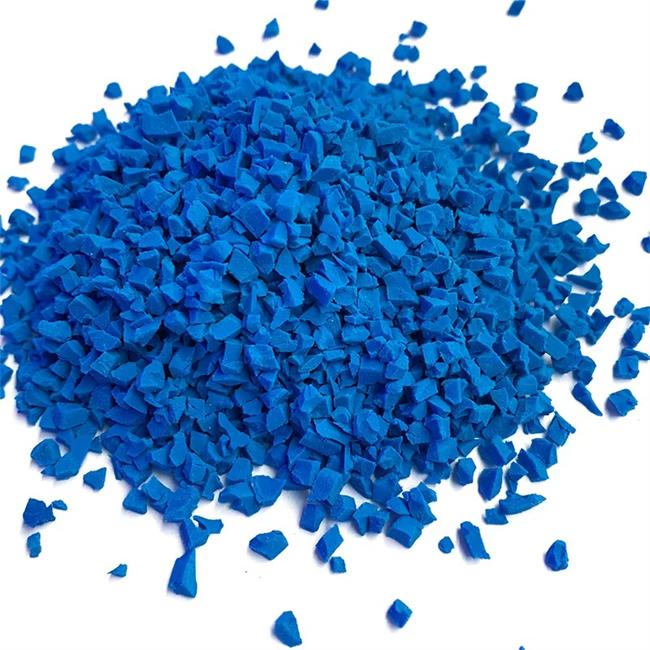
Applications of EPDM Granules in Brazilian Sports Projects
EPDM granules serve as the colored wearing layer in poured-in-place rubber systems, which are widely used across Brazil for:
- Athletic running tracks — IAAF-standard surfaces use EPDM granules as the top layer for color, traction, and UV stability
- Playgrounds and school yards — critical fall-height safety surfaces, often installed over an SBR shockpad base to meet NBR 16071-3 requirements
- Multi-use games areas (MUGA) — basketball, volleyball, and handball courts
- Artificial turf infill — EPDM granules provide elastic performance and reduce field compaction
- Pool surrounds and walkways — slip-resistant, drainage-friendly surfaces
Brazilian projects face specific challenges: intense year-round UV exposure, temperatures exceeding 35°C in many regions, and heavy seasonal rainfall. These conditions demand EPDM granules with high polymer content and consistent particle size distribution to maintain performance over time .

Advantages of EPDM Granules for Brazilian Conditions
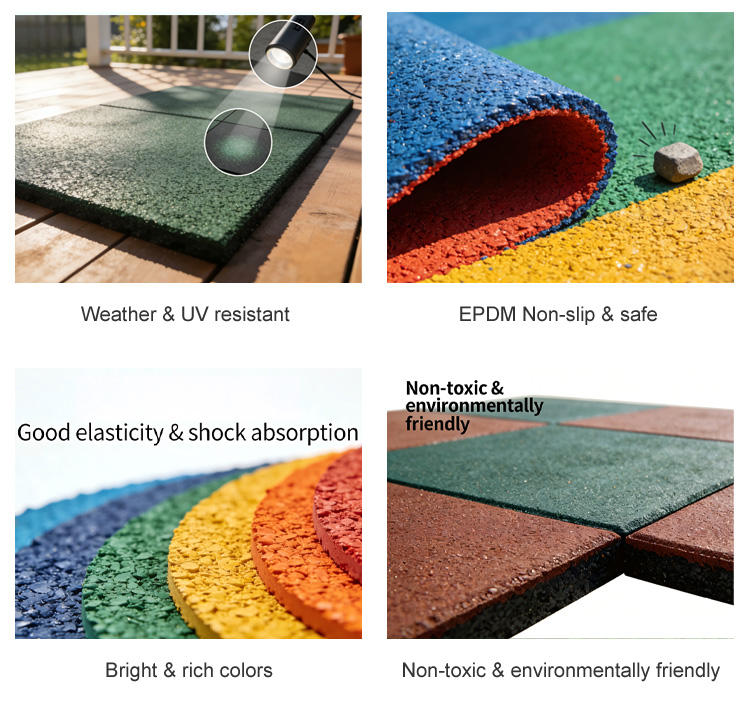
UV and color stability. EPDM’s saturated polymer backbone resists UV degradation far better than SBR or recycled rubber granules. For Brazil‘s high-radiation environment, this means colors remain vibrant and surfaces don’t become brittle or powdery after a few years .
Thermal performance. EPDM granules maintain elasticity across a wide temperature range, typically cited from -40°C to 120°C. In Brazil’s heat, quality EPDM resists softening and compaction — a failure mode seen when low-grade sulfur-cured granules are used in artificial turf .
Drainage and safety. Angular EPDM granules with controlled particle size create a porous surface that drains quickly during heavy rain. This reduces slip risk and prevents standing water on playgrounds and tracks .
Impact absorption. When properly installed over an SBR base layer, EPDM surfaces provide consistent shock absorption for playground safety and athletic performance .
Low maintenance. Unlike loose-fill surfaces, poured EPDM systems form a seamless, monolithic surface that doesn’t require raking or replenishment. Brazilian project specs often emphasize ease of cleaning and resistance to mold and fungi .
How to Select EPDM Granule Size for Your Brazilian Project
Particle size selection should follow the application requirement, not the other way around:
Running tracks and jogging paths: Use 0.5–1.5 mm for the wearing layer. Finer granules create a denser, smoother surface with consistent traction .
Playgrounds and wet pour safety surfaces: Use 1–3 mm or 2–4 mm. Coarser granules provide more texture and better drainage on outdoor playgrounds, while still bonding effectively with PU binder .
Artificial turf infill: Use 0.5–2.5 mm angular granules. This range balances elasticity, stability, and resistance to compaction under foot traffic .
Basketball and multi-sport courts: Use 1–3 mm for a slightly firmer surface with good ball response .
Beyond particle size, Brazilian buyers should verify:
- EPDM polymer content — minimum 20% is a reasonable threshold for outdoor sports use; higher content (25%+) improves durability
- Particle size consistency — inconsistent sizing causes uneven binder coverage and weak spots
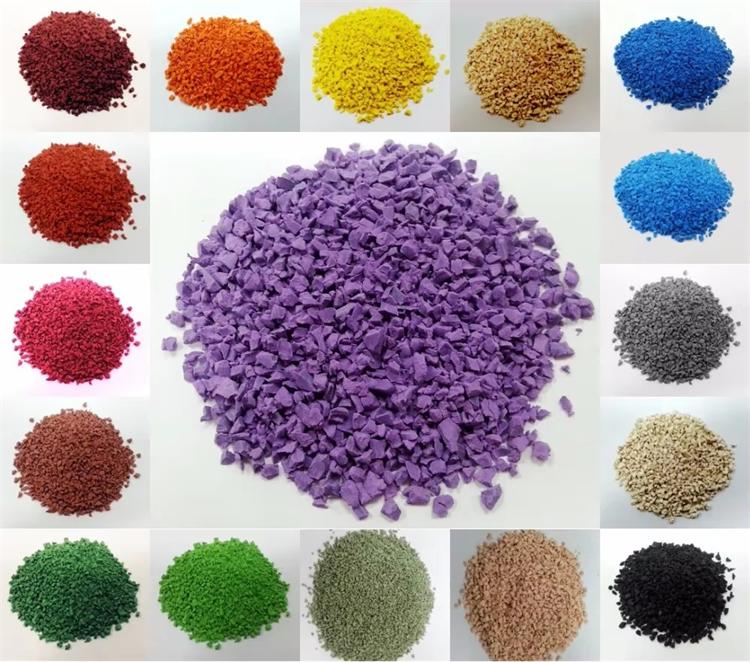
- Color fastness — ask for UV-stable pigments, especially for light colors
- Binder compatibility — EPDM granules must bond properly with the specified PU binder system
FAQ
Can I use the same EPDM granule size for both playgrounds and running tracks in Brazil?
No. Running tracks typically require finer granules (0.5–1.5 mm) for consistent traction and low rolling resistance. Playgrounds benefit from coarser granules (1–3.5 mm) for better impact absorption and drainage. Using one size for both compromises performance .
Does EPDM granule size affect shock absorption performance?
Yes. Coarser granules with more void space between them allow greater compression under impact, which can improve shock absorption when combined with an appropriate SBR base layer. Very fine granules can compact and reduce the system‘s ability to absorb falls .
How does Brazil’s heat affect EPDM granule performance?
High temperatures accelerate aging in low-quality EPDM. Sulfur-cured granules with low polymer content can soften and clump in extreme heat, as seen in several German artificial turf failures. For Brazilian conditions, specify EPDM granules with high polymer content and UV-stable formulation .
What EPDM granule size is used for artificial turf infill in Brazil?
0.5–2.5 mm is the standard range for artificial turf infill. This size provides the right balance of stability, elasticity, and resistance to compaction under cleats and foot traffic .
Can I customize EPDM granule size for a specific Brazilian project?
Yes. Many manufacturers offer custom sizing for projects with unusual specifications. If your project requires a non-standard particle size, color, or polymer content, discuss your requirements with the supplier before ordering .
How do I verify EPDM granule quality before purchasing for a Brazilian project?
Request: (1) particle size distribution data, (2) EPDM polymer content by weight, (3) UV aging test results or color fastness data, and (4) samples for visual inspection of granule shape, color consistency, and dust content. Third-party test reports are preferable for large projects .
Does granule size affect the quantity of EPDM needed per square meter?
Yes, indirectly. Coarser granules have lower bulk density, so you may need slightly more by weight to achieve the same layer thickness. However, installation thickness and binder ratio are the primary factors determining material quantity. For a typical 10 mm EPDM wearing layer, expect approximately 5–6 kg per square meter .

Selecting the right EPDM granule particle size for Brazilian sports projects comes down to matching the granule specification to the application — finer granules for tracks, coarser for playgrounds, and 0.5–2.5 mm for turf infill. But particle size alone isn‘t enough. Brazil’s climate demands EPDM granules with high polymer content, UV stability, and consistent quality to avoid the premature fading, hardening, or clumping that plagues low-grade materials.
If you are sourcing EPDM rubber granules for a Brazilian sports project and need specific particle sizes, colors, or polymer content, contact us to discuss your requirements and request samples.

WOW(LYG) New Material Co Ltd is a manufacturer specializing in the production of EPDM granules. We use sulfur-free vulcanization technology, it increases the service life by more than 3 times than traditional EPDM granules, and enhances the performance, including anti-aging, high-temperature resistance, and colorfastness.
We have over 25 years of production experience and offer customization for colors and granule sizes. NO MOQ.


