 注: 建议图片大小150px*50px

丨
注: 建议图片大小150px*50px Views: 0 Author: Site Editor Publish Time: 2026-09-16 Origin: Site


For most Mexican sports projects, the practical particle size range is 1–3 mm for running tracks and multi-sport courts, and 1–4 mm for playgrounds and wet-pour surfaces. These two specifications cover the majority of sports flooring applications. Smaller granules (0.5–1.5 mm) are used when a smoother, denser surface finish is required, while larger granules (2–4 mm or 3–5 mm) are specified for higher shock absorption or where a more textured surface is acceptable.
The “best” size ultimately depends on three factors: the type of sports surface, the installation system (wet-pour, sprayed, or prefabricated), and the performance requirement (safety, durability, or aesthetics). Mexico’s climate—particularly intense UV exposure in northern and coastal regions—makes particle size consistency and color stability critical considerations, because inconsistent granule sizing can lead to uneven binder coverage and accelerated color degradation.

Applications of EPDM Granules in Mexican Sports Projects
EPDM granules are used across a wide range of sports and recreational surfaces in Mexico:
- Running tracks and athletic fields: Typically specified at 1–3 mm or 1–4 mm, depending on whether the surface is sprayed or troweled. Red granules are the most common for track surfaces due to visibility and UV stability.
- Playgrounds and wet-pour safety surfaces: 1–4 mm granules are standard for poured-in-place playgrounds, often combined with a shockpad beneath for critical fall height compliance. Color options are broader here—green, blue, yellow, and custom shades are frequently requested.
- Multi-sport courts (basketball, tennis, badminton): 1–3 mm granules provide a good balance of texture and smoothness for ball bounce consistency and player safety.
- Artificial turf infill: 0.5–2 mm granules are used as infill material, where a finer size helps the granules settle between turf fibers without excessive migration.
The core problems EPDM granules solve in these applications are: reducing impact injuries, providing consistent ball rebound and player traction, resisting UV fading in high-sunlight environments, and maintaining surface integrity through temperature fluctuations and occasional heavy rain.

Advantages of EPDM Granules for Mexican Conditions
Mexico’s climate presents specific challenges for sports surfacing materials: prolonged UV radiation, high temperatures in many regions, and in some areas, significant rainfall. EPDM granules address these challenges through:
- UV and weather resistance: EPDM’s saturated polymer backbone resists degradation from UV exposure and temperature extremes. However, color stability still depends on pigment quality and, in some cases, the use of UV-resistant top coatings—particularly in hot climates where intense sun can affect lighter or brighter shades.
- Elasticity and impact absorption: EPDM granules provide consistent shock absorption when properly bound with polyurethane binder. The granule size affects the surface’s cushioning characteristics—larger granules generally offer greater compression and energy return.
- Color durability: High-quality EPDM granules with UV-stable pigments maintain appearance longer than lower-grade alternatives. This is especially relevant for Mexican projects where surfaces are exposed year-round.
- Non-toxic and environmentally stable: EPDM is free of heavy metals and meets relevant safety standards for playground and sports surfaces, making it suitable for schools and public facilities.
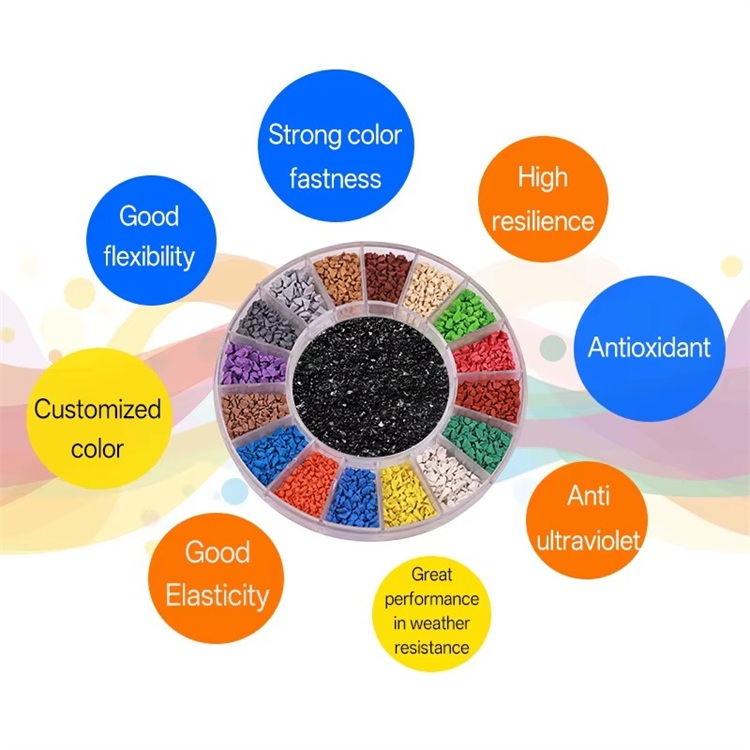
EPDM Granules Customization: Choosing the Right Specification
Selecting the right EPDM granule for a Mexican sports project involves more than just picking a particle size. Procurement teams should consider:
Particle size and distribution. The stated size range (e.g., 1–3 mm) is only part of the picture. Consistent sizing within the range matters because excessive fines or oversized particles can cause uneven binder distribution, leading to weak spots or surface irregularities. Suppliers who sieve their granules carefully and control distribution produce more predictable installation results.
Polymer content. EPDM granules are not 100% pure EPDM rubber. They contain EPDM polymer combined with fillers, pigments, and processing aids. A higher polymer content (e.g., 20% or above) generally correlates with better elasticity, tensile strength, and color retention. For high-traffic or high-performance sports surfaces, specifying a minimum polymer content is advisable.
Color and UV stability. Mexican projects in sunny regions should prioritize granules with proven UV stability. Dark colors (black, dark green, dark red) tend to fade less noticeably than light or pastel shades. If bright colors are required, confirming UV-resistant formulations or top coatings with the supplier is a practical step.
Binder compatibility. EPDM granules must be compatible with the polyurethane binder used in the installation system. Incompatible binder-granule combinations can result in poor adhesion, premature granule release, or surface failure. Suppliers should be able to confirm which binder systems their granules are designed for.
Supply consistency. For projects with specific color, size, or performance requirements, the supplier’s ability to deliver consistent batches over the project timeline is as important as the product specification itself. Variations between batches can create visible color differences or installation inconsistencies.
If you need EPDM granules in a specific particle size range, color, or polymer content for a Mexican sports project, contact us to discuss your requirements and receive a specification-matched quotation.
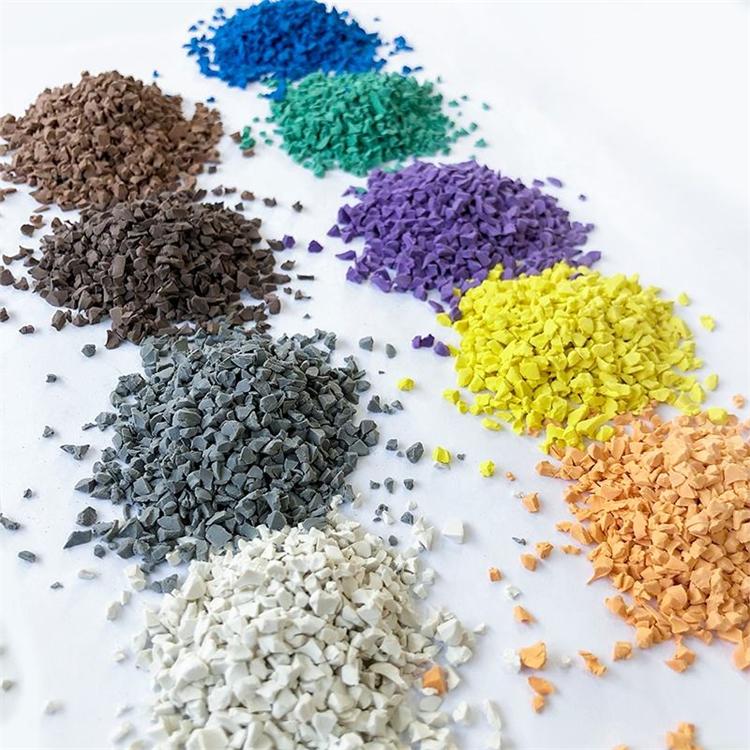
FAQ
Can I use 2–4 mm granules for a running track in Mexico?
Yes, but it is less common than 1–3 mm. Larger granules may be specified for specific track systems or where a more textured surface is acceptable, but 1–3 mm remains the standard for most running track installations because it produces a denser, more consistent wearing surface.
Does particle size affect UV resistance?
Particle size itself does not directly determine UV resistance. UV performance is primarily a function of the EPDM polymer quality and pigment formulation. However, inconsistent or overly fine granule sizes can expose more surface area to UV degradation, potentially accelerating color fade in poorly formulated products.
What is the difference between 1–3 mm and 1–4 mm EPDM granules?
The 1–4 mm range includes larger granules that can provide slightly more cushioning and a more textured surface. 1–3 mm produces a smoother, denser finish. For playgrounds, 1–4 mm is common; for running tracks and courts, 1–3 mm is more typical.
Do I need different granule sizes for the base layer and top layer?
In some wet-pour systems, yes. A common approach is using larger granules (e.g., 2–4 mm) in the base layer for shock absorption and smaller granules (e.g., 1–3 mm) in the wearing surface for appearance and texture. However, many single-layer systems use one size throughout. The installation system specification determines this.
How do I know if EPDM granules are suitable for Mexico’s climate?
The key indicators are UV stability data (accelerated weathering test results, if available) and pigment quality. Suppliers familiar with hot, high-UV markets can typically advise on which color ranges or formulations perform best in those conditions. Darker colors and higher polymer contents are generally safer choices for prolonged sun exposure.
Can EPDM granules be customized for a specific project color?
Yes. Most EPDM granule manufacturers offer custom color matching, though minimum order quantities may apply for non-standard shades. Color consistency across batches should be confirmed before large orders.
What happens if the granule size is inconsistent?
Inconsistent sizing—too many fines or oversized particles—can lead to uneven binder coating, weak adhesion points, and surface irregularities. It may also affect the final surface’s uniformity in appearance and performance. Sourcing from suppliers with controlled sieving processes reduces this risk.
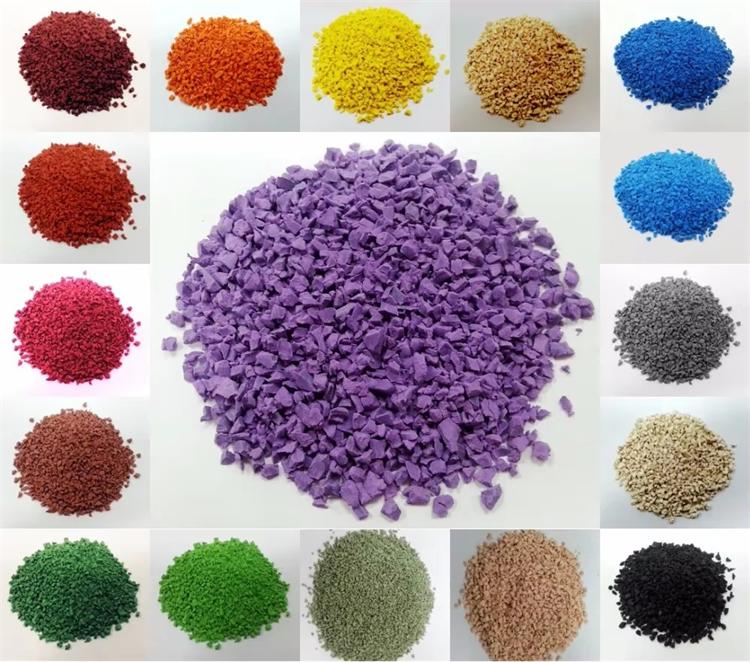
For Mexican sports projects, 1–3 mm EPDM granules serve as the workhorse specification for running tracks and multi-sport courts, while 1–4 mm is the standard for playgrounds and wet-pour safety surfaces. The best choice for a specific project depends on the installation system, performance requirements, and climate conditions. Procurement decisions should account for granule size consistency, polymer content, UV stability, and supplier reliability—not just the headline particle size range. If you are sourcing EPDM granules for a Mexican sports project and need a specific particle size, color, or specification, contact us to discuss your requirements.

WOW(LYG) New Material Co Ltd is a manufacturer specializing in the production of EPDM granules. We use sulfur-free vulcanization technology, it increases the service life by more than 3 times than traditional EPDM granules, and enhances the performance, including anti-aging, high-temperature resistance, and colorfastness.
We have over 25 years of production experience and offer customization for colors and granule sizes. NO MOQ.


