 注: 建议图片大小150px*50px

丨
注: 建议图片大小150px*50px Views: 0 Author: Site Editor Publish Time: 2026-09-15 Origin: Site


For U.S. playgrounds and sports surfaces, there is no single EPDM granule size that is best for every project. For wet-pour playground surfacing, commonly specified EPDM granule sizes are around 1–4 mm, while finer or coarser grades may be selected depending on the surfacing system, layer design, texture, appearance, and performance requirements. For sports surfaces such as running tracks and recreational flooring, the appropriate particle size can also vary according to the system and installation requirements.
The right EPDM granule size should therefore be selected together with color, density, hardness, elasticity, weather resistance, and the requirements of the finished surface. For U.S. projects, consistency in particle size is particularly important because it affects mixing, spreading, surface texture, appearance, and material consumption.
Applications of EPDM Granules
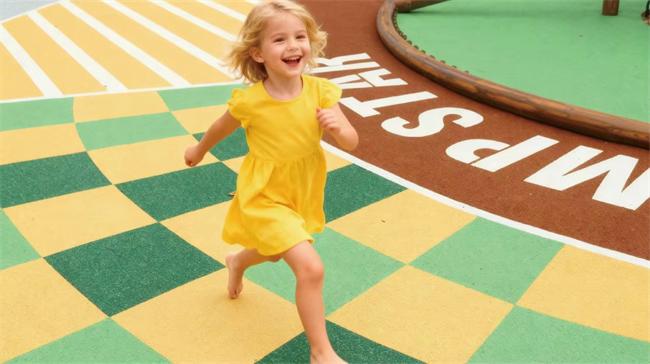
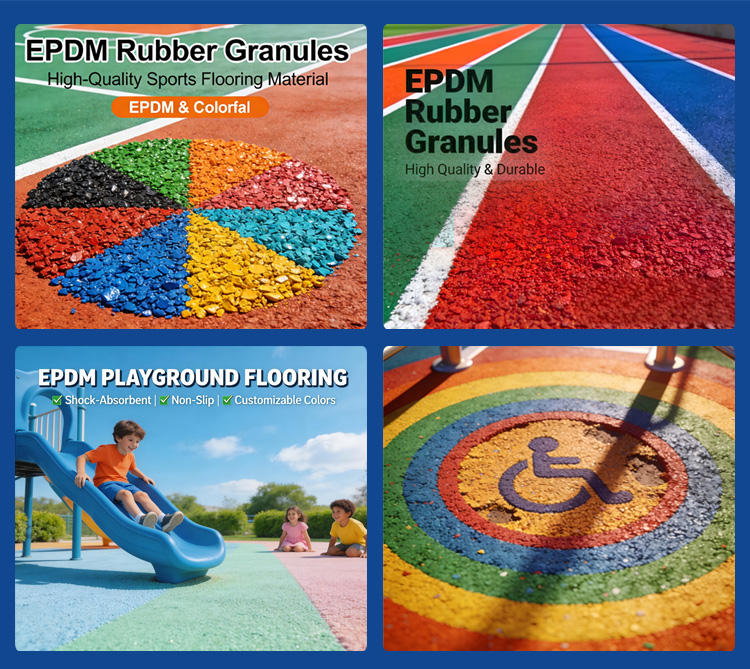
EPDM rubber granules are commonly used as a colored rubber aggregate in wet-pour playground surfaces, running tracks, sports flooring, recreational areas, and other resilient outdoor surfaces.
For playground projects, EPDM granules are often selected when the surface needs a combination of color, resilience, outdoor durability, and a consistent finished appearance. The particle size influences how the granules behave during mixing and installation and contributes to the texture and visual effect of the finished surface.
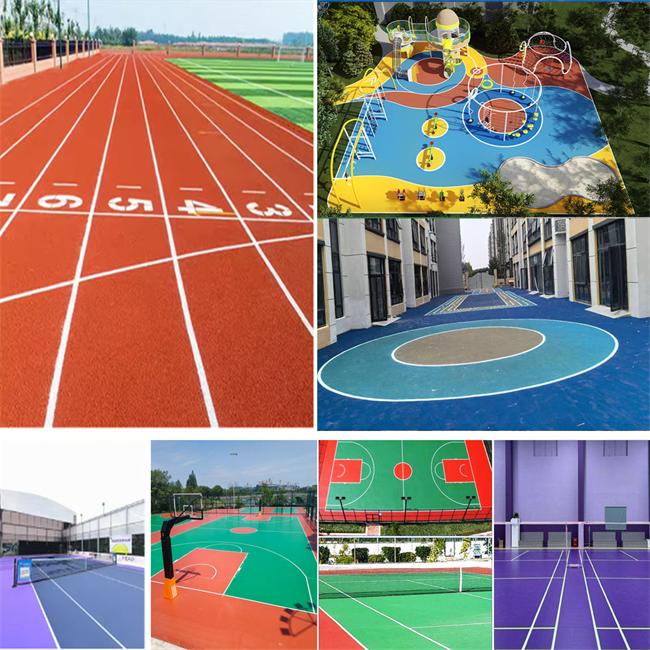
For running tracks and other sports surfaces, particle size needs to be considered as part of the complete surfacing system. The requirements may differ between a track, multi-purpose sports area, recreational flooring system, or another application.
This is why simply asking for "EPDM granules" is often not enough when purchasing material. A supplier needs to understand the intended application and required specification before recommending a particular grade.
Why Does EPDM Granule Size Matter?
Particle size affects more than the appearance of the granules.
1. Surface texture
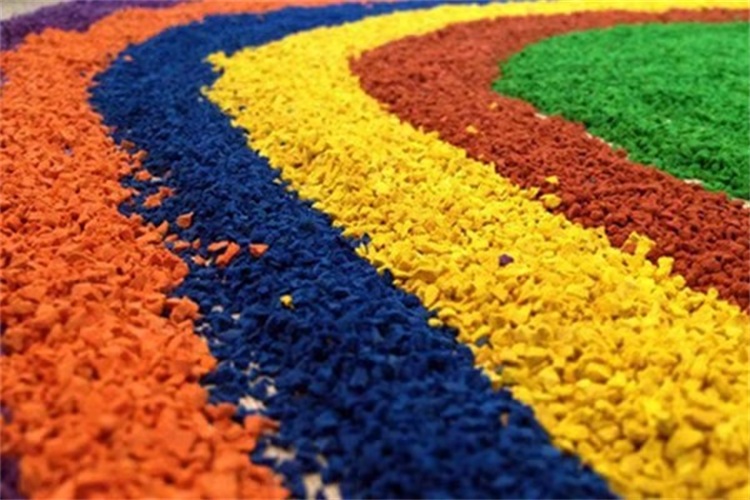
Different granule sizes can produce different surface textures after installation. Finer particles can contribute to a more compact and relatively smooth appearance, while larger granules can create a more pronounced rubber texture.
The final texture also depends on the binder, mixing ratio, installation method, and other components of the surfacing system.
2. Mixing and installation
Granule size influences how EPDM particles mix with polyurethane binder and other materials. Consistent particle sizing can make material handling and installation more predictable.
For contractors, this means that particle-size consistency can be just as important as the nominal size itself.
3. Appearance and color distribution
Particle size can affect how color appears across the finished surface. When a project uses bright colors or multiple colors to create playground patterns, consistent granules can help achieve a more uniform visual result.
For large U.S. playground projects, matching the same color and particle-size specification across multiple orders can also be important.
4. Material consumption
Particle size and bulk density influence how much material is required for a given surface area and thickness. The actual consumption should therefore be calculated based on the complete system rather than particle size alone.
Which EPDM Granule Size Should You Choose?
The best size depends primarily on where and how the EPDM granules will be used.
EPDM Granules for Playground Surfacing
For wet-pour playground applications, a contractor may consider particle sizes in the approximately 1–4 mm range, depending on the specific system and layer requirements.
Different sizes may be used for different layers or surface designs. The correct choice should follow the project's installation specification rather than selecting a size simply because it is commonly available.
For playground buyers, the key questions are:
What particle size does the surfacing system require?
Is the material intended for the base or wearing layer?
What surface texture is required?
What colors are required?
Does the supplier provide consistent particle sizing?
Can the same specification be supplied for future projects?
EPDM Granules for Running Tracks
Running-track systems can have different material requirements from playground wet-pour systems. Particle size should be selected according to the track construction, surface system, binder, required texture, and project specification.
A buyer should avoid assuming that the granule size suitable for a playground automatically provides the same result on a running track.
EPDM Granules for Sports Flooring
For sports and recreational flooring, particle size should be evaluated together with elasticity, surface texture, durability, and the overall flooring system.
The appropriate specification can vary depending on whether the material is being used for a running surface, recreational area, multi-purpose sports facility, or another application.
What Other EPDM Granule Specifications Should Buyers Check?
Particle size is only one part of the purchasing decision.
Color
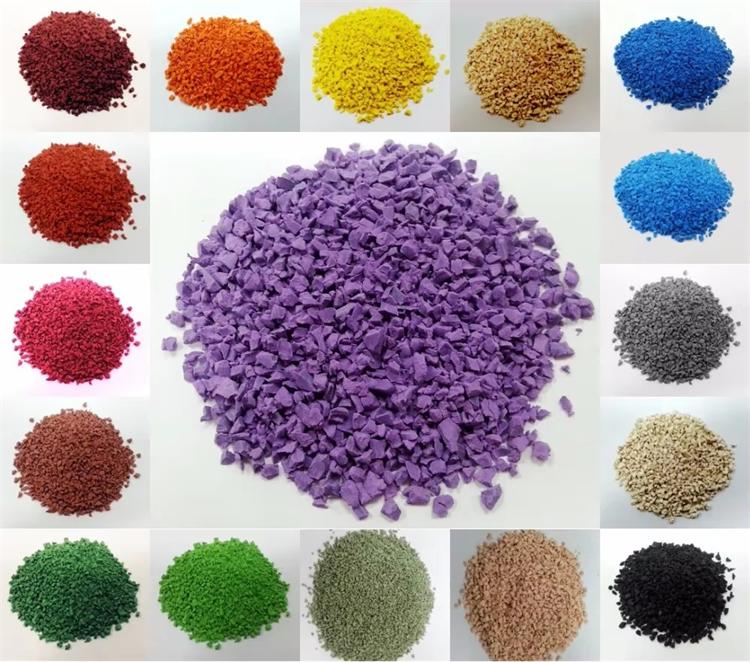
Color is particularly important for playgrounds and recreational surfaces. EPDM granules are available in a wide range of colors, allowing contractors and designers to create functional zones, patterns, logos, and decorative surfaces.
For outdoor U.S. projects, buyers should also consider color stability and resistance to UV exposure rather than evaluating color only from a sample.
Density
Bulk density affects packaging, transportation, material consumption, and how much volume a particular quantity of granules provides.
A lower bulk density can be advantageous for transportation and handling, but buyers should compare density together with the actual performance and application requirements of the material.
Hardness and Elasticity
The required hardness and elasticity depend on the surfacing system and intended application. For resilient outdoor surfaces, the rubber's physical properties can influence how the finished system performs under repeated use.
EPDM granules manufactured with our sulfur-free technology are designed to provide enhanced elasticity and tensile performance. Our product data indicates tensile strength of approximately 4–7 MPa, while the exact performance of the finished surface depends on the formulation, particle size, binder, and installation system.
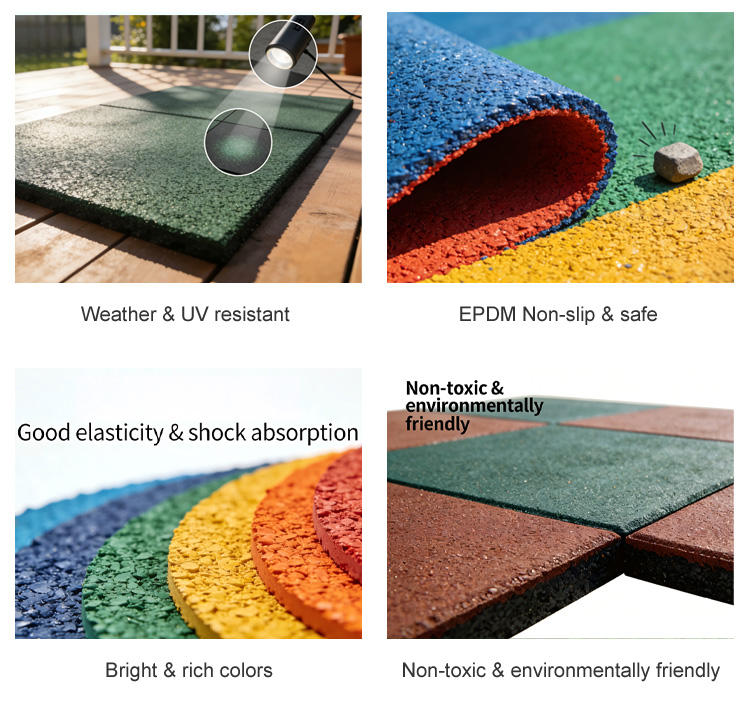
Weather and UV Resistance
Outdoor playgrounds and sports surfaces in the U.S. can be exposed to strong sunlight, temperature changes, rain, snow, and repeated use.
For this reason, EPDM granules should be evaluated for resistance to aging, oxidation, UV exposure, and heat. Color stability is particularly important when bright colors are used in outdoor playgrounds.
Our sulfur-free EPDM technology is designed to improve molecular stability, aging resistance, oxidation resistance, and color retention under demanding outdoor conditions.
What Problems Can Better EPDM Granules Help Solve?
For a contractor or purchasing manager, choosing the right EPDM granules is ultimately about reducing project risks.
A suitable product can help address problems such as:
inconsistent particle size during installation;
uneven surface appearance;
premature color fading;
reduced elasticity after prolonged outdoor exposure;
poor suitability for the selected surfacing system;
difficulty obtaining replacement material with the same color or specification;
inconsistent supply between different orders.
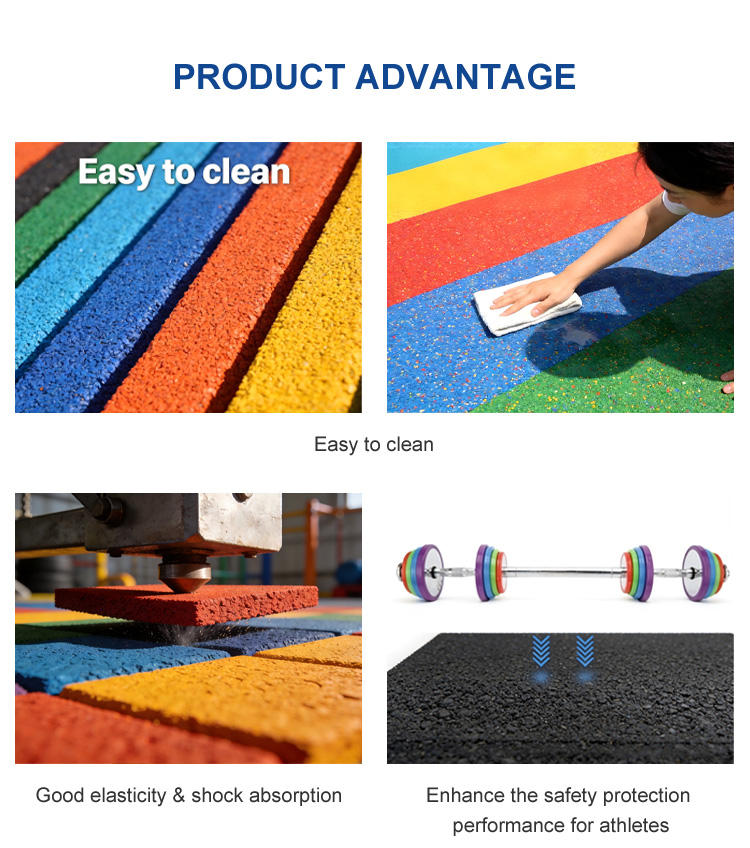
For outdoor applications, material stability becomes especially important. Our EPDM granules use sulfur-free technology, which is intended to improve molecular stability and reduce aging-related performance deterioration.
The material is also designed to be odor-free under normal use because it does not contain sulfur. This characteristic can be relevant for playground and recreational environments where users are in close contact with the surface.
EPDM Granules Customization for U.S. Projects
A U.S. project may require a specification that is different from a standard stock product.
For this reason, EPDM granules can be customized according to:
Particle size
Color
Application
Performance requirements
Packaging
Order quantity
Other agreed specifications
We support customized particle sizes and colors for customers with specific project requirements. Flexible minimum order quantities also make it possible to supply both smaller project requirements and larger commercial orders.
With more than 25 years of industry experience and a complete production line, we can adjust production according to the customer's required granule size, color, and specification.
For buyers importing EPDM granules into the United States, it is also worth considering supply continuity. If the same color or particle size is needed for future projects, it is useful to work with a manufacturer capable of reproducing the agreed specification consistently.
FAQ
What is the most common EPDM granule size for playgrounds?
There is no universal size for every playground system. EPDM granules around 1–4 mm are commonly considered for wet-pour playground applications, but the appropriate size depends on the surfacing design, layer, binder system, and project specification.
Is smaller EPDM granule size always better?
No. Smaller does not automatically mean better. A finer particle may provide a different surface texture and mixing behavior, while larger particles may produce a different visual and textural effect. The correct size is the one that matches the complete surfacing system.
What EPDM granule size is suitable for running tracks?
The required size depends on the specific running-track system and construction method. Buyers should follow the system specification and evaluate particle size together with hardness, elasticity, binder compatibility, and surface texture.
Does EPDM granule size affect color appearance?
Yes. Particle size can influence how a color appears across the finished surface, particularly on large colored areas. Consistent particle sizing and color are therefore important for projects requiring a uniform appearance.
Should I choose EPDM granules based only on particle size?
No. Particle size should be evaluated together with color, density, hardness, elasticity, weather resistance, UV resistance, and the requirements of the complete surfacing system.
Can EPDM granules be supplied in custom sizes and colors?
Yes. EPDM granules can be produced to customized particle-size and color requirements, subject to the manufacturer's production capabilities and the agreed specification. Customization can be useful when a project requires a particular surface appearance or when replacement material needs to match an existing installation.
How can I make sure different EPDM granule orders match?
Provide the supplier with a clear specification covering particle size, color, material requirements, and other relevant parameters. For repeat projects, retaining the approved sample or specification is also useful for maintaining consistency between orders.

For U.S. playgrounds and sports surfaces, the best EPDM granule size is not simply the smallest or largest available—it is the size that matches the intended application and complete surfacing system. Wet-pour playground projects may commonly use granules in the approximately 1–4 mm range, while running tracks and sports flooring can require different specifications.
When sourcing EPDM rubber granules, look beyond particle size. Consistent granule sizing, color stability, weather resistance, elasticity, material performance, customization capability, and reliable supply can all affect the success of a project.
If you are sourcing EPDM granules for a U.S. playground, running track, sports flooring or wet-pour project and already know the required particle size, color, or specification, we can discuss the material requirements and provide a customized EPDM granule solution for your project.

WOW(LYG) New Material Co Ltd is a manufacturer specializing in the production of EPDM granules. We use sulfur-free vulcanization technology, it increases the service life by more than 3 times than traditional EPDM granules, and enhances the performance, including anti-aging, high-temperature resistance, and colorfastness.
We have over 25 years of production experience and offer customization for colors and granule sizes. NO MOQ.


