 注: 建议图片大小150px*50px
丨
注: 建议图片大小150px*50px Views: 0 Author: Site Editor Publish Time: 2026-09-02 Origin: Site


Before placing an order, the most important questions to ask an EPDM granule manufacturer are: What EPDM granule specifications are suitable for your application? How consistent is the particle size, color, and material performance across batches? What is the material composition, and how does it affect durability, UV resistance, color stability, odor, and installation?
For projects such as playgrounds, running tracks, sports surfacing, and wet pour rubber surfaces, asking these questions helps you confirm whether the granules match the required performance, appearance, and installation conditions. It also reduces the risk of ordering material that looks suitable on paper but performs differently on site.

Why These Questions Matter
EPDM rubber granules are not a one-size-fits-all material. The same product name can cover different particle sizes, colors, densities, hardness ranges, and performance characteristics. If you only ask about price or availability, you may miss important factors that affect long-term performance.
A reliable manufacturer should be able to explain:
Which granule size range is suitable for your surface system
Whether the color is stable under UV exposure and outdoor weathering
How the material behaves during mixing, pouring, and curing
Whether the granules are suitable for playgrounds, running tracks, sports areas, or other wet pour applications
What batch-to-batch consistency you can expect
Whether custom colors, particle sizes, or specifications are available for your project
This is especially important for contractors and procurement teams, because surface appearance, safety performance, and installation efficiency all depend on choosing the right EPDM granule specification.

Key Questions to Ask an EPDM Granule Manufacturer
What EPDM Granule Sizes Do You Offer?
Particle size affects surface texture, drainage, binder consumption, compaction, and final appearance. Different applications may require different granule ranges.
For example, finer granules may help create a smoother or more uniform surface layer, while larger granules may be used where different texture, thickness, or cushioning characteristics are required. The exact choice depends on the surface system, design thickness, binder type, and project specification.
Ask the manufacturer:
What particle size ranges are available?
Can you supply a specific size range for our application?
How consistent is the particle size within each batch?
Do you recommend different sizes for base layers and wear layers?
What Colors Are Available, and How Stable Are They?
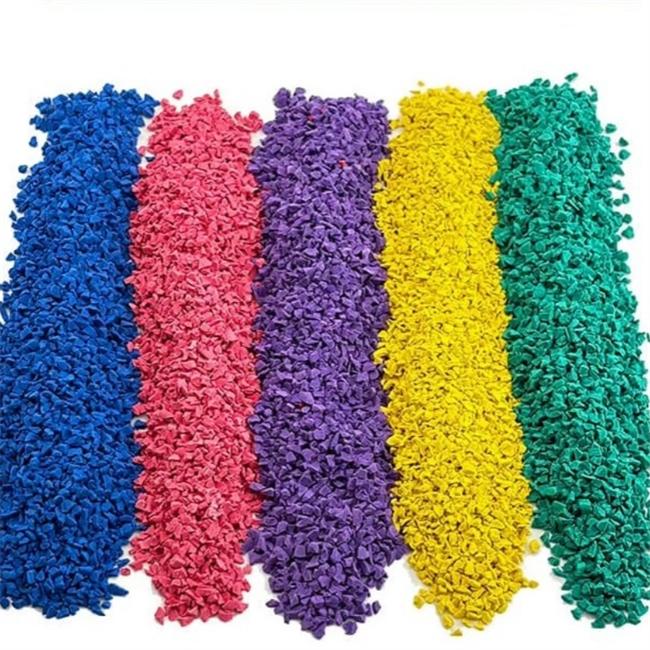
Color is often important for playgrounds, sports surfacing, running tracks, and decorative wet pour surfaces. However, color selection should not be based only on appearance.
You should ask whether the color can maintain its visual performance after long-term exposure to sunlight, rain, temperature changes, and regular use. UV resistance and color stability are especially important for outdoor projects.
Useful questions include:
Which standard colors are available?
Can you match a specific color for the project?
How does the color perform under UV exposure?
Is the color consistent between different production batches?
Do you recommend certain colors for high-sunlight or high-traffic areas?
What Is the Material Composition?
The composition of EPDM rubber granules can influence odor, weather resistance, aging resistance, elasticity, and long-term performance. Not all EPDM granules are produced with the same formulation or manufacturing process.
A practical question to ask is whether the granules contain sulfur or sulfur-related components. Sulfur-free EPDM granules are often preferred for applications where low odor is important, especially in warm weather or strong sunlight.
You can ask:
Are the granules sulfur-free?
What is the EPDM content or material composition?
Are the granules suitable for indoor, outdoor, or child-friendly environments?
Do the granules produce odor during installation or after curing?
Can you provide technical data relevant to our application?
How Do the Granules Perform Under UV, Heat, and Weather Exposure?
Outdoor rubber surfaces are exposed to sunlight, rain, temperature changes, and repeated use. For these environments, UV resistance, weather resistance, and heat resistance are important selection factors.
Ask the manufacturer:
How do the granules resist UV exposure?
Are they suitable for hot climates or high-temperature environments?
How do they perform after long-term outdoor exposure?
Do they resist oxidation and color fading?
Are they suitable for regions with strong sunlight, heavy rain, or large temperature changes?
The actual performance may vary depending on granule size, color, formulation, binder system, installation quality, and local climate.
Can You Customize Granule Size, Color, or Specification?
Many projects have specific design or performance requirements. A standard catalog may not always meet every need.
If your project requires a particular color, particle size, or specification, ask whether the manufacturer can customize the product. Customization capability is especially useful for playground designers, contractors working on branded sports areas, or procurement teams managing large-volume orders.
Ask:
Can you produce custom colors?
Can you adjust particle size distribution?
What is the minimum order quantity?
Can you supply consistent material for multi-batch projects?
How long does production take for custom orders?
How Do You Control Quality and Batch Consistency?
Consistency matters more than many buyers realize. If granule size, color, or material properties vary between batches, the finished surface may show visible differences or behave differently during installation.
Ask the manufacturer:
How do you control particle size consistency?
How do you ensure color matching between batches?
Do you inspect material before shipment?
Can you provide samples before bulk production?
How do you handle large or repeated orders?
For contractors, consistent material means more predictable mixing, laying, and finishing. For procurement teams, it means fewer surprises during delivery and installation.
What Applications Are Your EPDM Granules Suitable For?
Different applications place different demands on EPDM granules. A product suitable for one type of wet pour surface may not be the best choice for another.
Common applications include:
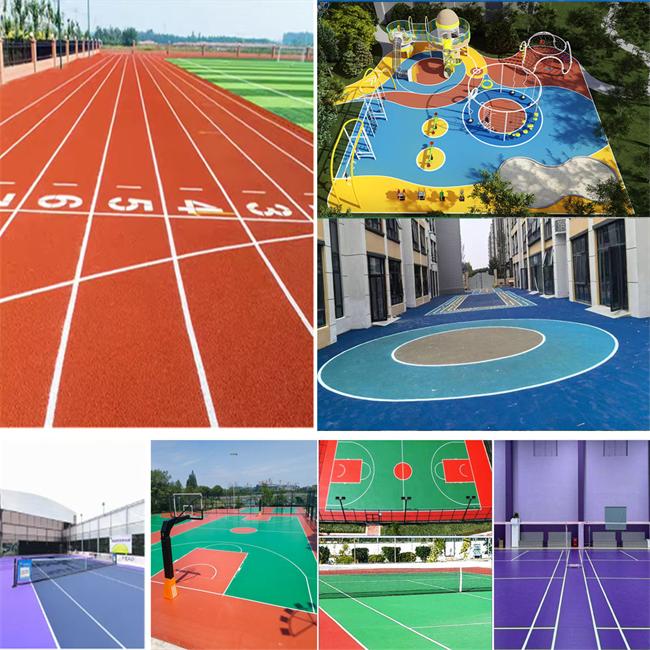
Playground surfaces
Running tracks
Sports surfacing
Wet pour rubber surfaces
Recreational and landscape areas
Safety and impact-absorbing surfaces
Ask the manufacturer which applications their granules are designed for, and whether they can recommend a suitable specification based on your project type, thickness, climate, and performance expectations.
What Technical Data, Samples, or Certifications Can You Provide?
Before making a purchasing decision, it is reasonable to request supporting information. This helps engineers, contractors, and procurement teams confirm that the material meets project requirements.
You can ask for:
Product samples
Particle size information
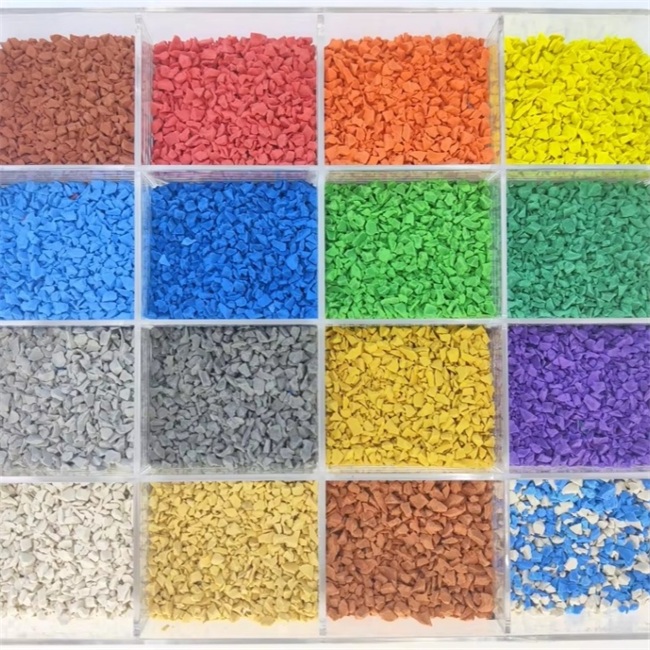
Color samples or color charts
Technical data sheets
Safety or environmental information
Installation recommendations
Batch consistency records
Avoid manufacturers who cannot clearly explain their product specifications or who rely only on general marketing claims.

Practical Considerations When Choosing EPDM Granules
For Contractors and Installers
Installation performance is just as important as product appearance. Ask whether the granules mix well with binder, lay evenly, and produce a consistent surface finish. Irregular particle size or inconsistent color can affect both installation efficiency and final appearance.
Also consider:
Whether the granules suit your chosen binder system
Whether the recommended mixing ratio is clear
Whether the material is easy to handle on site
Whether the surface texture meets the project design
For Procurement Teams
When purchasing EPDM granules, focus on long-term value rather than unit price alone. A lower price may not be economical if the material has poor color stability, inconsistent particle size, or limited suitability for the intended application.
Key purchasing factors include:
Specification clarity
Batch-to-batch consistency
Color and size customization
Supply reliability
Lead time
Minimum order flexibility
Technical support
For Playground and Sports Surfacing Projects
Safety, appearance, and durability are usually the main concerns. EPDM granules used in playgrounds and sports areas should be selected based on the required surface performance, design thickness, color scheme, and environmental conditions.
Ask the manufacturer whether their granules are suitable for:
Impact-absorbing playground surfaces
Color-coded sports areas
Running tracks
Outdoor recreational surfacing
Projects requiring long-term color retention
For Outdoor Projects in Hot or High-UV Climates
If the project is located in a region with strong sunlight and high temperatures, UV resistance, heat resistance, and color stability become more important. Sulfur-free EPDM granules may be a better choice where low odor and improved weather resistance are required.
However, actual performance depends on the full surface system, not just the granules. Always confirm suitability with the manufacturer based on your local climate and installation method.
How to Choose the Right EPDM Granules for Your Project
A practical selection process should follow these steps:
Confirm the application
Identify whether the surface is for a playground, running track, sports surfacing, wet pour area, or recreational space.
Define the required granule size
Choose a particle size range that matches your surface design, thickness, and texture requirements.
Select the color based on design and UV exposure
For outdoor projects, prioritize color stability and UV resistance, not only initial appearance.
Check material composition
If low odor, weather resistance, and long-term performance are important, ask whether the granules are sulfur-free and oxidation-resistant.
Request samples and technical data
Samples help confirm color, texture, and particle size before bulk ordering.
Confirm batch consistency
For large projects, consistent material across batches helps avoid visual and performance differences.
Discuss customization and supply capacity
If your project needs specific colors, sizes, or repeated deliveries, confirm that the manufacturer can support your requirements.
FAQ
What is the most important question to ask an EPDM granule manufacturer?
The most important question is whether the granule specification matches your application. You should confirm particle size, color, material composition, UV resistance, batch consistency, and suitability for your specific surface system.
How do I know if EPDM granules are suitable for outdoor use?
Ask the manufacturer about UV resistance, weather resistance, color stability, heat resistance, and oxidation resistance. Outdoor projects usually require granules that can maintain performance and appearance after long-term exposure to sunlight and weather.
Why should I ask whether EPDM granules are sulfur-free?
Sulfur-free EPDM granules are often associated with lower odor, especially in hot or sunny conditions. They may also offer better resistance to certain aging factors, depending on the formulation and application environment.
Can EPDM granule color fade over time?
Color stability depends on the material formulation, pigment quality, UV exposure, climate, installation method, and maintenance. For outdoor projects, ask the manufacturer about color retention and UV resistance before selecting a color.
Does particle size affect installation?
Yes. Particle size can influence surface texture, binder consumption, mixing behavior, compaction, and final appearance. The best particle size depends on the surface system and project requirements.
Should I request samples before placing a bulk order?
Yes. Requesting samples helps you check color, particle size, texture, and overall suitability before committing to a large order. This is especially useful for projects with strict design or performance requirements.
What information should I provide to the manufacturer?
You should provide the application type, project location or climate conditions, required granule size, color preference, estimated quantity, installation method, and any performance or design requirements. The more specific your information, the more accurate the recommendation will be.
Final Checklist Before Ordering EPDM Granules
Before confirming an order, make sure you have clear answers to these questions:
Is the granule size suitable for the project?
Is the color appropriate for the design and UV exposure?
Is the material composition clearly explained?
Are the granules sulfur-free if low odor is required?
Can the manufacturer provide consistent batches?
Are samples and technical data available?
Can the manufacturer support custom colors, sizes, or specifications?
Is the supply capacity suitable for your project timeline?
Answering these questions before ordering helps you choose EPDM rubber granules that are suitable for the application, reliable in performance, and practical for procurement and installation.

If you are planning a playground, running track, sports surfacing, or wet pour project and need EPDM rubber granules in specific colors, particle sizes, or specifications, contact us to discuss your requirements and request suitable product options.
WOW(LYG) New Material Co Ltd is a manufacturer specializing in the production of EPDM granules. We use sulfur-free vulcanization technology, it increases the service life by more than 3 times than traditional EPDM granules, and enhances the performance, including anti-aging, high-temperature resistance, and colorfastness.
We have over 25 years of production experience and offer customization for colors and granule sizes. NO MOQ.


