 注: 建议图片大小150px*50px
丨
注: 建议图片大小150px*50px Views: 0 Author: Site Editor Publish Time: 2026-09-01 Origin: Site


For most wet pour rubber surfacing projects, 1–3 mm EPDM granules are the standard choice for the top wearing layer, while 2–5 mm or 2–6 mm granules are commonly used in the base layer. The best size depends on the layer position, surface finish, impact absorption needs, and the type of project — such as a playground, running track, school yard, or sports area.
A single "best size" does not apply to every wet pour system. The top layer usually needs finer granules for a smoother, more consistent finish, while the base layer can use slightly larger granules to support cushioning, thickness, and cost efficiency.

If you are choosing EPDM granule size for a wet pour system, a practical starting point is:
Top layer / wearing course: 1–3 mm EPDM granules
Base layer / cushioning course: 2–5 mm or 2–6 mm EPDM granules
Playgrounds and schools: 1–3 mm top layer for smoothness and color consistency
Running tracks and sports areas: 1–3 mm or 1–4 mm top layer, depending on finish and performance requirements
Thicker impact-absorbing systems: 2–5 mm or 2–6 mm granules in the base layer
For projects where appearance matters, such as playgrounds, school yards, and decorative safety surfaces, 1–3 mm granules are usually preferred because they create a more uniform surface, better color definition, and a cleaner visual finish.

Why Granule Size Matters in Wet Pour Surfacing
EPDM granule size affects more than just appearance. It influences how the surface looks, performs, and wears over time.
Surface Smoothness
Smaller granules, such as 1–3 mm, generally produce a smoother and more even top surface. This is important for areas where children run, play, or fall, because a consistent surface reduces uneven texture and improves usability.
Larger granules can create a more open or textured finish. That may be suitable for some base layers, but it is less ideal for the visible top layer of a playground or sports surface.
Color Appearance and Design Clarity
Wet pour surfacing is often chosen for its color options and design flexibility. Smaller EPDM granules help colors appear more consistent and patterns look sharper.
If the project includes logos, game markings, themed areas, or multi-color designs, 1–3 mm granules usually give better visual control. Larger granules may reduce pattern clarity because each particle covers more surface area.
Binder Coverage and Mix Consistency
Granule size also affects how polyurethane binder wraps around each particle. If granules are too large or inconsistent, binder distribution may become less uniform. If granules are too fine without proper grading, the mix can become denser and may affect workability.
That is why particle size consistency matters as much as the size range itself. A well-graded EPDM granule helps produce a more predictable mix, better compaction, and a more reliable finished surface.
Cushioning and Layer Performance
Wet pour systems often use two layers:
Base layer for shock absorption and thickness
Top layer for wear resistance, color, and surface finish
The base layer does not need the same visual smoothness as the top layer. Using 2–5 mm or 2–6 mm granules in the base layer can help build thickness and cushioning without unnecessarily increasing material cost in the wearing course.
Durability and Wear Resistance
Granule size alone does not determine durability. The performance of a wet pour surface also depends on EPDM material quality, binder ratio, mixing method, installation thickness, substrate condition, and long-term exposure to UV, rain, heat, and foot traffic.
However, a consistent granule size helps installers achieve a more even surface, which can support better long-term wear performance.

Practical Considerations When Choosing EPDM Granule Size
Before selecting a granule size, it is useful to look at the project requirements rather than choosing a size in isolation.
Project Type
Different applications have different priorities:
Playgrounds: smoothness, color design, safety, and UV resistance
School yards: durability, visual appeal, and consistent finish
Running tracks: surface uniformity, performance, and weather resistance
Sports surfacing: cushioning, traction, and long-term color stability
Decorative outdoor areas: color accuracy and design flexibility
Surface Finish Requirements
If the client expects a clean, smooth, and visually consistent surface, finer granules are usually more suitable for the top layer. If the surface is mainly functional and appearance is less critical, slightly larger granules may be acceptable in the base layer.
Layer Thickness
Thicker wet pour systems often require a stronger cushioning base. In these cases, larger granules in the base layer can help achieve the required depth and shock absorption. The top layer should still be chosen based on finish, wear, and color requirements.
Color and Pattern Design
For multi-color designs, smaller granules usually give better pattern definition. If the design includes curves, logos, or contrasting zones, the granule size should support visual clarity rather than blur the design.
Climate and Outdoor Exposure
Outdoor wet pour surfaces are exposed to sunlight, rain, temperature changes, and repeated use. EPDM granules used in these environments should maintain color stability and resist weathering over time.
Color retention depends on pigment quality, material formulation, UV exposure, and installation conditions. Choosing granules with stable color performance is especially important for projects where appearance matters over the long term.
Installation System
The recommended granule size may vary depending on the binder type, mixing ratio, installation method, and installer experience. Always check the granule size recommendation with the installer or system supplier before placing an order.
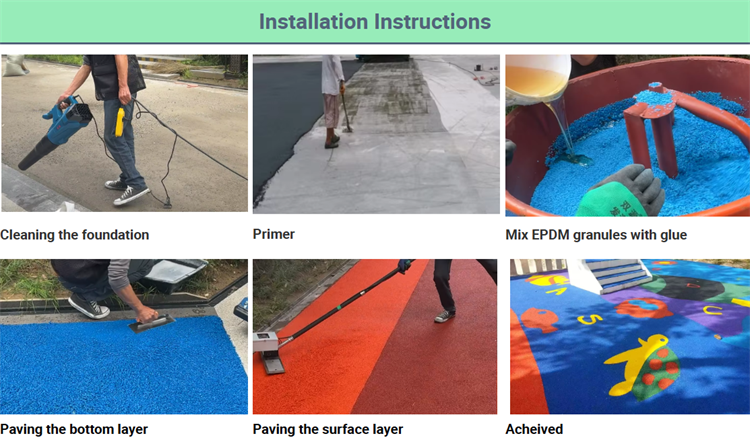
How to Choose EPDM Granules for Wet Pour Projects
When selecting EPDM granules, size should be considered together with color, consistency, material performance, and application requirements.
Match the Size to the Layer
Use a clear layer-by-layer approach:
Top layer: 1–3 mm for smoothness, color clarity, and visual consistency
Base layer: 2–5 mm or 2–6 mm for cushioning, thickness, and structural support
Decorative surfaces: smaller granules for sharper patterns and cleaner color separation
High-use outdoor areas: consistent granule size to support even mixing and reliable installation
Check Particle Size Consistency
Uniform granule size helps reduce variation during mixing and installation. If granules contain too much dust, oversized particles, or irregular fragments, the finished surface may look uneven or perform inconsistently.
For procurement purposes, it is useful to confirm:
The main particle size range
Whether the granules are screened or graded
The level of fines or oversized particles
Whether the supplier can provide consistent batches
Consider Color Stability
Wet pour surfaces are often installed outdoors, so color stability matters. EPDM granules with good UV and oxidation resistance are more suitable for long-term outdoor use.
If your project uses bright colors, custom shades, or multi-color designs, ask the supplier about color consistency between batches. This helps avoid visible differences when new areas are added or repaired later.
Balance Performance and Cost
Using 1–3 mm granules in both layers may give a very fine finish, but it can increase material cost unnecessarily. A more practical approach is often:
Finer granules in the visible top layer
Slightly larger granules in the base layer
Consistent quality across both layers
This helps balance appearance, cushioning, installation efficiency, and project cost.
Confirm Application Compatibility
Before ordering, confirm that the selected granule size matches the project specification, installer recommendation, and surface system. Different contractors and system designs may prefer slightly different size ranges.
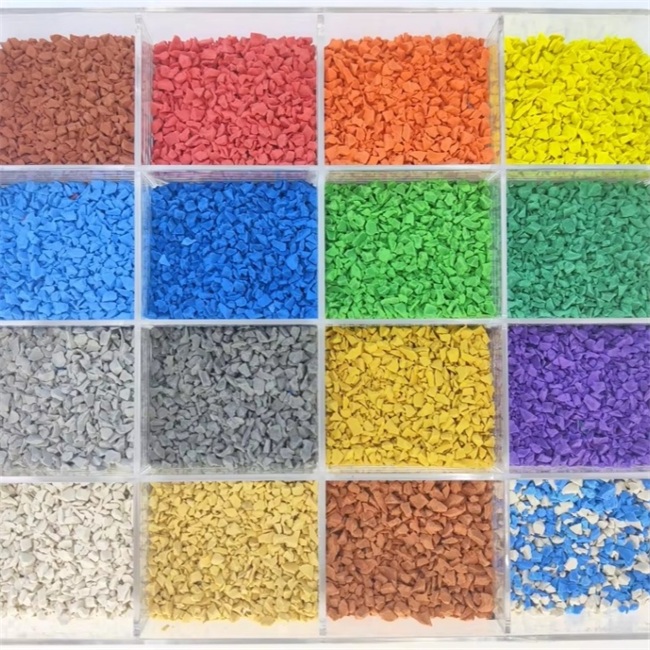
EPDM Granules Selection
When choosing EPDM rubber granules for wet pour surfacing, focus on these factors:
Particle size range: 1–3 mm for top layers; 2–5 mm or 2–6 mm for base layers
Size consistency: uniform granules support better mixing and surface finish
Color stability: important for outdoor playgrounds, tracks, and decorative surfaces
UV and weather resistance: needed for long-term outdoor performance
Elasticity and cushioning: relevant for safety surfaces and sports areas
Batch consistency: important for large projects or phased installations
Custom color and size availability: useful for branded designs and project-specific requirements
If your project requires specific colors, particle sizes, or performance characteristics, it is better to confirm these details with the supplier before production.
FAQ
Is 1–3 mm EPDM granule size suitable for playground wet pour surfaces?
Yes. 1–3 mm EPDM granules are commonly used for the top layer of playground wet pour surfaces because they provide a smooth finish, good color consistency, and better visual clarity for designs and safety markings.
Can larger EPDM granules be used in wet pour surfacing?
Yes, but usually in the base layer. Granules such as 2–5 mm or 2–6 mm are often used for cushioning and thickness. For the visible top layer, smaller granules are usually preferred to improve surface smoothness and appearance.
Does granule size affect the color appearance of wet pour surfacing?
Yes. Smaller granules generally help colors look more uniform and patterns appear sharper. Larger granules can create a more textured look, which may be suitable for some base layers but less ideal for detailed decorative surfaces.
Which EPDM granule size is better for running tracks?
Running tracks often use 1–3 mm or 1–4 mm granules in the top layer, depending on the required surface finish and performance. The final choice should be confirmed with the installer or system designer.
Does granule size affect shock absorption?
Granule size can influence layer structure, but shock absorption depends on the complete wet pour system, including base layer thickness, binder ratio, material elasticity, and installation quality. The base layer usually plays a larger role in cushioning than the top layer.
Should I use the same granule size for both layers?
Not necessarily. A common approach is to use finer granules in the top layer for appearance and wear resistance, and slightly larger granules in the base layer for cushioning and cost efficiency.
How do I confirm the right EPDM granule size for my project?
Check the project specification, surface thickness, application type, and installer recommendation. If the project includes custom colors or designs, confirm granule size, color stability, and batch consistency with the supplier before ordering.

For most wet pour projects, 1–3 mm EPDM granules are the best choice for the top layer, while 2–5 mm or 2–6 mm granules are more suitable for the base layer. The right size depends on surface smoothness, color design, cushioning needs, installation thickness, and long-term outdoor performance.
If you are planning a playground, running track, school yard, or sports flooring project and need EPDM rubber granules in a specific size, color, or specification, contact us to discuss your requirements and get a suitable product recommendation.

WOW(LYG) New Material Co Ltd is a manufacturer specializing in the production of EPDM granules. We use sulfur-free vulcanization technology, it increases the service life by more than 3 times than traditional EPDM granules, and enhances the performance, including anti-aging, high-temperature resistance, and colorfastness.
We have over 25 years of production experience and offer customization for colors and granule sizes. NO MOQ.


