 注: 建议图片大小150px*50px
丨
注: 建议图片大小150px*50px Views: 0 Author: Site Editor Publish Time: 2026-07-15 Origin: Site


You've secured the bid, the EPDM granules are on site, and the weather forecast looks promising. But within six months, the surface starts to fail—granules shedding, colors fading, or the rubber separating from the sub-base. The client is unhappy, your reputation takes a hit, and you're facing costly repairs out of your own pocket.
This scenario plays out far more often than it should. Based on industry data, premium materials account for only about 30% of a project's success—the remaining 70% depends entirely on the engineering and installation process . Even the highest-quality EPDM granules will fail if the installation is compromised.
This guide walks through the seven most common wet pour installation mistakes, why they happen, and exactly how to avoid them—so your next project delivers the durability, safety, and appearance your clients expect.

What Is Wet Pour EPDM Surfacing?
Wet pour is a seamless rubber safety surfacing system installed on-site by mixing rubber granules with a polyurethane binder and applying it in two layers .
The two-layer structure:
- Base layer (SBR) : Made from recycled rubber granules (typically from tyres), this layer provides critical shock absorption and determines the critical fall height rating
- Wearing course (EPDM) : The top layer of colored EPDM (ethylene propylene diene monomer) granules, which provides UV resistance, color stability, and a non-slip finish
Common applications:
- Playgrounds and nursery areas
- Sports courts and multi-use games areas
- Fitness trails and outdoor gym zones
- Splash parks and water play areas
- Accessible pathways and sensory gardens
The key advantage of wet pour is its seamless, joint-free finish—no loose material, no trip hazards, and consistent impact absorption across the entire surface .

Mistake 1: Neglecting Sub-Base Preparation
The problem: Poor sub-base preparation is the leading cause of wet pour failure . An uneven, contaminated, or poorly drained base compromises adhesive bonding and telegraphs imperfections through the finished surface.
What happens when you skip this step:
- The rubber layer doesn't bond properly to the substrate
- Water pools in low spots, accelerating surface degradation
- The finished surface shows unevenness and creates trip hazards
- Cracking and lifting occur as the base shifts
The fix:
For installations over soil, excavate to an appropriate depth and compact a minimum of 100mm (4 inches) of MOT Type 1 stone as a free-draining sub-base . Always lay a geotextile membrane between soil and sub-base to prevent weed growth and root encroachment .
For installations over existing hard surfaces (concrete or tarmac):
- Ensure the surface is completely dry before application—trapped moisture will cause adhesive failure
- Clean thoroughly to remove contaminants like oil, dust, or old paint
- Check for cracks and repair before installing
- Cut a keying channel (approximately 5mm deep) around the edges to lock the rubber in place
Critical standard: For fall height safety compliance, the sub-base must meet BS EN 1177 impact attenuation requirements .

Mistake 2: Incorrect Binder-to-Granule Ratios
The problem: Too little binder and the surface won't hold together—granules shed and the surface crumbles. Too much binder and the mixture becomes too wet, resulting in a dense, less porous surface with poor drainage and reduced impact absorption.
What happens:
- Insufficient binder (under 10%) : Granules loosen and sweep away under foot traffic—one of the most visible signs of poor installation
- Excessive binder (over 20%) : The surface becomes overly dense, reducing its shock-absorbing properties and creating a smooth, potentially slippery finish
The fix:
The industry standard ratio for EPDM top layers is 18% binder by weight . For SBR base layers, the ratio is typically 10-12% binder .
Layer Type--Binder Ratio--Notes
EPDM Top Layer:18-20%, Higher binder for durability and color retention
SBR Base Layer: 10-12%, Lower binder allows greater porosity for drainage
Always use precise weighing equipment—not guesswork—when measuring materials on site.

Mistake 3: Ignoring Weather Conditions
The problem: Polyurethane binders react chemically with moisture. Installing in rain, high humidity, or even morning dew can trigger micro-foaming—a chemical reaction where moisture causes the binder to foam and bubble within the surface .
What happens:
- The finished surface develops a foamy, discolored appearance—often white or yellowish spots
- Microscopic bubbles weaken the binder, leading to premature surface breakdown
- In severe cases, the top layer becomes friable and sheds granules rapidly
The fix:
- Only install when the forecast shows at least 24 hours of dry weather
- Check under decks and in shaded areas for lingering moisture—these spots often stay damp longer
- Never start too early in the day—dew and ground moisture may still be present
- Ideal installation temperatures: 4-27°C (40-80°F)
Post-installation: Each layer requires 24-48 hours to fully cure under suitable conditions . Protect the area from foot traffic and water during this period.

Mistake 4: Inadequate Drainage Design
The problem: Water pooling on the surface doesn't just create a slip hazard—it penetrates the rubber, weakens the adhesive bond, and accelerates degradation of both the EPDM top layer and SBR base layer.
What happens:
- Standing water breaks down the binder, causing granules to loosen
- Moisture penetrates through seams to the adhesive layer, causing failure from the bottom up
- Over time, water pooling leads to mold and bacterial growth beneath the surface
- Freeze-thaw cycles in cold climates can cause cracking and spalling
The fix:
- Design the installation with a minimum 1-2% slope to direct water away from the surface
- For grass-level installations, raise the surface slightly above surrounding ground level to aid drainage
- In flood-prone areas, consider installing drainage channels before laying the sub-base
- Regular maintenance: inspect and clear drainage channels to prevent blockages
Mistake 5: Failing to Account for Critical Fall Height
The problem: This is potentially the most serious mistake—installing wet pour at insufficient depth for the height of adjacent play equipment, resulting in a surface that fails safety standards.
What happens:
- The surface doesn't provide adequate impact attenuation
- Children are at risk of serious head injury from falls
- The installation fails regulatory inspection and may need complete replacement
- Legal liability for the contractor and facility owner
The fix:
Critical Fall Height (CFH) is determined by the highest point of the play equipment from which a child could fall. The required wet pour depth is directly correlated to CFH:
Wet Pour Depth --Critical Fall Height
40mm --1.3m
60mm --2.0m
80mm --2.5m
100mm --2.6m
140mm --3.0m
Key standards: All installations must comply with BS EN 1177 (impact-attenuating playground surfacing) and BS EN 1176 (playground equipment) .
Practical tip: Play areas often contain equipment of varying heights, each requiring its own fall zone and depth specification . Map all equipment and ensure the surrounding surface meets the requirement for the highest adjacent equipment.

Mistake 6: Rushing the Curing Process
The problem: The "first 72 hours" rule is critical—if you allow foot traffic, heavy loads, or equipment to access the surface before the binder has fully cured, you create permanent damage .
What happens:
- The adhesive bond is disrupted, creating ripples and indentations in the surface
- Heavy point loads (like ladder feet or playground equipment) cause permanent depressions
- The surface appears uneven and unprofessional
The fix:
- Allow 24-48 hours minimum for initial cure
- For heavy point loads (playground equipment, sports equipment), extend the restriction period to 72 hours
- Maintain stable temperature and humidity during the curing period
- Securely barrier the area and post clear signage
Pro tip: Even after the surface feels firm, the chemical bond continues to strengthen over several days. Treat the curing period with the same care as the installation itself.

Mistake 7: Choosing Low-Quality EPDM (Especially "Recycled EPDM")
The problem: Not all EPDM granules are created equal. The term "EPDM" has become somewhat generic, and some suppliers offer recycled EPDM that is inferior to virgin material—often misrepresented as "virgin" .
What happens:
- Fading and discoloration: Low-quality EPDM lacks UV stabilizers, causing colors to fade within months
- Shorter lifespan: The material becomes brittle and loses tensile strength faster
- Granule shedding: Poor binder compatibility leads to premature surface breakdown
- Odor issues: Low-quality EPDM may contain sulfur compounds that off-gas under heat
The fix:
Specify virgin EPDM (not recycled) for the wearing course. Key performance indicators to verify:
- Tensile strength: ≥ 3.5 MPa (high-quality material exceeds this significantly)
- Elongation at break: ≥ 400% (indicates flexibility and durability)
- UV resistance: Material should be color-stable after prolonged exposure
- Ash content: ≤ 65% (lower ash indicates higher rubber content)
For contractors and purchasing managers: Ask your supplier for independent test reports on the specific product and thickness offered. Reputable suppliers will provide this documentation . Request references of installations over three years old to verify long-term performance.
What Makes EPDM Perform at Its Best
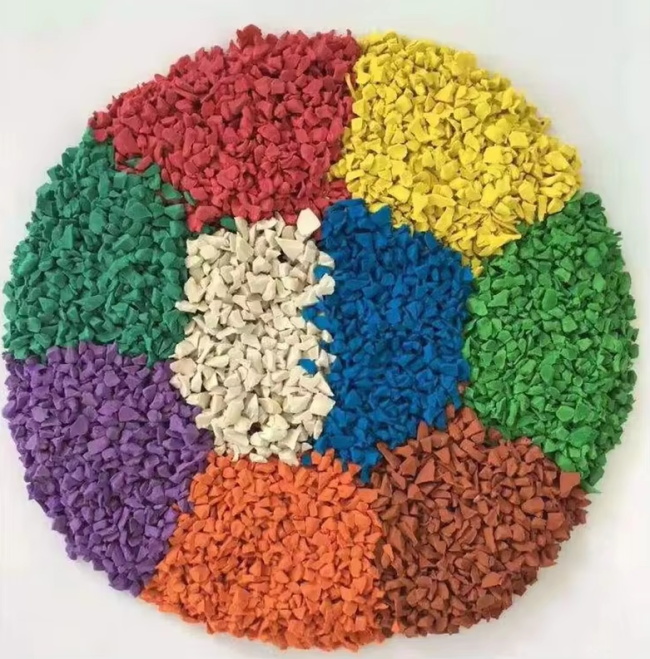
Not all EPDM granules are engineered equally. The highest-performance EPDM products eliminate sulfur from the manufacturing process. This matters because:
Traditional sulfur-cured EPDM releases sulfur compounds when exposed to heat and UV radiation. The result? Surface discoloration, odor, and accelerated aging .
Advanced sulfur-free EPDM offers significant advantages:
- No odor: Without sulfur, the material doesn't decompose under UV or heat exposure
- 3+ times longer lifespan: More stable molecular structure resists aging
- 2-3 times higher tensile strength: Reaches 4-7 MPa (vs. 3.5 MPa standard)
- Superior color stability: 5+ times more UV-resistant than sulfur-cured products
- Food-grade safety: Meets stricter environmental and health standards
For sports flooring and playground applications where durability and safety are paramount, specifying sulfur-free EPDM from the outset eliminates many of the issues that plague inferior products.
Final Checklist for a Successful Installation
Before Installation
Verify sub-base is compacted, level, and free-draining
Check moisture levels—surface must be completely dry
Confirm binder-to-granule ratios (18% top layer, 10-12% base)
Review weather forecast—dry conditions only
Confirm EPDM quality (virgin, sulfur-free, independent test reports)
During Installation
Use precise weighing equipment for binder ratios
Mix thoroughly using forced-action mixer to ensure even coating
Apply primer to substrate before laying rubber
Work in sections and join seamlessly
Maintain consistent layer depth across the area
After Installation
Allow 24-48 hours minimum for initial cure
Restrict heavy loads for 72 hours
Barrier the area and post clear signage
Avoid power washing—use gentle cleaning methods
Schedule regular inspections for early signs of wear
About Our EPDM Granules
With 25+ years of industry experience, we manufacture sulfur-free EPDM granules that deliver superior performance for wet pour installations. Our products achieve tensile strength of 4-7 MPa, with UV stability rated 5+ times higher than conventional sulfur-cured EPDM. All materials meet rigorous quality standards with no minimum order quantity and custom color and size options.


Contact our technical team for product specifications, test reports, and sample materials for your next project. We support contractors, distributors, and procurement teams worldwide with fast delivery and dedicated technical support.
WOW(LYG) New Material Co Ltd is a manufacturer specializing in the production of EPDM rubber granules. We use sulfur-free vulcanization technology, it increases the service life by more than 3 times than traditional EPDM granules, and enhances the performance, including anti-aging, high-temperature resistance, and colorfastness.
We have over 25 years of production experience and offer customization for colors and granule sizes. NO MOQ.


