 注: 建议图片大小150px*50px
丨
注: 建议图片大小150px*50px Views: 0 Author: Site Editor Publish Time: 2026-07-14 Origin: Site


If you are specifying materials for a playground, running track, or sports flooring installation, the question is not simply *“Which is cheaper?”* The wrong material choice leads to early project failure, costly repairs, UV degradation, and even potential health and safety liabilities.
You are evaluating EPDM vs SBR rubber granules. This guide is written for the people who actually need to know the difference: Playground Contractors, Sports Flooring Installers, Importers, and Government Procurement officials. We will address your real pain points. We will discuss cost, UV resistance, safety, lifespan, and the hidden risks. We will not simply provide product descriptions. We will help you make a choice that ensures your project meets safety standards, lasts for decades, and protects your reputation.

What Are EPDM and SBR Granules?
To understand the differences, we must first explain what these materials actually are.
SBR (Styrene-Butadiene Rubber):
This is a synthetic rubber developed as a substitute for natural rubber. In the flooring industry, SBR granules are generally produced from recycled tyre rubber . This makes SBR a cost-effective and environmentally efficient choice. It is typically black and often used as a "workhorse" material for shock pads and base layers .
EPDM (Ethylene Propylene Diene Monomer):
EPDM is a premium synthetic rubber that belongs to the polyolefin family . Unlike SBR, it does not necessarily rely on recycled tyre content. It is known for its high polymer content and chemical stability. It is available in a wide variety of colours because the colour is mixed directly into the material, rather than just painted on the surface .

Application: Where Do These Materials Go?
We must analyse where these materials are used in the field.
The "Top Layer" vs "Base Layer" Strategy:
In professional sports surfaces and playgrounds, EPDM and SBR generally do not compete; they complement each other .
- SBR (The Base Layer): SBR is used as the shock-absorbing base layer (also called the black rubber sub-base). It provides thickness, impact attenuation, and strength at a fraction of the cost . It is also used in indoor gym floors where UV exposure is not a concern .
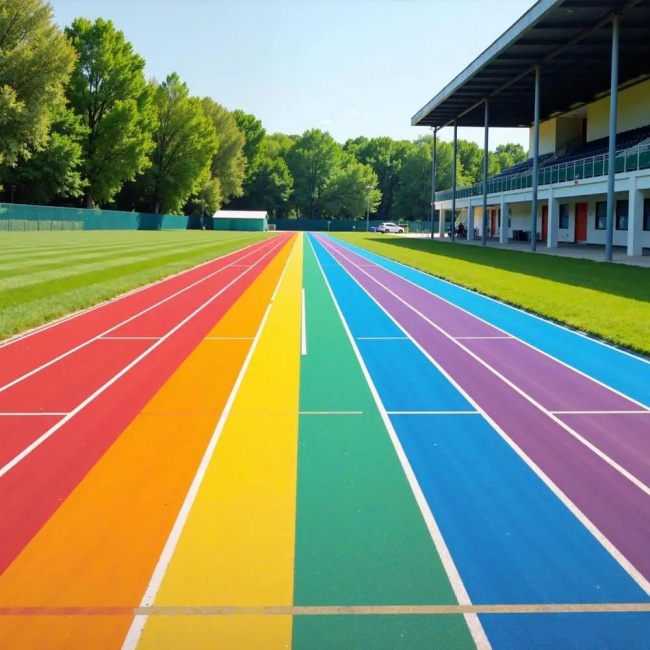
- EPDM (The Top Layer/Face Coat): EPDM is used as the top layer (the coloured wearing course) . It provides the colour, UV protection, and aesthetic finish. It is the material that the user actually sees and touches .
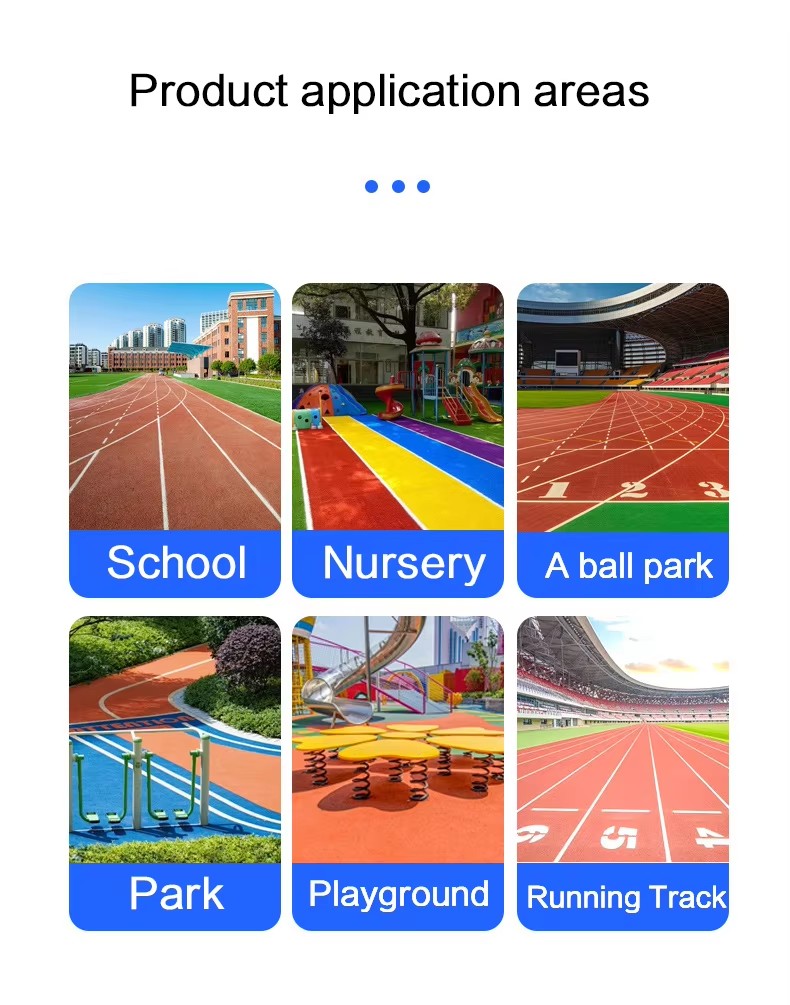
- Exceptions: For high-end playgrounds and safety surfaces requiring BS EN 1177 compliance for critical fall height, EPDM is used as the primary surface layer due to its UV stability and resistance to degradation . EPDM is also used in artificial turf infill .
Addressing Your Procurement Pain Points
Pain Point 1: "Why do my surfaces fade or look patchy after one summer?"
The Answer: EPDM vs SBR Granules in UV resistance.
SBR has poor UV and ozone resistance. Under sun exposure, SBR degrades, hardens, and cracks . Because SBR is mostly black (carbon black), the fading may not be as visible on the colour itself, but the material's structural integrity degrades.
EPDM has excellent UV resistance. It does not crack, harden, or discolour when exposed to sunlight . Specifically, high-quality EPDM granules are manufactured with a no-sulfur technology. Many granules use sulfur for vulcanization. The issue is that sulfur bonds break down under heat and UV, releasing sulfuric acid and causing the colour to fade and the material to become brittle. Our manufacturing process eliminates this, stabilizing the molecular structure.
Pain Point 2: "The rubber smells awful, especially in the heat."
The Answer: The smell is generally tied to the sulfur content and "scrap" materials.
SBR (made from recycled tyres) contains residual oils and chemicals that leach out. Studies have shown that SBR leachates contain PAHs (Polycyclic Aromatic Hydrocarbons) and heavy metals like zinc . When SBR gets hot, these compounds release volatile organic compounds, creating a strong "tyre smell" .
High-quality EPDM is odourless. Because our EPDM granules contain no sulfur, they do not break down into sulfuric acid under heat. The molecular structure remains stable, preventing the release of foul odours even in high-temperature environments. This is a crucial factor for schools, hospitals, and municipal areas where air quality is a concern.
Pain Point 3: "The surface is starting to crack and break down. What about tensile strength?"
The Answer: EPDM generally offers superior mechanical properties, but it depends on the polymer content.
- Tensile Strength: EPDM can achieve tensile strengths between 4 and 7 MPa, with elongation properties exceeding 400% . Our specific EPDM formulation increases elasticity and tensile strength by 2 to 3 times compared to standard materials.
- Compression Set: This indicates how well the material bounces back. EPDM demonstrates a significantly lower compression set after aging than SBR, meaning it retains its shape and shock absorption longer .
- Abrasion: While SBR has good abrasion resistance, EPDM provides consistent abrasion resistance along with the ability to hold its colour on the surface .
Pain Point 4: "Are we going to get sued for environmental toxicity?"
The Answer: The Health and Environmental Risk.
SBR Risks:
SBR, derived from recycled tyres, has been the subject of intense regulatory scrutiny. It contains PAHs, which are potentially carcinogenic . The European Chemicals Agency (ECHA) has proposed restrictions on PAH levels in rubber granules. The risk is not just about cancer; it is about environmental microplastic pollution. Studies suggest that 3-5 tonnes of rubber granulate are added to football fields per year, with over half escaping into the environment .
EPDM Safety:
Our EPDM granules are made with high-purity, virgin polymers. They are non-toxic and can reach food-grade hygiene standards. There is no leaching of toxic heavy metals or hazardous PAHs. This eliminates the health concerns associated with recycled tyre crumb. Moreover, because the material does not degrade quickly, it reduces microplastic pollution in the long run.
Pain Point 5: "How do the costs compare?"
The Answer: SBR is cheaper upfront. EPDM offers better value over time.
SBR is the "budget" choice, typically used for base layers. EPDM is more expensive because it requires virgin polymers and specific colouring techniques .
However, we must view this from a Total Cost of Ownership (TCO) perspective. If you use SBR in a UV-exposed top layer, you will be replacing it within 3-5 years. The cost of resurfacing (labour + material + downtime) outweighs the initial savings. EPDM can last for 10–15 years without significant maintenance.
Pain Point 6: "I need different colours and specific sizing for a special project."
The Answer: Supply chain flexibility.
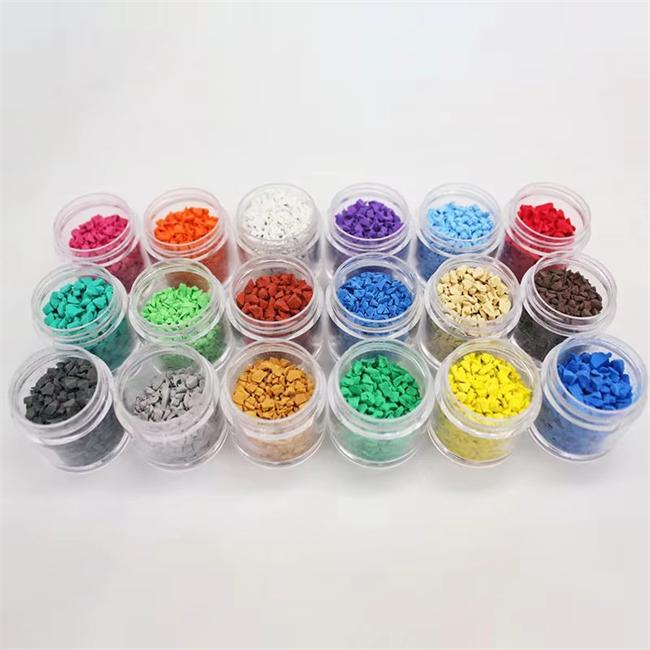
Standard SBR is black and has limited sizing options (e.g., 0.5–1mm, 1–2mm, 2–4mm) . EPDM offers vastly superior customization. It is available in a wide range of standard colours (red, green, blue, yellow, brown) . More importantly, suppliers can support custom colour matching and specific granule sizes.
Why More Engineering Projects Are Choosing EPDM
The shift from SBR to EPDM in top-layer applications is not a trend; it is an engineering necessity. Here is a breakdown of why:
1. Superior Weathering: UV and ozone degrade the carbon bonds in SBR. EPDM is inherently stable to UV. Our EPDM specifically utilizes a sulfur-free system. Products with sulfur have molecules that react with oxygen and UV, leading to a chain reaction of degradation. Our no-sulfur technology stabilizes the molecule, increasing lifespan by over 300% .
2. Regulatory Compliance: As discussed, the EU and other markets are cracking down on PAHs in recycled rubber. EPDM avoids these issues entirely .
3. Aesthetic Integrity: EPDM offers "through colour," meaning the granule's colour remains consistent even after wear. SBR is black. If you paint SBR, the paint chips off over time.

How to Avoid Critical Procurement Errors
Error 1: Using SBR as a Topcoat.
*The Solution:* Stick to EPDM for the final wearing course (2-4mm thickness) and SBR for the base layer (up to 40-60mm thickness).
Error 2: Buying "Cheap" EPDM.
Not all EPDM is created equal.
- Check the Polymer Content: Genuine EPDM should have a high content of EPDM rubber polymer (between 10% and 40%). Low polymer content means you are paying for cheap fillers (like calcium carbonate) that will crumble .
- Check the Vulcanization System: Ask whether the granules are sulfur-cured or peroxide-cured. Sulfur-cured EPDM will still fade and smell, albeit less than SBR. Our sulfur-free system is the gold standard.
Our Technical Specifications and Commitment
We have been in the EPDM industry for over 25 years. We operate advanced production lines and have extensive experience in supplying sports flooring systems to the EU, US, and Southeast Asia .
We solve the procurement pain points:
- No Minimum Order Quantity (No MOQ): We do not force you to buy excess inventory. We understand that projects have specific needs. You can order exactly what you need.
- Customization: We support colour matching and granule size specification (e.g., 0.5-1.5mm, 1-2mm, 2-4mm) .
- Performance Guarantee: Our EPDM tensile strength reaches 4-7 MPa. The density is low, offering more coverage per kilogram, reducing material costs. The angular shape of the granules provides excellent mechanical interlocking with PU binder, ensuring a strong bond.
- VOC Compliance: With no sulfur and no VOC issues, our granules are suitable for indoor and outdoor applications where air quality is a priority.

If you are building a budget indoor gym floor, SBR might be acceptable for the base. For municipal playgrounds, professional sports tracks, and any outdoor environment, EPDM is the mandatory choice.

WOW(LYG) New Material Co Ltd is a manufacturer specializing in the production of EPDM rubber granules. We use sulfur-free vulcanization technology, it increases the service life by more than 3 times than traditional EPDM granules, and enhances the performance, including anti-aging, high-temperature resistance, and colorfastness.
We have over 25 years of production experience and offer customization for colors and granule sizes. NO MOQ.


