 注: 建议图片大小150px*50px
丨
注: 建议图片大小150px*50px Views: 0 Author: Site Editor Publish Time: 2026-08-25 Origin: Site


For playground contractors, sports surfacing installers, and municipal project managers, few issues are as frustrating as a newly installed EPDM surface losing its vibrant color within months of installation. Fading, yellowing, and uneven discoloration can turn a showcase project into a maintenance headache and reputational risk.
The outdoor color stability of EPDM granules is not simply an aesthetic concern—it is a direct indicator of material quality, UV resistance, and long-term performance. When EPDM granules fade prematurely, it often signals degradation of the polymer matrix itself, which can compromise elasticity, tensile strength, and overall service life.

What Determines Outdoor Color Stability of EPDM Granules?
Outdoor color stability refers to an EPDM granule's ability to resist color change—including fading, yellowing, or whitening—when exposed to sunlight, UV radiation, heat, and moisture over time. Several interrelated factors determine this performance:
Base Polymer Quality: The fundamental EPDM polymer (Ethylene Propylene Diene Terpolymer) must be of high purity. Low-quality or recycled EPDM often contains impurities that accelerate degradation under UV exposure. Premium EPDM with a polymer content exceeding 20% provides a stable matrix that resists breakdown .
Pigment Selection and Loading: The color pigments themselves must be UV-stable grades. Industry-leading manufacturers use high-quality pigments from established suppliers and maintain consistent pigment loading to ensure batch-to-batch color consistency. The pigment must be fully integrated into the granule matrix, not merely surface-coated.
UV Stabilizer Package: This is perhaps the most critical component. Effective UV stabilizers protect the polymer by scavenging free radicals formed when high-energy UV photons break chemical bonds in the rubber . Specialized stabilizers added at 1.25–2.0 phr (parts per hundred rubber) can significantly extend color life . Without adequate stabilization, even high-quality EPDM will degrade.
Curing System: The cross-linking method affects both mechanical properties and UV resistance. Sulfur-cured EPDM using premium sulfur with strictly controlled specifications ensures optimal linking of hydrocarbon chains . However, conventional sulfur curing can release sulfuric acid under high heat and UV exposure, leading to odor and accelerated degradation.
Inorganic Fillers: Calcium carbonate (chalk) is commonly used as a filler. Its quality and purity matter—low-grade fillers can introduce impurities that affect UV resistance and binder adhesion .

Applications Where Color Stability Matters Most
The importance of color stability varies by application, but it is always a consideration:
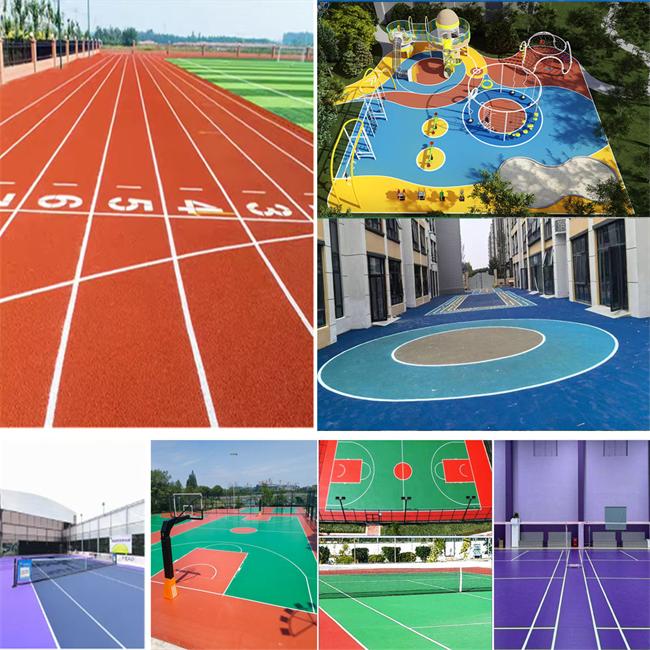
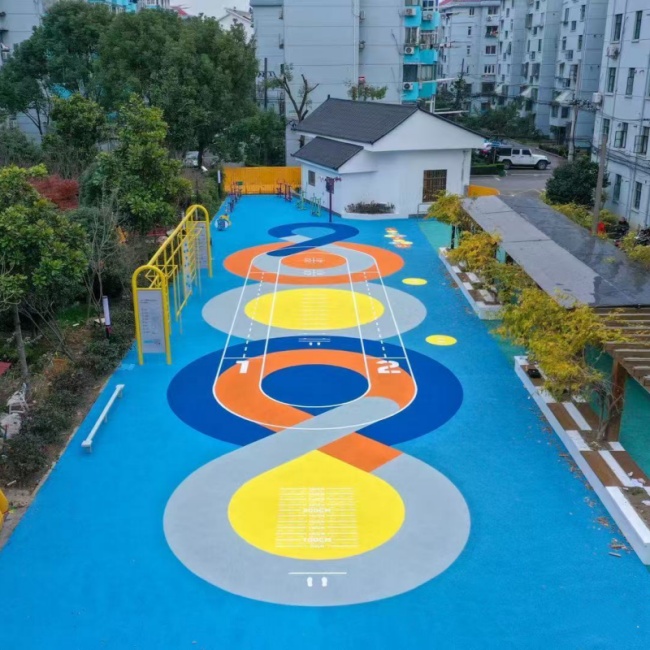
- Wet Pour Playground Surfacing: Safety surfaces in schools, parks, and kindergartens rely on bright colors to create engaging environments. Fading diminishes visual appeal and may raise safety concerns about material degradation.
- Running Track Systems: Competitive tracks demand consistent color across the entire surface for professional aesthetics. Uneven fading is unacceptable for certified facilities.
- Poured in Place Rubber (PIP): These seamless surfaces are installed in high-traffic areas where color uniformity is essential for design integrity.
- Splash Pads and Water Parks: Constant moisture combined with UV exposure creates an aggressive environment. Color stability here signals overall weather resistance.
- Commercial and Municipal Projects: Public spaces represent significant investment. Premature fading undermines stakeholder confidence and can lead to costly resurfacing.
Common Challenges Affecting Color Stability
UV Radiation
UV radiation is the primary cause of color degradation. Testing according to standards like EN 14877 and NF P90-100 evaluates performance after specified UVA exposure. High-quality EPDM can achieve grey scale ratings of 4–5 (minimal fading) after 2,550 hours of exposure, and 3.5–4 after 5,000 hours . Products without adequate UV stabilization may show visible changes in 500–1,000 hours.
Binder Yellowing (Yellowing Effect)
EPDM granules are typically bound with polyurethane (PU) binders. Aromatic PU binders are not UV-stable and undergo a reversible yellowing effect when exposed to sunlight . This yellowing can be particularly noticeable with lighter colors and can change the perceived color of the finished surface. Importantly, this yellowing does not affect mechanical properties—but it is visually undesirable .
Heat and Moisture Synergy
In regions with intense sunlight and high humidity, UV degradation accelerates. The combination of radiation and moisture promotes oxidation and hydrolysis of both the EPDM and the binder system. The base polymer's resistance to oxidation, ozone, and water determines how well it withstands these conditions .
Poor-Quality Recycled Material
EPDM granules made from recycled rubber or containing recycled content often have compromised UV stability. The recycled material may contain a mix of polymers, impurities, and degraded stabilizers that accelerate color change. Manufacturers using only virgin EPDM with a single, controlled polymer source deliver more predictable and reliable color performance.
How to Choose EPDM Granules with Superior Color Stability
Request UV Test Data
Ask suppliers for test reports from ISO/IEC 17025 accredited laboratories. Look for:
- UV resistance results according to EN 14877 or NF P90-100
- Grey scale ratings (1 = severe fading, 5 = no fading) after specified exposure levels
- Test duration—longer exposure demonstrates greater confidence in performance
Understand the Curing System
Inquire about the curing system used. Sulfur-cured EPDM with premium, controlled sulfur is standard for high-performance granules . However, be aware that sulfur-based curing can break down under extreme UV and heat, releasing sulfuric acid compounds that produce odor and can accelerate degradation. Advanced formulations using sulfur-free curing systems offer superior stability. They do not decompose into acidic compounds, preserving both molecular integrity and color vibrancy while extending service life.
Evaluate Binder Compatibility
The binder system is as important as the granules. Aliphatic (UV-stable) PU binders do not yellow and are strongly recommended for bright, light colors including white, grey, bright blue, lilac, pink, and turquoise . Aromatic binders may be acceptable for dark colors like brown, dark green, and red, where yellowing is less visually apparent .
Check Batch-to-Batch Consistency
Color consistency across batches is a sign of quality control. Ask suppliers how they maintain color matching and what tolerances they use. Manufacturers with in-house color-matching capabilities and spectrophotometric quality control deliver more consistent results.
Verify Polymer Content
Higher polymer content generally correlates with better durability and color retention. Premium EPDM granules typically exceed 20% polymer content. Lower polymer content indicates higher filler loading, which can reduce UV resistance and tensile strength .
Assess Tensile Strength and Elongation
These mechanical properties reflect material quality. High-performance EPDM granules typically achieve tensile strength > 5 MPa and elongation at break > 800% . Lower values suggest compromised material quality or excessive filler.
Technical Specifications to Request
When evaluating suppliers, request the following technical specifications:
- Polymer Type: Virgin EPDM only (no recycled polymer blends)
- Polymer Content: > 20% EPDM as the only polymer
- Tensile Strength: > 4–7 MPa, depending on grade
- Elongation at Break: > 800%
- Hardness: 65 ± 5 Shore A
- Density: Approximately 1.6 g/cm³
- UV Resistance: Grey scale rating 4–5 after 2,550 hours UVA exposure minimum
- Sulfur Content: Low or sulfur-free, to ensure no decomposition products under UV and heat
- Odor: No sulfurous odor, especially when heated or under strong sunlight
- Service Life Expectancy: Significantly extended due to stable molecular structure
- Antioxidant Package: Specific UV stabilizers and antioxidants used
- Weathering Standards: Compliance with recognized standards

Manufacturer Insights: Expert Guidance from the Factory Floor
With over 25 years of industry experience manufacturing EPDM granules exclusively—not installing surfaces—we have observed what separates high-performance materials from those that fail prematurely. Here is our professional guidance:
Choose the right particle size for your application:
- 0.5–1.5 mm: Ideal for thin-layer applications and fine-textured surfaces where color density is critical
- 1–3 mm: Most common for playground safety surfacing and wet-pour systems
- 1–4 mm: Used for running tracks and heavy-duty sports surfaces
- 2–4 mm: Suitable for base layers and applications requiring greater thickness
For applications requiring maximum outdoor color stability, sulfur-free EPDM formulations are a game-changer. Because they contain no sulfur, they do not break down under UV and heat to release sulfuric acid compounds. This means:
- No odor emission, even under intense sunlight and high temperatures
- No acid-catalyzed degradation, dramatically slowing the aging process
- Service life extended by 3× or more compared to conventional sulfur-cured granules
- Elasticity and tensile strength increase by 2–3×, reaching 4–7 MPa—far exceeding standard requirements
- Color vibrancy is preserved with enhanced antioxidant protection
These technical advantages are not theoretical. They are the result of controlling the chemistry at the molecular level—something only possible when you are a dedicated manufacturer, not a middleman or trader.
Match the binder to the color: For bright, light colors (whites, bright blues, pinks, lilacs), always specify aliphatic (UV-stable) PU binders. Aromatic binders will yellow, changing the perceived color of the surface . For dark colors (browns, dark greens, reds), aromatic binders may be acceptable, but aliphatic binders are always the superior choice for maximum color stability.
Consider environmental factors: For projects in regions with intense UV exposure (e.g., Middle East, Australia, Southern Europe, parts of North America), specify enhanced UV stability grades. Standard EPDM may fade in 2–3 years under extreme conditions, while premium UV-stable grades maintain color for significantly longer. Sulfur-free formulations show even greater resistance to harsh conditions.
Do not cut costs on pigments: The cost difference between high-quality, UV-stable pigments and cheap alternatives is minimal relative to the total project cost, but the impact on color life is dramatic. Always verify pigment quality and source.
Sulfur-free is the future: If you are specifying EPDM for projects where color stability, low odor, and environmental safety are priorities, sulfur-free EPDM granules represent the current best available technology. The combination of extended service life, superior mechanical properties, and enhanced color retention directly reduces lifecycle costs.

Why Global Buyers Choose Our EPDM Granules
As a dedicated EPDM manufacturer with 25+ years of industry experience, we have built our reputation on material science, not installation services. We focus exclusively on producing high-quality EPDM granules, which means we control every variable that affects color stability:
- Sulfur-free technology: Our granules contain no sulfur compounds. Under UV and heat, they do not decompose to release sulfuric acid or other aggressive byproducts. This preserves molecular integrity, extends service life by 3× or more, and eliminates the odor issues commonly associated with conventional EPDM.
- Superior mechanical properties: Our sulfur-free formulation delivers tensile strength of 4–7 MPa—2–3× higher than conventional granules—and elongation at break that meets or exceeds industry standards.
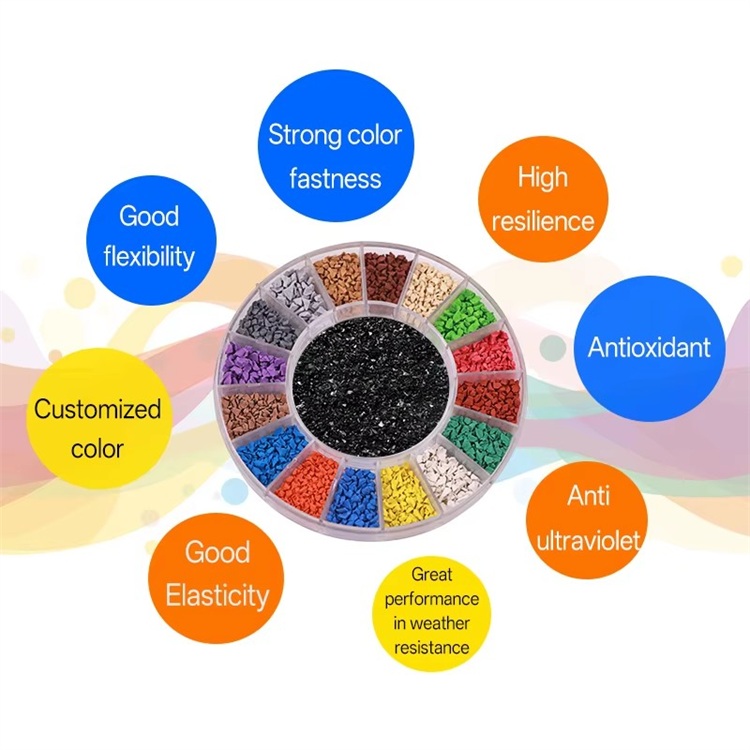
- Exceptional antioxidant protection: Advanced antioxidant packages protect the polymer matrix and color pigments, delivering 5× better performance retention compared to standard products.
- Vibrant, fade-resistant colors: Premium pigments combined with our stable polymer matrix ensure colors remain vivid and true for years.
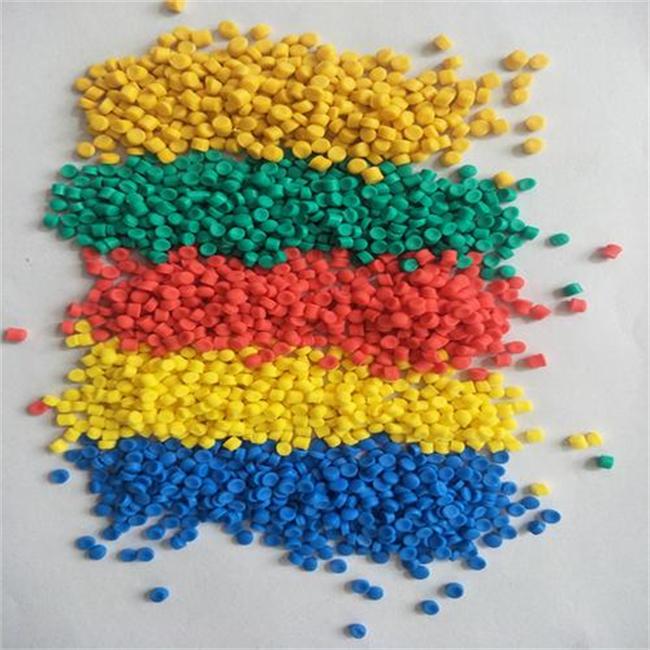
- Full custom capability: We support RAL color matching, Pantone color matching, customer sample color matching, and custom color combinations. Particle sizes available include 0.5–1.5 mm, 1–3 mm, 1–4 mm, 2–4 mm, and other specifications.
- Flexible packaging and logistics: We accommodate full container loads, LCL (less than container load) shipments, and custom packaging requirements. No minimum order quantity (no MOQ) ensures we can support projects of all sizes.
- Global export experience: Our clients include contractors, importers, distributors, and OEM buyers across Europe, North America, Australia, the Middle East, and beyond. We understand international shipping, documentation, and quality standards.
- Rapid delivery and stable supply: With full production lines and responsive capacity, we deliver on time, every time.
- Commitment to quality: Every batch is quality-controlled, with rigorous testing for color consistency, particle size distribution, tensile strength, elongation, and UV resistance.
Our sulfur-free EPDM granules are ideal for playgrounds, running tracks, safety surfacing, sports floors, and recreational areas worldwide—delivering long-lasting color and performance with no unpleasant odor, even under the harshest weather conditions.
Frequently Asked Questions
What size EPDM granules should I choose for a playground safety surface?
For wet-pour playgrounds, 1–3 mm granules are most common for the wearing course. For base layers or thicker applications, 1–4 mm or 2–4 mm may be used. The wearing course for safety surfacing typically uses 1–3 mm or 1–4 mm to achieve the required thickness and impact attenuation. For specific project specifications, consult the design engineer.
Can EPDM granules fade in sunlight?
Yes, all organic materials degrade under UV radiation over time. However, high-quality EPDM granules with premium pigments, effective UV stabilizers, and sulfur-free formulations resist fading significantly longer than standard products. Grey scale ratings of 4–5 after extended UV exposure indicate excellent resistance .
How much PU binder is required for installation?
Binder requirements vary based on granule size, desired thickness, and surface type. Typically, 10–15% binder by weight is used, depending on the specific product and application. Always consult the binder manufacturer's recommendations. We provide guidance as part of our technical support.
How long does EPDM surfacing last?
With proper installation, high-quality EPDM surfacing can last 10–15 years or more. Sulfur-free EPDM formulations with superior UV stability and mechanical properties extend service life by 3× or more compared to conventional products. Color life depends on UV exposure, pigmentation quality, and binder choice. Using aliphatic (UV-stable) binders and high-quality granules significantly extends aesthetic life.
Can you customize EPDM granule colors?
Yes, we offer full custom color services. We match RAL colors, Pantone colors, customer-supplied samples, and provide custom color combinations. With a dedicated color development process, we ensure consistency across batches.
What certifications are available for your products?
Our products meet international standards for sports surfaces, playground safety, and environmental safety. We can provide test reports and compliance documentation. Sulfur-free grades achieve food-grade safety standards due to their non-toxic, non-odorous formulation.
Is there a minimum order quantity (MOQ)?
No. We have no MOQ and support projects of all sizes, from small playgrounds to major municipal installations. Whether you need a sample, a partial container, or a full container, we accommodate your requirements.
How should I choose between aromatic and aliphatic PU binders?
For bright, light colors (white, bright blue, lilac, pink, turquoise, grey), always use aliphatic (UV-stable) binders to avoid yellowing . For dark colors (brown, dark green, red), aromatic binders may be acceptable but aliphatic binders are always the superior choice for maximum color stability. If the project demands the highest quality finish, specify aliphatic binders regardless of color.
How can I verify the quality of EPDM granules before ordering?
Request product samples for physical inspection. Reputable manufacturers are happy to provide samples. Run simple tests for odor, color consistency, and particle shape. Request test reports for UV resistance, tensile strength, and elongation. These parameters provide objective evidence of material quality. Sulfur-free granules will have no rubbery sulfur odor.
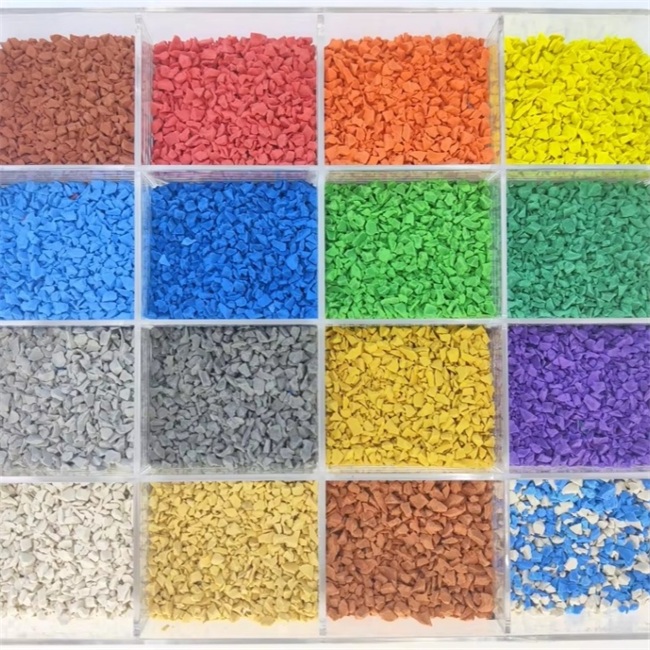
Outdoor color stability of EPDM granules is a critical performance parameter that reflects overall material quality. Understanding the factors that drive color retention—polymer quality, pigment selection, UV stabilizers, curing system, and binder compatibility—enables informed procurement decisions that protect project investments.
When specifying EPDM granules, prioritize manufacturers who:
- Use virgin EPDM with high polymer content
- Employ advanced stabilizers and premium pigments
- Provide verifiable test data from accredited laboratories
- Demonstrate batch-to-batch consistency
- Offer full custom capability and responsive service
- Use sulfur-free formulations that eliminate odor, enhance stability, and extend service life 3× or more
- Achieve tensile strength of 4–7 MPa and enhanced elasticity for superior durability
For contractors and buyers seeking reliable, high-performance EPDM granules with exceptional outdoor color stability, we are ready to support your projects with expert technical guidance, samples, and competitive quotes. Contact us to discuss your requirements, request material documentation, or arrange a sample shipment.

WOW(LYG) New Material Co Ltd is a manufacturer specializing in the production of EPDM rubber granules. We use sulfur-free vulcanization technology, it increases the service life by more than 3 times than traditional EPDM granules, and enhances the performance, including anti-aging, high-temperature resistance, and colorfastness.
We have over 25 years of production experience and offer customization for colors and granule sizes. NO MOQ.


