 注: 建议图片大小150px*50px
丨
注: 建议图片大小150px*50px 


Poured-In-Place (PIP) repair is one of the most frequent challenges faced by playground contractors, sports surfacing installers, and facility managers worldwide. When an EPDM rubber surface develops cracks, holes, or delamination, the repair quality determines whether the surface lasts another decade or fails within months. This guide addresses the real-world problems, procurement pitfalls, and technical solutions that professionals encounter daily.

What Is PIP Repair and Why Does It Matter?
PIP repair refers to the process of restoring damaged poured-in-place rubber surfaces—typically EPDM (ethylene propylene diene monomer) wear layers bonded to an SBR (styrene-butadiene rubber) cushion layer. These seamless systems are found on playgrounds, running tracks, fitness trails, and commercial landscapes.
The challenge? PIP repair is not simply "filling a hole." It requires understanding binder chemistry, granule quality, substrate conditions, and proper priming techniques. A poorly executed repair can delaminate within months, creating tripping hazards, failing safety tests, and wasting significant project budgets .

Why Professionals Search for "PIP Repair": The Real Pain Points
The Problem: Cracks, Holes, and Surface Failure
Contractors and facility managers encounter several common failure modes:
Cracks in the surface layer often indicate one of three root causes: the wear layer has thinned beyond its tensile limit, insufficient binder was used during original installation, or the substrate beneath has shifted due to poor compaction .
Holes and divots typically result from impact damage, vandalism, or freeze-thaw cycles that cause the rubber to shrink and separate .
Delamination at edges or between layers almost always traces back to one missed step: failure to prime. When the repair area's edges and base aren't properly primed, the new material won't bond chemically, leading to lifting within weeks or months .
The Concern: Will the Repair Match and Last?
Aesthetic matching is a major anxiety. EPDM surfaces fade over time due to UV exposure. A repair using standard aromatic binder will darken or yellow light-colored granules, creating an obvious patch . Professionals worry about:
- Color mismatch that fails visual inspection on municipal projects
- Repair failure that costs more than the original installation
- Safety compliance failure when impact attenuation is compromised
- Product warranties voided by improper repair techniques
The Anatomy of a Successful PIP Repair
Critical Step: Priming
Every professional repair begins with proper priming—yet it remains the most frequently skipped step. Here's why it's essential:
Primer serves two functions: it penetrates and strengthens the existing substrate while creating a chemical bridge between the old surface and new repair material. Without primer, the binder in your repair mix cannot bond to the edges of the cut or the base layer beneath.
What to prime: All surfaces the new mix will contact—the vertical edges of the cut, the exposed base layer (SBR cushion), and any adjacent concrete or border materials .
Which primer to use: For EPDM wear layers, choose an aliphatic-based primer with UV resistance. Avoid using regular binder as a substitute—it lacks the spread and penetration characteristics of a true primer .
Timing: Apply primer immediately after cutting the repair area and trowel the repair mix while the primer is still fresh. Waiting hours, especially in high temperatures, compromises the bond .

Core Technical Specifications That Must Be Verified
When purchasing or inspecting EPDM granules, there are five key parameters that directly determine whether a repair project will remain stable over the long term; procurement managers and contractors must verify each one individually.
First, rubber content. This is a hard metric for distinguishing between high- and low-quality products. High-quality EPDM granules have a rubber content of at least 20%, and some premium products can reach 25% or higher. In contrast, many low-priced products on the market have an actual rubber content of only 13% or even lower, with the remainder consisting of fillers such as calcium carbonate and light calcium carbonate. The direct consequences of insufficient rubber content are poor elasticity, susceptibility to breakage under tension, and surface chalking and granule shedding within two years. A simple way to check this is to repeatedly rub a handful of granules between your palms; if a large amount of white powder remains on your palms, it indicates excessive filler content, and the product should not be selected.
Second, tensile strength and elongation at break. These two metrics collectively determine the surface’s ability to resist cracking and deformation. High-quality EPDM produced using sulfur-free technology can achieve tensile strengths of 4 to 7 MPa and elongation at break exceeding 550%. This means the material can be stretched to more than 5.5 times its original length without breaking and can quickly rebound to its original shape. In contrast, EPDM produced using conventional sulfur-curing processes typically has a tensile strength ranging from 2.5 to 3.5 MPa, with an elongation at break of only about 400%. The difference between the two becomes evident in practical use: high-quality material can withstand children running and jumping, the weight of wheelchairs, and thermal expansion and contraction caused by outdoor temperature fluctuations without cracking, whereas ordinary material will develop extensive cracking within about a year under the same conditions.
Third, resistance to UV aging. This is the key factor determining color longevity. In laboratory accelerated aging tests (500 hours of continuous exposure at 70 degrees Celsius), high-quality sulfur-free EPDM granules should exhibit zero chalking and zero cracking, with a color difference (ΔE) controlled within 3—a change virtually imperceptible to the naked eye. In contrast, standard EPDM often begins to show surface whitening, fading, or fine cracks after approximately 300 hours under the same test conditions. In actual outdoor use, high-quality materials retain their rich, vibrant colors even after five years in areas with intense sunlight, while standard materials fade noticeably within six months to a year and turn grayish-white after two years, losing both their decorative and protective functions.
Fourth, volatile organic compounds (VOCs) and odor levels. For sensitive environments such as schools, hospitals, and indoor venues, these are essential criteria. EPDM produced using traditional sulfur-curing processes decomposes under high temperatures and intense UV radiation, releasing sulfur-containing compounds—which is why many rubber running tracks emit a pungent odor in the summer. EPDM produced using sulfur-free technology contains no sulfur bonds in its molecular structure; therefore, even under surface temperatures exceeding 60 degrees Celsius, it does not decompose to produce sulfuric acid-like substances, ensuring it is truly odorless. Its VOC emissions meet food-contact-grade hygiene standards, making it suitable for venues with the highest air quality requirements.
Fifth, bulk density and granule morphology. These parameters directly affect installation efficiency and material consumption. High-quality EPDM granules, produced through precisely controlled crushing and screening processes, form angular, three-dimensional granules with a low bulk density (typically between 0.55 and 0.65 grams per cubic centimeter). A low bulk density means that the same weight can cover a larger area, reducing transportation costs and total material consumption. At the same time, angular granules provide better mechanical interlocking and porosity during mixing and spreading, allowing the adhesive to evenly coat each granule and resulting in a uniform, fine-textured surface after curing. In contrast, smooth or crumb-like granules have a high bulk density and small specific surface area, leading to poor adhesive bonding and ultimately a loose surface prone to granule loss.

What Makes High-Quality EPDM Granules Essential for Repairs?
The Problem with Inferior Materials
The EPDM market has significant quality variation. Here's what procurement professionals must verify:
No odor under heat and UV: Conventional sulfur-vulcanized EPDM releases sulfuric compounds under UV exposure, creating an unpleasant smell. Sulfur-free technology eliminates this issue entirely—no decomposition, no odor, even in extreme heat .
Superior tensile strength: Standard EPDM achieves 3.5–4.5 MPa tensile strength. High-performance sulfur-free formulations reach 4–7 MPa, providing 2–3 times the elasticity and durability .
Color stability: The biggest complaint? "It faded within six months." Quality EPDM uses internally colored granules (color runs through the entire granule), not surface coating. UV-stable formulations maintain color integrity for 5+ years without significant fading .
Granule uniformity: High-quality granules have clean-cut edges, consistent granule size, and no dust contamination. Dust absorbs binder, altering the required ratio and weakening the surface .

How to Test EPDM Quality on Site
Before committing to a supplier, perform these simple tests:
1. The stretch test: Quality granules stretch to 2× their length before breaking and snap back quickly. Inferior material cracks or fractures instantly .
2. The burn test: High rubber content burns slowly with black smoke, leaving a rubbery residue. Low-quality material with excessive fillers burns fast to white ash .
3. The sink test: Drop granules in water. High-density, quality material sinks. Granules with excessive chalk/filler float—avoid them .
4. The smell test: Rub a handful vigorously. Quality EPDM has only a mild rubber scent. Chemical, plastic, or acidic odors indicate recycled content or improper formulation .
Common PIP Repair Mistakes That Cost Contractors Thousands
Mistake 1: Skipping Primer
The most common and expensive error. Industry experts consistently note that unprimed repairs delaminate within months—a cost far exceeding the 15 minutes and minimal material for priming .
Mistake 2: Using the Wrong Binder Ratio
Standard EPDM repair mix requires a 5:1 to 6:1 ratio of granules to binder for the wear layer. Using less binder to save money creates a surface that crumbles and releases granules. Conversely, using too much binder makes the surface hard, reducing impact absorption and potentially failing safety tests .
Mistake 3: Improper Substrate Preparation
EPDM must be installed over a solid, dry, clean concrete or asphalt base with proper drainage. Installation over unsealed concrete that retains moisture leads to hydrostatic blistering—steam pressure from heated water pushes the surface upward, creating bubbles and delamination .
Mistake 4: Ignoring Weather Windows
Install or repair only when temperatures exceed 10°C (50°F) and are below 30°C (86°F). In summer heat above 35°C, schedule work at night when temperatures drop below 30°C. Rain within 24–48 hours of application ruins the cure .
Mistake 5: Cutting Corners on the Base Layer
The SBR cushion layer absorbs impact. Without it, EPDM wears prematurely and fails impact tests. For playgrounds, the Critical Fall Height (CFH) determines thickness. High equipment (1.8m+ fall height) requires 60–100mm total thickness—not a place to economize .

How to Avoid Procurement Pitfalls When Buying EPDM Materials
Red Flags in Supplier Selection
Price below market: Genuine EPDM has a minimum viable price. Any quote significantly below standard market rates indicates recycled content, excessive fillers, or secondary-grade materials. A professional recommends: "Normal EPDM granules priced below 8,000 yuan per ton are absolutely problematic" .
Refusing sample requests: A legitimate factory provides samples quickly. Delays or excuses suggest the supplier is a trader, not a manufacturer .
Vague specifications: Insist on documented technical data—tensile strength, elongation at break, hardness, specific gravity, and UV aging test results. Reputable suppliers provide these openly .
Rapid On-Site Identification Methods Without a Laboratory
For importers, distributors, and on-site construction supervisors, it is not always possible to conduct laboratory testing every time. The following four sets of simple tests can be used to quickly assess material quality during delivery inspection or prior to construction; it is recommended that they be included in the purchase contract as acceptance criteria.
Tensile Rebound Test. Take a single granule, pinch both ends between your thumb and index finger, and stretch it forcefully. High-quality granules can be stretched to more than twice their original length and will quickly return to their original shape upon release, with no cracks on the surface. Poor-quality granules will break before reaching even double their original length, or they will remain deformed and unable to retract after stretching, indicating insufficient rubber content and cross-linking.
Burning Test. Use a lighter to ignite a small amount of granules and observe the results. High-quality EPDM burns slowly, with an orange-yellow flame accompanied by black smoke; it self-extinguishes when removed from the flame, leaving behind black, elastic residue. Substandard materials, due to high calcium carbonate content, burn rapidly and produce white ash, accompanied by a pungent, plastic-burning odor or a sour smell—typical characteristics of recycled material or excessive fillers.
Floating Test. Place a handful of granules into clean water and stir. Genuine EPDM with high rubber content has a density close to or slightly greater than water and will slowly sink to the bottom of the container. Granules with excessive fillers, however, have a low density and will float on the surface or remain suspended in the water. This method allows for quick identification of substandard products.
Odor Test. Place a handful of granules in a sealed plastic bag, expose it to direct sunlight for two hours, or heat it with a hair dryer to 50–60 degrees Celsius, then smell the granules. High-quality sulfur-free EPDM has only a faint natural rubber scent and no irritating or chemical odors. If you detect a distinct plastic smell, chemical solvent odor, or a smell similar to burning tires, it indicates that the material contains sulfides or recycled rubber and is unsuitable for indoor use or environments exposed to high temperatures and direct sunlight.
The "Sample First, Payment Staged" Rule
Smart procurement follows this payment structure:
- 30% deposit on order placement
- 50% on delivery/sample approval
- 20% on final inspection/acceptance
This protects against substandard material arriving on site .
Documentation Requirements
- CMA/CNAS-certified test reports (not generic "test certificates")
- Certificate of origin for imported projects
- MSDS (Material Safety Data Sheet) for binder components
- Binder composition with evidence of aliphatic content (if specified)

Frequently Asked Questions About PIP Repair
Q1: Why is my PIP repair peeling/lifting after only a few months?
A: The most common cause is failure to prime the repair area before application. Without primer, the new mix cannot bond chemically to the old surface edges or base layer. Other causes include: using the wrong binder type (aromatic vs. aliphatic), moisture in the substrate, or applying in temperatures outside the 10–30°C window .
Q2: Can I repair EPDM surfaces myself, or do I need a specialist?
A: Small patches (up to 2–5 sq ft) can be DIY using pre-packaged repair kits. However, larger areas, color matching, safety-critical installations (playgrounds), or any repair requiring structural integrity should be performed by experienced installers. A poorly executed DIY patch creates worse tripping hazards than the original damage .
Q3: How do I match the color of aged EPDM with new repair material?
A: Complete color matching is nearly impossible because EPDM fades significantly under UV exposure over years. Smart contractors make the repair look intentional—cutting a geometric shape (circle, square, or familiar design) and patching with a contrasting or complementary color. If color match is essential, specify aliphatic binder to prevent ambering of light colors .
Q4: What's the difference between SBR and EPDM in repair contexts?
A: SBR (styrene-butadiene rubber) is the black cushion/base layer—it's cheaper, recycled from tires, provides impact absorption. EPDM is the colored top/wear layer—it's UV-resistant, colorful, and durable. For repairs, you match the layer: EPDM patch for wear layer damage, SBR-based fill for base layer issues. Never use EPDM granules to fill deep gaps—they make the surface too hard and affect impact test results .
Q5: How long should PIP repairs cure before use?
A: Minimum 24 hours for foot traffic. For full load (playground equipment, athletic activity), wait 48–72 hours, depending on temperature and humidity. Colder or more humid conditions extend cure time. Protect the area from rain, direct sunlight, and wind during the first 24 hours .
Q6: Is UV-stable EPDM really worth the extra cost?
A: Absolutely. Standard EPDM begins fading within 6–12 months under intense sunlight. UV-stable formulations maintain color integrity for 5+ years. For municipal projects, schools, or any high-visibility installation, the upgrade pays for itself by avoiding costly recapping or early replacement .
Q7: What causes EPDM to crack—and can cracks be repaired?
A: Cracks result from: insufficient wear layer thickness, too little binder in original mix, poor substrate compaction causing voids, or extreme temperature cycles. Hairline cracks can be treated with rebinder. Wider cracks require cutting the damaged area, priming, and patching with fresh EPDM mix .
Q8: How do I verify EPDM quality before buying large quantities?
A: Request samples and perform these field tests: stretch test (should stretch to 2× length and return), burn test (slow burn, black smoke, rubbery residue), sink test (sinks in water), and smell test (no chemical odor). Always verify CMA/CNAS test reports and visit the factory if possible to inspect raw materials and quality control equipment .
Why Increasingly More Projects Choose High-Performance EPDM
Longevity That Lowers Lifecycle Costs
A quality EPDM surface lasts 10–15 years with minimal maintenance—compared to wood chips that require annual topping or asphalt that needs resealing every 2–3 years .
Safety Compliance Without Compromise
EPDM systems meet EN1177, ASTM F1292, and other critical fall height standards when properly specified. Impact attenuation depends on total thickness—for high playground equipment (1.8m+ fall height), specify 60–100mm total thickness .
Environmental and Health Benefits
Sulfur-free EPDM eliminates VOC emissions and odor under UV exposure—critical for schools, hospitals, and public facilities. Food-grade hygiene standards are achievable with the correct formulation, making these surfaces suitable for the most sensitive environments .
Aesthetic and Design Flexibility
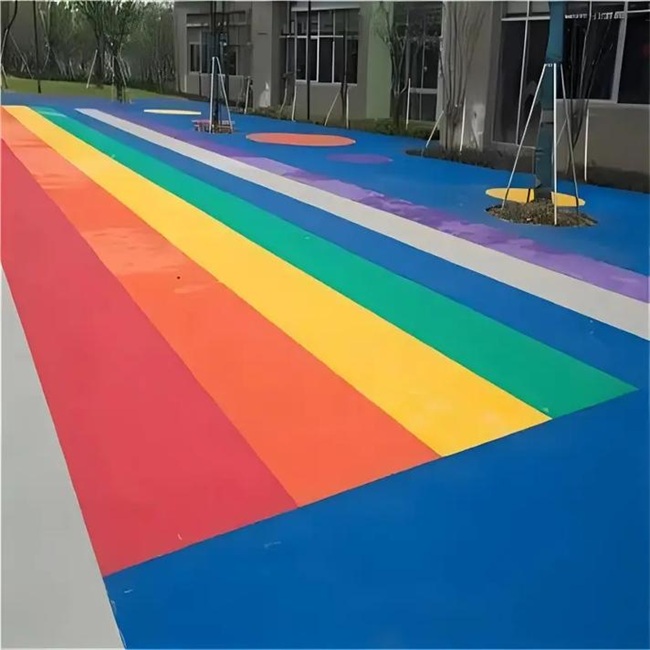
Available in over 20 standard colors with custom matching capability, EPDM enables creative designs, logos, and zone markings. The color runs through the entire granule, ensuring the surface retains its appearance even with wear .
Practical Tips for PIP Repair Success
1. Always prime edges and base—never skip this step, regardless of repair size .
2. Cut repair areas at a 45° bevel to create a stronger bond between old and new material .
3. Use aliphatic binder for light colors to prevent yellowing/ambering .
4. Mix only what you can use within 30 minutes—binder begins curing immediately .
5. Lubricate your trowel with soapy water to achieve a smooth finish without pulling the mix .
6. Match binder ratios precisely: 5–6 parts EPDM to 1 part binder for the wear layer; 4–5 parts for pattern/logo areas .
7. Check weather forecasts—no rain within 48 hours, temperatures between 10°C and 30°C .
8. Keep a record of batch numbers—color variations occur between batches; same area should use same batch .
9. Factor in 24–48 hours curing time before returning the area to use .
10. For gap repairs between tiles: fill bottom with base material, leave 1/2 inch for EPDM wear layer top .

Making PIP Repair a Long-Term Solution
PIP repair is more than a maintenance task—it's a technical procedure requiring proper materials, chemistry knowledge, and attention to detail. By understanding the importance of priming, selecting the right binder (aliphatic vs. aromatic), verifying EPDM quality through simple field tests, and avoiding common procurement pitfalls, contractors and facility managers ensure their repairs last—not just months, but years.
When sourcing materials, prioritize suppliers who:
- Provide documented technical specifications and test reports
- Offer flexible MOQ and customization options
- Use sulfur-free, odorless formulations for improved UV stability and longevity
- Demonstrate 15+ years of industry expertise
- Maintain quality control from raw material to finished product
The bottom line: A successful PIP repair costs a fraction of full surface replacement and extends the life of your EPDM installation by another 5–10 years when done correctly. Invest the extra 15 minutes in priming, specify the right binder, verify your material quality, and you'll avoid the costly cycle of repeat repairs.


WOW(LYG) New Material Co Ltd is a manufacturer specializing in the production of EPDM rubber granules. We use sulfur-free vulcanization technology, it increases the service life by more than 3 times than traditional EPDM granules, and enhances the performance, including anti-aging, high-temperature resistance, and colorfastness.
We have over 25 years of production experience and offer customization for colors and granule sizes. NO MOQ.


