 注: 建议图片大小150px*50px
丨
注: 建议图片大小150px*50px Views: 0 Author: Site Editor Publish Time: 2026-08-27 Origin: Site


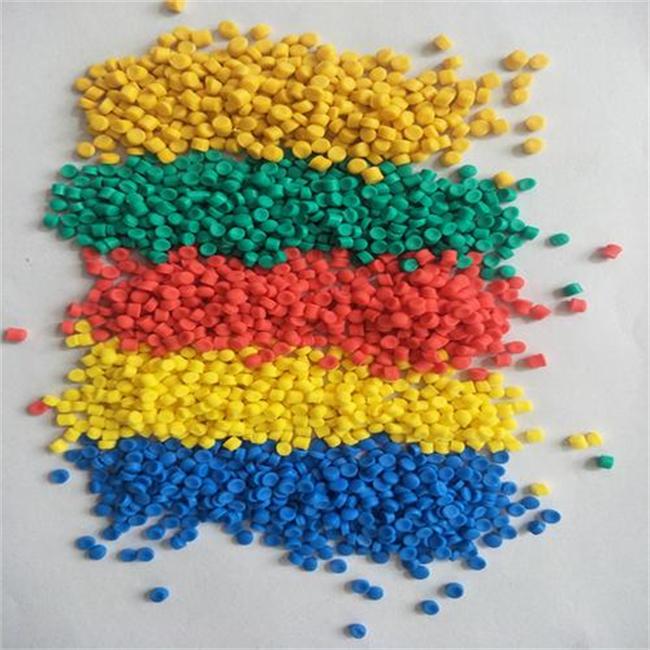
EPDM granules are not made of 100% pure EPDM rubber, despite what the name might suggest. They are actually a compound—a carefully engineered mixture where EPDM (Ethylene Propylene Diene Monomer) serves as the primary base polymer, combined with fillers like calcium carbonate, cross-linking agents such as sulfur, processing oils, color pigments, and various performance-enhancing additives . The typical EPDM content in high-quality granules ranges from 20% to over 60%, with the remainder consisting of these other essential ingredients that give the granules their final properties .

The Ingredients of EPDM Granules
Understanding what goes into EPDM granules helps explain why different products perform differently in real-world applications. While the common term “EPDM granules” suggests a single-material product, these granules are actually a formulated rubber compound .
1. Base Polymer: EPDM Rubber
EPDM is a synthetic rubber—a terpolymer made from ethylene, propylene, and a diene monomer. As the matrix material, EPDM is the main component that gives the granules their elasticity, weather resistance, and overall durability. It holds all other ingredients together .
The quality and percentage of EPDM in the final product are decisive factors for granule quality. Lower-priced granules often substitute or reduce high-quality EPDM by replacing it with other, less suitable polymers, which directly impacts long-term performance .
2. Fillers
Calcium carbonate (commonly known as chalk) is the most typical filler used in EPDM granules . Fillers serve several functions:
- They affect the haptic (touch) experience and physical properties of the finished granules
- They ensure optimal adhesion of polyurethane binders during installation
- They enhance the weight and volume properties of the granules
- They are a cost-optimized means of achieving the desired granule volume
Fillers are the least expensive raw material in EPDM granules but typically make up the majority of the content by weight .
3. Cross-Linking Agents
Cross-linking (vulcanization) is essential to transform raw rubber into a durable, elastic material. Sulfur is the proven, traditional cross-linking agent used in EPDM granule manufacturing . During vulcanization, sulfur creates chemical bridges between the hydrocarbon chains of the EPDM, resulting in:
- A stable and resistant product
- The elastic properties commonly associated with rubber
- Long-term durability
Some formulations may use alternative cross-linking agents such as peroxide instead of sulfur, depending on the desired properties and application requirements .
4. Processing Oils
Paraffinic oil is commonly used as a processing aid in EPDM granule production. It serves to:
- Regulate the hardness of the finished granules
- Improve flexibility and processability during manufacturing
5. Color Pigments
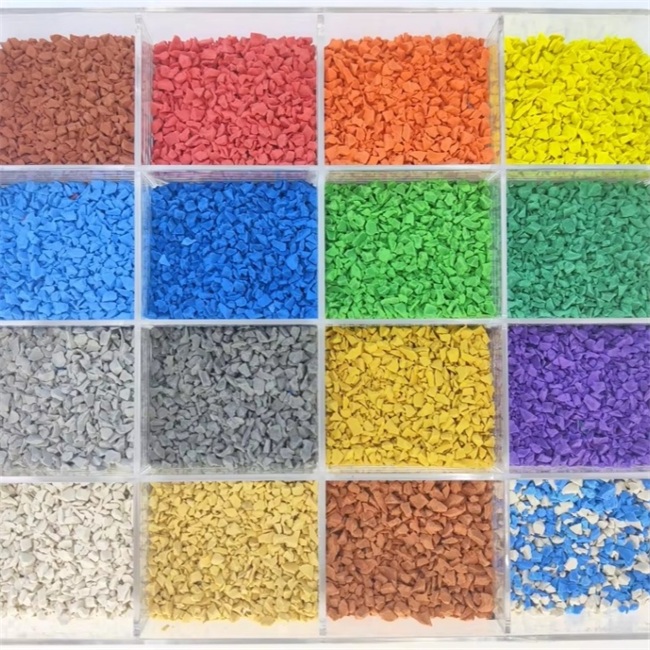
Color pigments or masterbatches are added to achieve full, through-dyeing of the granules. Depending on the required color, pigments may be organic or inorganic . High-quality granules are fully dyed through, ensuring color stability throughout the product’s service life.
6. Additives for Enhanced Performance
Depending on the intended application, manufacturers add specific performance-enhancing ingredients:
- UV stabilizers to improve resistance to sunlight and prevent degradation
- Antioxidants to slow aging and extend service life
- Flame retardants for safety-critical applications
- Foaming agents to achieve lower bulk density
Practical Considerations: Why This Matters for Your Project
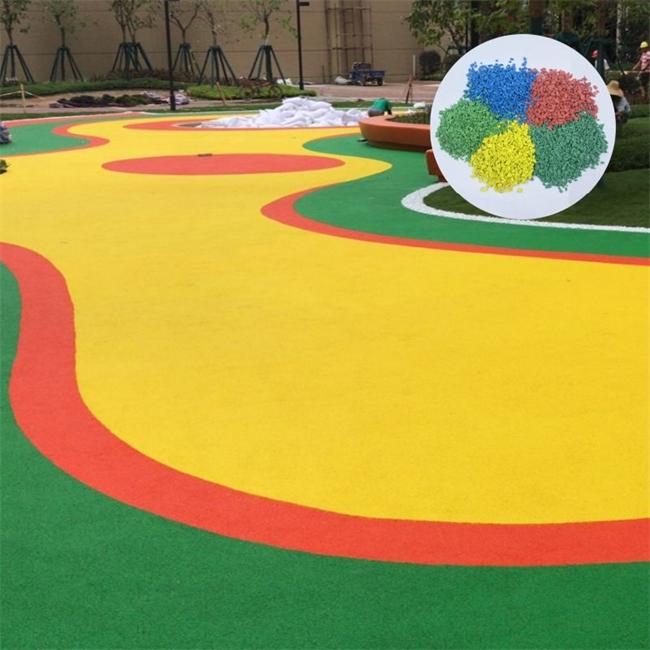
The composition of EPDM granules directly affects their performance in real-world applications—playgrounds, running tracks, sports flooring, and wet-pour surfaces. Here’s what you should know when evaluating products:
EPDM Content = Quality Indicator
The EPDM polymer content is a key indicator of quality. High-quality products typically contain more than 20% EPDM as the only polymer . Products with lower EPDM content—often replaced with cheaper fillers or polymers—may cost less initially but typically offer reduced elasticity, poorer weather resistance, and shorter service life.
Cross-Linking Method Affects Performance
Sulfur-cured EPDM granules are the industry standard and offer excellent controllability in manufacturing . Sulfur cross-linking produces stable, highly elastic granules. However, products using sulfur may have certain odor and stability considerations.
No Two Products Are Identical
Because EPDM granules are a compound, no two products are exactly alike. The specific formulation—including the quality and ratio of raw materials—determines:
- Color stability under UV exposure
- Durability and resistance to weathering
- Elasticity (tensile strength)
- Bulk density (affecting coverage rate and cost efficiency)
- Long-term performance in different climates
The “100% EPDM” Myth
Many users assume more EPDM is always better. However, if EPDM granules were made of 100% EPDM, the final product would:
- Lack important properties needed for the intended application
- Be prohibitively expensive for most projects
The optimal composition is a balance between cost and performance—and the manufacturer’s know-how in selecting and combining raw materials is what makes the difference .
EPDM Granules Selection: What to Look For
When selecting EPDM granules for your project, consider these key factors:
By Application
Different applications demand different properties:
- Playground safety surfacing: Focus on impact attenuation and color appeal
- Running tracks: Prioritize elasticity, durability, and consistent particle size
- Artificial turf infill: Require specific particle size and shape for optimal performance
- Wet-pour flooring: Need good binder adhesion and color stability
By Particle Size (Granule Size)
EPDM granules are available in various sizes, typically ranging from 0.5 mm to 4.0 mm . The appropriate size depends on:
- The thickness of the intended installation
- Application type (surface coating vs. infill vs. poured systems)
- Desired surface texture and drainage properties
By Color
Color stability is critical for aesthetic applications. High-quality granules use UV-stable pigments and are fully dyed through to maintain appearance even with surface wear . Ensure the product you choose offers the color stability your project requires.
By Performance Requirements
Consider:
- UV resistance for outdoor applications
- Weather resistance in variable climates
- Tensile strength and elasticity for high-traffic areas
- Low odor for indoor installations or sensitive environments
- Environmental compliance (food-grade or low-VOC standards)
FAQ
Are EPDM granules 100% EPDM rubber?
No. Despite the common name, EPDM granules are compounds that typically contain 20%–60% EPDM along with fillers, processing oils, cross-linking agents, pigments, and additives .
What is the main filler used in EPDM granules?
Calcium carbonate (chalk) is the most common filler used in EPDM granules, affecting the product’s haptic properties, weight, and binder adhesion .
Why is sulfur used in EPDM granule production?
Sulfur is the cross-linking agent that creates chemical bonds between EPDM polymer chains during vulcanization, giving the granules their durable, elastic properties .
What percentage of EPDM should a good-quality granule contain?
High-quality granules typically contain more than 20% EPDM as the only polymer. Higher EPDM content generally indicates better performance but comes at a higher cost .
What is the difference between sulfur-cured and peroxide-cured EPDM granules?
Sulfur is the traditional, proven cross-linking agent offering highly controllable vulcanization. Peroxide can be used as an alternative cross-linking agent, potentially offering different property profiles depending on the application requirements .
How do EPDM granules get their color?
Color pigments or masterbatches are added during manufacturing. High-quality granules are fully dyed through, ensuring consistent color even with surface wear .
Are all EPDM granules the same?
No. The quality, type, and proportion of raw materials vary significantly between manufacturers. The specific composition directly affects product performance, durability, and suitability for different applications .
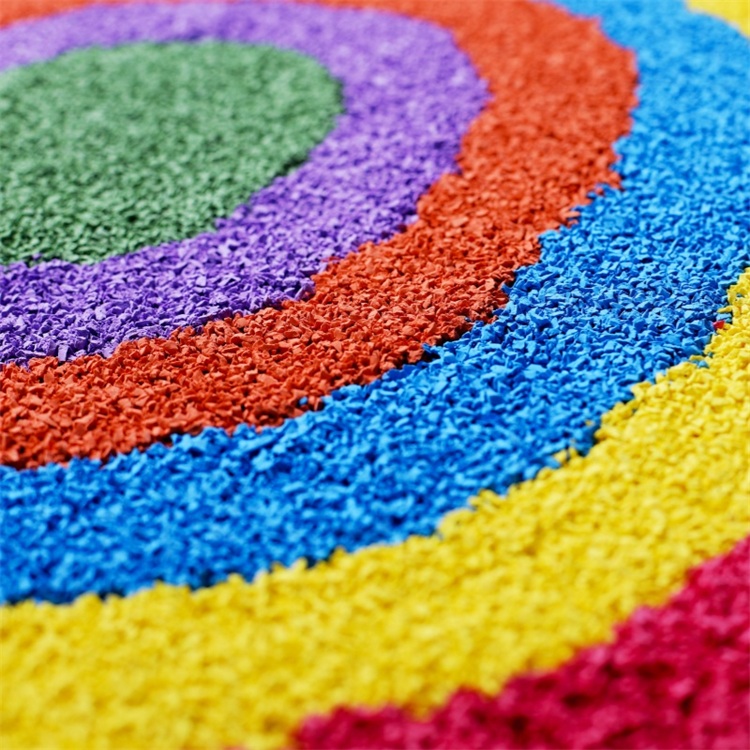
EPDM granules are a sophisticated engineered compound where EPDM rubber serves as the primary polymer, combined with fillers, cross-linking agents, processing oils, pigments, and additives to achieve specific performance characteristics. The quality of the final product depends on the selection, quality, and proportion of these ingredients—which is why not all EPDM granules perform equally.
Whether you need EPDM granules for playgrounds, running tracks, artificial turf, or wet-pour flooring, understanding composition helps you make informed decisions that impact project quality, longevity, and cost-effectiveness.
If you are looking for EPDM rubber granules with specific particle size, color, or performance characteristics for your project, contact us to discuss your requirements. Our team can help you select the optimal product specification for your application.

WOW(LYG) New Material Co Ltd is a manufacturer specializing in the production of EPDM rubber granules. We use sulfur-free vulcanization technology, it increases the service life by more than 3 times than traditional EPDM granules, and enhances the performance, including anti-aging, high-temperature resistance, and colorfastness.
We have over 25 years of production experience and offer customization for colors and granule sizes. NO MOQ.


