 注: 建议图片大小150px*50px
丨
注: 建议图片大小150px*50px Views: 0 Author: Site Editor Publish Time: 2026-07-19 Origin: Site


If you're a playground contractor, sports surfacing installer, importer, or specifier searching for playground surfacing solutions, you're likely facing a familiar challenge: how to choose a surface that truly lasts, meets safety standards, and won't become a liability in two years. This guide is built around the real questions procurement professionals ask—and the costly mistakes you need to avoid.

What Is Playground Surfacing, Really?
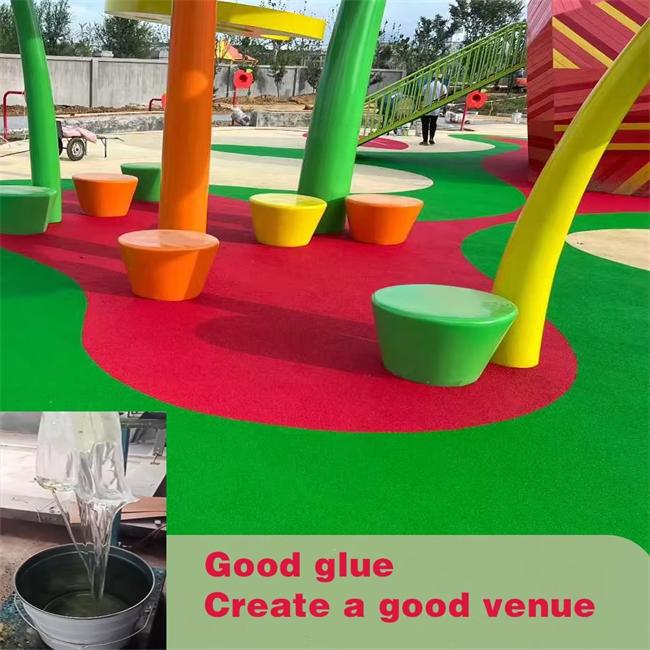
When we talk about playground surfacing in the commercial and municipal context, we're primarily discussing poured-in-place (PIP) rubber systems, specifically those using an EPDM (Ethylene Propylene Diene Monomer) wear layer. This is the seamless, colourful, shock-absorbing surface you see under swings, slides, and climbing structures in schools, parks, and childcare centres.
The industry-standard system consists of two layers :
- A base/cushion layer: Typically made from SBR (styrene-butadiene rubber) recycled tyre crumb mixed with a polyurethane binder. This layer provides the bulk of impact absorption.
- A top/wear layer: Made from EPDM granules, also bound with polyurethane. This layer provides durability, UV resistance, colour, and the finished playing surface.
The thickness of these layers is not arbitrary—it's engineered based on the critical fall height (CFH) of the playground equipment above it . An EPDM playground surface is tested to standards like ASTM F1292 and EN1177 to ensure it limits impact force (G-max) and head injury risk (HIC) .

Why Specifiers and Contractors Are Moving to EPDM
The fundamental reasons playground surfacing professionals choose EPDM over alternatives like loose-fill wood chips, sand, or even rubber tiles are rooted in safety, accessibility, and lifecycle cost.
Critical Fall Height Protection That Doesn't Shift
Unlike loose-fill materials that displace over time, creating dangerous thin spots, poured-in-place EPDM surfacing provides consistent, verifiable impact attenuation across the entire use zone . This is essential for meeting ADA accessibility requirements, as wheelchairs and walkers need a firm, stable, and slip-resistant surface—something loose materials cannot provide .
All-Weather Performance and Drainage
EPDM surfacing is porous. Water drains through it, meaning no ponding and minimal slip risk even after heavy rain . This is a critical operational advantage for contractors managing municipal projects where downtime is costly.
Design Flexibility for Branding and Safety
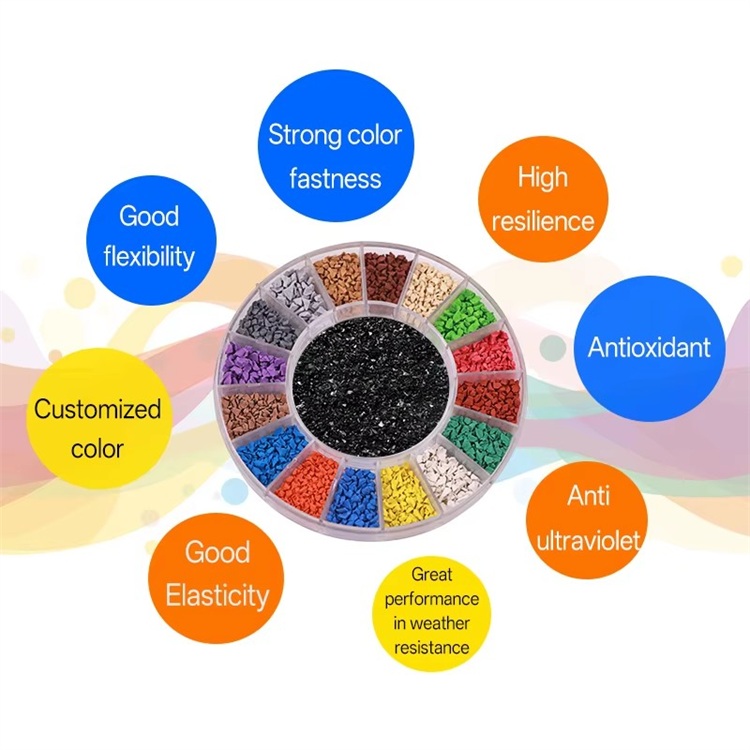
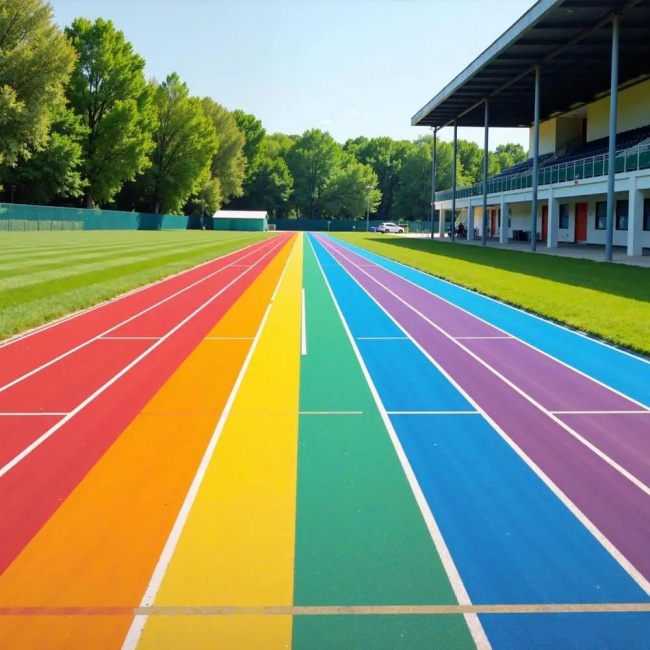
You're not limited to black or green. EPDM granules come in a wide spectrum of colours and can be custom-blended to create logos, number grids, hopscotch patterns, and educational graphics directly in the surface . This is a major selling point for schools and landscape architects.
The Real Pain Points: Why Good EPDM Goes Bad
Here's where we get to the problems that keep procurement managers and contractors up at night. The market is flooded with EPDM granules, but they are not all the same.
The "Sulfur vs. No-Sulfur" Problem
Most EPDM granules on the market are cured using sulfur. This is the conventional method. However, sulfur-based vulcanisation introduces a fundamental weakness: the sulfur bonds break down under prolonged exposure to ultraviolet (UV) light and high temperatures .
When these bonds break, they release sulfuric acid derivatives. This causes:
- Foul odours in hot weather, a major complaint in public spaces.
- Accelerated ageing, as the molecular structure degrades.
- Chalking and fading, where the surface turns dull and powdery.
This is why you see "10-year warranty" surfaces that look faded and worn in just 2-3 years. It's not necessarily poor installation; it's poor chemistry.
Beyond UV: the PU Binder Failure
Another common failure point isn't the granule itself, but the bond between the granules and the polyurethane binder. If the granules have a high oil content or aren't manufactured to a tight tolerance, the binder won't properly coat them. This leads to:
- Delamination: The top layer peels away from the base.
- Granule loss: The surface becomes loose and friable.
- Uneven texture: Poor performance and an unprofessional finish.
How to Avoid These Mistakes: The Procurement Checklist
When you're comparing quotes from different distributors or manufacturers, use this checklist to ask the right questions.
1. What is the curing process?
Ask: "Are these sulfur-cured or peroxide/no-sulfur cured EPDM granules?" The answer is a fundamental quality differentiator.
2. What is the tensile strength?
A typical EPDM granule will offer around 3.5 MPa . High-quality, durable granules will exceed 5 MPa . This is a direct measure of resistance to tearing and wear.
3. What is the elongation at break?
Look for over 500% , ideally 800% . This shows the material can stretch and recover without breaking, maintaining its shock-absorbing properties.
4. Is it IPEMA certified?
This is often a requirement in North American tenders. IPEMA certification means the product has been third-party tested to meet ASTM F1292 safety standards .
5. What's the PAH content?
Ensure compliance with REACH regulations and toy safety standards like EN71-3. This isn't just for the environment; it's for the health of the children using the surface .
6. How is the installation verified?
Don't just ask the installer; ask how they will verify the thickness and critical fall height post-installation and provide as-built documentation .

Our Approach: Engineering Stability with No-Sulfur Technology
Our EPDM granules are manufactured using a completely different approach—a peroxide curing system that entirely eliminates sulfur. This isn't a minor tweak; it's a fundamental difference in chemistry that solves the core issues of the traditional product.
The "No Odor" and "3x Life" Advantage
Because our granules contain no sulfur, they do not release sulfuric acid or sulfurous odors, even when exposed to extreme heat and intense UV radiation. This makes them suitable for applications where air quality is a concern, even approaching food-grade hygiene standards.
More critically, this stable molecular structure means the material doesn't break down at the same rate. This results in:
- Increased tensile strength: Reaching 4-7 MPa, which is 2-3 times higher than standard products.
- Superior elasticity: Offering better impact absorption and recovery.
- Significantly extended lifespan: 3 times longer than conventional sulfur-cured EPDM.
- Exceptional colour retention: The absence of sulfur degradation means colours stay vibrant and don't fade or chalk.

25 Years of Experience, No MOQ
We understand the practical constraints of your business. Importers don't want to tie up cash in massive container orders they aren't sure they can move. Contractors might need a specific colour for a unique project without committing to a full production run.
We operate without a minimum order quantity (MOQ). Our state-of-the-art production lines and 25 years of industry experience allow us to offer:
- Flexible colour matching: Custom colours for your specific project.
- Any granule size: Tailored to your installation equipment and requirements.
- Fast turnarounds: Scaling up production to handle large municipal projects without the inflexibility of a rigid supply chain.


By choosing a higher-grade, no-sulfur EPDM, you're not just buying granules. You're buying a surface that remains safe, compliant, and vibrant for the long term—reducing warranty claims, callbacks, and costly resurfacing projects.
WOW(LYG) New Material Co Ltd is a manufacturer specializing in the production of EPDM rubber granules. We use sulfur-free vulcanization technology, it increases the service life by more than 3 times than traditional EPDM granules, and enhances the performance, including anti-aging, high-temperature resistance, and colorfastness.
We have over 25 years of production experience and offer customization for colors and granule sizes. NO MOQ.


