 注: 建议图片大小150px*50px
丨
注: 建议图片大小150px*50px Views: 0 Author: Site Editor Publish Time: 2026-07-15 Origin: Site


If you are a playground contractor, sports flooring installer, or procurement manager, you have likely asked the same critical question during project planning: What is the right wet pour thickness of EPDM granules for my project?
This question is seldom about a number. It is about safety compliance, budget control, material efficiency, and long-term durability. You need the surface to pass critical fall height tests, withstand heavy usage, and maintain vibrant aesthetics—all without inflating costs or delaying your construction timeline.

What Is Wet Pour EPDM?
Wet pour EPDM is a seamless, rubber safety surfacing system installed on-site. It is a two-layer system: a shock-absorbing base layer and a decorative, wear-resistant top layer made of EPDM (Ethylene Propylene Diene Monomer) granules bound with polyurethane resin.
Unlike standard SBR rubber (recycled tire rubber), virgin EPDM is a synthetic rubber produced for superior weather resistance and color stability. The "wet pour" process involves mixing the granules with a binder on-site and troweling the mixture onto prepared surfaces, offering a joint-free finish ideal for playgrounds, running tracks, and landscaping projects.

Why Wet Pour Thickness Matters
Industry professionals don't ask about thickness for academic reasons; they need it to meet specific operational requirements. Here is why it matters to you:
1. Critical Fall Height (CFH) Compliance
The thickness of the wet pour surface directly dictates the fall height it can absorb. If you install a 20mm surface where a 40mm surface is required, the impact attenuation will fail, exposing the client to liability. The sub-base SBR layer must be thick enough to absorb impact, while the EPDM top layer provides the durable, UV-resistant wearing course.
2. Infrastructure and Base Suitability
The required thickness determines whether you can lay the system directly on concrete or macadam, or whether you need to excavate and add a MOT Type 1 stone base. Generally, thinner surfaces (around 20mm) can be applied over hard bases, while thicker systems (40mm to 130mm) require compacted stone sub-bases.
3. Material Cost Calculation
Every millimeter of thickness directly affects material volume. The coverage rate is generally 0.90 kg per square meter per millimeter thickness. This means a 15mm EPDM top layer requires significantly more material than a 6mm layer. For procurement managers, this is the difference between a budget being blown out and a bid winning the contract.
4. Drainage Requirements
Wet pour surfaces are permeable. The thickness and granularity of the layers affect water flow rates. If the drainage layer is too thick or poorly installed, water pooling will reduce the life of the PU binder and the vibrancy of the color.

Common Wet Pour Thickness Standards
While specifications vary by project, the industry generally adheres to these guidelines:
EPDM Top Layer (Wearing Course):
The top layer is normally 6mm to 15mm thick, usually 1-4mm granules. The thickness depends on traffic and wear requirements.
SBR Base Layer (Shockpad):
The SBR recycled rubber base is 20mm to 115mm thick. This is where the majority of the impact absorption occurs to meet critical fall height.
Total System Thickness:
The total thickness (base + top) typically ranges from 20mm to 130mm.
Standard Application Guidelines:
- For Concrete/Macadam: 20mm to 40mm total thickness is acceptable for basic safety surfacing, provided the required CFH is low.
- For Soil/Grass/Dirt: You need a minimum of 40mm total thickness (including a stone sub-base) to prevent the surface from shifting and to ensure drainage.
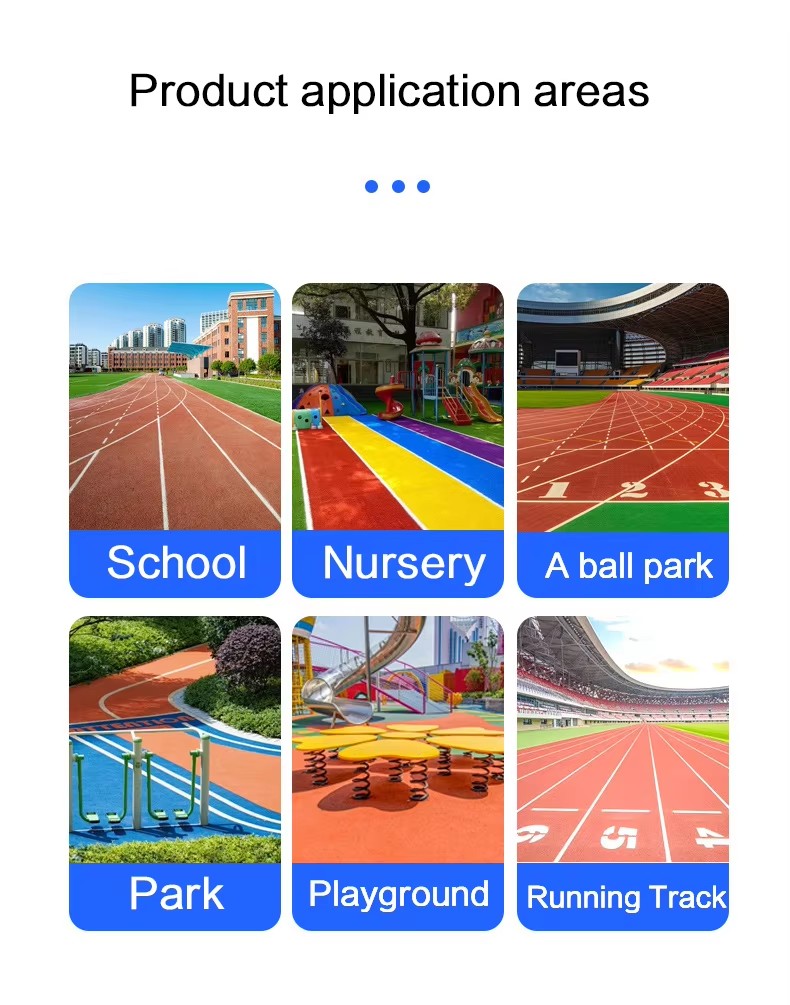
- Sports Tracks (Heavy Traffic): Often require a 6mm to 8mm EPDM top layer over a thicker 20mm to 30mm base layer.
The Impact of Material Quality on Thickness Effectiveness
This is the most overlooked factor in the procurement process. A standard low-quality EPDM granule will degrade under UV light and oxidation, losing its elasticity.
Common Industry Pains We Solve:
The Problem: Color Fading and UV Damage
Low-quality EPDM granules contain sulfur, which degrades under UV and heat, breaking down the molecular structure. This causes the surface to fade, turn chalky, and become brittle.
Our Advantage: Sulfur-Free Technology
Our EPDM granules contain zero sulfur. Without sulfur, there is no acidic decomposition under UV exposure. This not only eliminates unpleasant odors (common in hot weather) but also stabilizes the molecular structure. Our sulfur-free formulation increases service life by more than 300%, ensuring color retention and performance longevity that standard products cannot match.
The Problem: Low Tensile Strength
Poor granules tear easily, leading to "birdbaths" and delamination. Standard products may achieve 1-2 MPa.
Our Advantage: Superior Elasticity
The sulfur-free structure enhances the polymer chain's integrity. Our product achieves a tensile strength of 4 to 7 MPa —2 to 3 times higher than standard rubber. This allows you to use a thinner top layer without compromising impact resistance, saving you material costs.
The Problem: High MOQ and Inconsistent Quality
Distributors often face long lead times and high minimum order quantities (MOQs).
Our Advantage: No Minimum Order Quantity
Whether you need a small batch for a municipal repair project or a 20-ton container for a national distributor, we support orders of all sizes. We offer custom color and particle size (0.5-5mm) with consistent quality controlled from our 25-year-experience production lines.
How to Choose the Right Thickness for Your Project
To determine the exact thickness you need, follow this decision matrix:
Step 1: Determine the Critical Fall Height (CFH)
Check local regulations (BS EN 1177 or equivalent). The height of the equipment determines the thickness of the sub-base. Higher equipment = thicker SBR base layer.
Step 2: Assess the Sub-Base
Hard concrete base? You can use a minimum 15mm top layer and a 20mm base. Installing on compressed soil or existing asphalt? You will need to add a 100mm+ drainage stone layer before the rubber goes on.
Step 3: Assess Traffic Load
For walkways and recreational areas, a 6mm to 8mm EPDM layer works. For sports surfaces, basketball courts, or high-traffic playgrounds, a 12mm to 15mm EPDM layer ensures the colors don't wear down to the base layer.
Step 4: Factor in Climate
In high-temperature regions, standard EPDM becomes sticky and soft. Our sulfur-free formulation has higher heat resistance, maintaining structural integrity even in extreme heat.

How to Avoid Procurement Errors
- Don't Save Money on Base Thickness: Cutting the base layer thickness by 10mm to save on SBR costs will cause the entire safety rating to fail. It is cheaper to spend on the base than to pay for site excavation later.
- Don't Confuse SBR with EPDM: The base layer is cheap black SBR; the top layer is expensive colored EPDM. Some suppliers try to mix EPDM color with SBR to cut costs. Ensure you specify that the top layer is virgin EPDM.
- Demand a UV Performance Guarantee: Ask for UV resistance data. Our material's performance retention is 5 times higher than conventional EPDM, ensuring you don't face fading complaints within 2 years of installation.
Conclusion: Why Increasingly More Projects Choose Sulfur-Free EPDM
The global market is rapidly shifting away from sulfur-containing rubber for critical safety surfaces. The shift is driven by the need for sustainability, longevity, and safety.
- Sustainability: Our product meets food-grade hygiene standards (non-toxic), making it safe for children and animals.
- Economy: The 3x longer lifespan means facility managers replace surfaces less frequently, saving money over a 10-year period.
- Quality: The low bulk density and high angularity of the granules improve drainage and provide better slip resistance compared to smooth, high-density competing products.
When specifying wet pour thickness, remember that the number on the blueprint is just the starting point. The true value lies in the tensile strength (4-7 MPa), the sulfur-free molecular integrity, and the UV stability of the granules you choose.


Ready to source high-performance, custom EPDM granules with flexible MOQ?
Contact us today to discuss your project specifications and get a sample for testing.
WOW(LYG) New Material Co Ltd is a manufacturer specializing in the production of EPDM rubber granules. We use sulfur-free vulcanization technology, it increases the service life by more than 3 times than traditional EPDM granules, and enhances the performance, including anti-aging, high-temperature resistance, and colorfastness.
We have over 25 years of production experience and offer customization for colors and granule sizes. NO MOQ.


