 注: 建议图片大小150px*50px
丨
注: 建议图片大小150px*50px Views: 0 Author: Site Editor Publish Time: 2026-08-25 Origin: Site


Characteristics: High requirements for the subbase and construction conditions; generally suitable for professional competition venues.
Thickness: Typically 13 mm.
Applications: Track and field facilities at elementary, middle, and high schools, as well as universities; Athletics Stadiums.
Common Materials: Polyurethane, EPDM rubber granules, and other elastic granules.
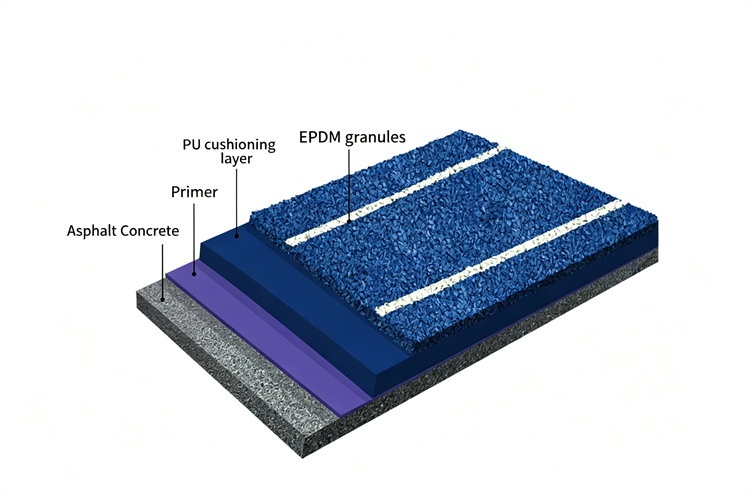
Construction Guide for Hybrid All-Plastic Running Tracks
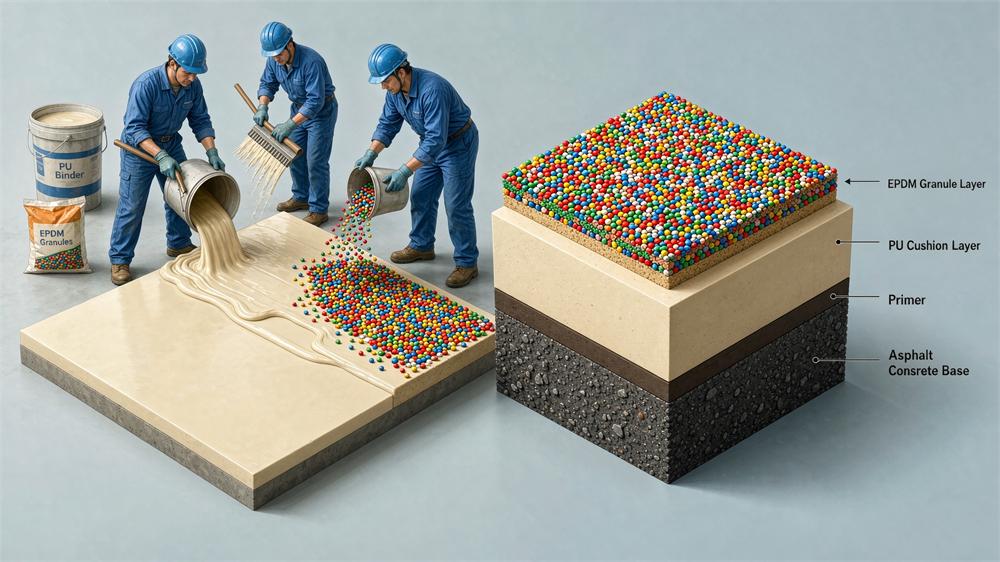
I. Subbase Preparation
(1) Cleaning:
The subgrade must be thoroughly swept clean prior to construction; it must be free of dirt and other loose debris.
(2) Grooving:
After cleaning the surface, cut V-shaped grooves into the expansion joints of the concrete subgrade, then fill and level them with appropriate material.
II. Subgrade Waterproofing Layer
(1) Construction Method for Concrete Subgrade:
The primer for the dedicated concrete subgrade is F605, which serves to isolate the subgrade from moisture and enhance adhesion. For existing concrete foundations, sand the surface first; for new concrete foundations, clean the surface with oxalic acid. Apply the F605 concrete primer evenly by roller at a rate of 0.15 kg/m².
(2) Asphalt Foundation Application Method:
First, mix the W01 sealing emulsion thoroughly with water, then blend it with 325# cement and 40-mesh quartz sand in the specified proportions to seal the asphalt foundation. Ratio of sealing emulsion : water : cement : quartz sand = 1:1:2:2
III. Two-Component PU Elastic Layer
The PU elastic layer is a two-component material, available in the following ratios: 1:5 (105A:105B), 1:4 (104A:104B), and 1:3 (103A:103B). Users may choose from these three formulations. During application, add 0.3%–0.5% of an eco-friendly zinc-bismuth drying accelerator as needed to control curing time. A leveling agent may also be added to improve flowability; however, the proportion of the leveling agent must be carefully controlled to prevent the finished product’s chemical indicators from exceeding standards.
IV. PU Elastic Layer Application Method
(1) Line the mixing area with plastic sheeting to ensure the floor remains clean. First pour Component A (transparent liquid hardener), followed by Component B (colored paste-like base material). Pour both into the center of the mixing bucket as much as possible; avoid pouring along the sides of the bucket to ensure the material near the edges mixes thoroughly. While mixing, move the mixer up, down, left, and right to ensure the materials are fully blended before adding the EPDM granules and mixing them in evenly.
(2) Pour the thoroughly mixed elastic layer material onto the prepared track base and apply it using a notched PU trowel (moving back and forth). Control the volume and apply the material in 2 to 3 passes to achieve the specified thickness.
(3) Twenty-four hours after applying the elastic layer, once the material has hardened and set, sprinkle water on the surface. Mark any areas where water pools and use the same material to level out the low spots.
(4) If foreign matter is mixed in during construction or if there are uneven areas, these must be sanded and smoothed before proceeding with the topcoat application.
(5) Precautions: Before application, confirm that the ground’s moisture content meets construction requirements before applying the elastic layer. During construction, ensure the material is mixed according to the specified ratio; mix thoroughly to ensure uniformity before spreading to avoid the formation of uncured material.
V. Two-Component PU Track Topcoat
The track topcoat is a two-component material, available in three specifications: 1:1 (101A:101B), 1:2 (102A:102B), and self-textured (502A:502B). Users may choose from these three types of topcoat materials. During construction, add 0.3%–0.5% of an eco-friendly zinc-bismuth drying accelerator as needed to control the curing time. A suitable amount of leveling agent may also be added to improve flowability; however, the proportion of the leveling agent must be carefully controlled to prevent the finished product’s chemical indicators from exceeding standards.
VI. PU Track Surface Application Method
(1) When the PU track surface is a self-textured finish, mix the user-selected self-textured (502A:502B) two-component surface material selected by the user. Add 10%–20% of 100–120 mesh (No. 8) quartz sand and 10%–20% of EPDM rubber powder of the same color to the total volume of Component A and Component B, along with 0.3%–0.5% of the environmentally friendly zinc-bismuth drying accelerator. Use a high-pressure sprayer and a specially designed spray gun to apply the mixture at a 45-degree upward angle relative to the ground. During spraying, keep the nozzle approximately 35 cm above the ground and move back and forth from left to right. Do not spray too densely; apply a total of 2–3 coats at the construction site. It is particularly important to note that no solvents must be added to the self-texturing Track A or Track B materials; the sprayed material must flow smoothly to produce better, more prominent patterns.
(2) When the track surface layer is a sprayed granule surface, mix the user’s chosen 1:1 (101A:101B) or 1:2 (102A:102B) two-component surface material at a rate of 1.2 kg/m² and add 1 kg/m² of 1–3 mm EPDM granules, 0.2 kg/m² of EPDM powder, and spray evenly once in a clockwise direction and once in a counterclockwise direction. During application, add 0.3%–0.5% of an eco-friendly zinc-bismuth drying accelerator as needed to control the curing time. A leveling agent may also be added to improve flow, but the proportion of the leveling agent must be carefully controlled to prevent the finished product from exceeding chemical standard limits during testing.
(3) When the track surface is a granulated surface, apply the user-selected 1:1 (101A:101B) or 1:2 (102A:102B) topcoat material at a rate of 2 kg/m² using a notched trowel. Once the mixture has leveled and begins to form a stringy consistency, evenly scatter 3–5 kg/m² of 2–4 mm EPDM granules. After curing, collect any excess granules. During application, add 0.3%–0.5% of an eco-friendly zinc-bismuth drying accelerator as needed to control the curing time. A leveling agent may also be added to improve flowability; however, the proportion of the leveling agent must be carefully controlled to prevent the finished product from exceeding chemical standard limits during testing.
(4) Precautions: Proceed with the topcoat application only after confirming that the elastic layer has been cleaned and any repairs to the substrate have been completed. The material for this layer is a two-component reactive compound. Once mixed, the two-component material must be used within 1 hour (no longer than 2 hours); otherwise, quality issues may arise. Therefore, do not mix too much material at once.
VII. Line Marking
The line marking paint is a two-component material with a hardener-to-white topcoat ratio of 1:3. A leveling agent may be added as needed during application. Measure and mark the positions according to standard dimensions. Apply masking tape along both sides of the marked lines on the court. Use a short-nap roller with the specialized line marking paint to apply an even coat between the masking tape strips. Once the surface is completely dry, remove the masking tape.
VIII. Precautions
(1) When mixing materials, ensure accurate weighing and thorough mixing.
(2) The surface must be kept clean before each step of the entire construction process.
(3) Ensure adequate ventilation in indoor facilities.
(4) Allow the surface to cure for at least 3–5 days before use.
(5) Strictly follow this construction procedure. In case of special circumstances, consult our sales manager; otherwise, our company assumes no responsibility for any construction quality issues that may arise.

