 注: 建议图片大小150px*50px
丨
注: 建议图片大小150px*50px 


When sourcing materials for wet pour playgrounds, poured-in-place rubber surfacing, running tracks, or sports surfaces, one question consistently shapes project outcomes: What are the real EPDM granule properties that determine performance, durability, and long-term value?
EPDM granule properties are not just a list of technical specifications. They directly affect color stability, UV resistance, elasticity, aging behavior, binder consumption, installation efficiency, and the lifespan of the finished surface. For playground contractors, sports surfacing installers, engineers, architects, landscape companies, municipal buyers, importers, and distributors, understanding these properties is essential for making confident purchasing decisions.
As a professional EPDM colored rubber granules manufacturer and exporter, we focus exclusively on EPDM granule production, customization, quality control, and global supply.

What Are EPDM Granules?
EPDM granules are colored rubber granules made from Ethylene Propylene Diene Monomer rubber. In surface systems such as wet pour playground surfacing and poured-in-place rubber (PIP), EPDM granules are mixed with polyurethane binder and installed on-site to create seamless, elastic, shock-absorbing rubber surfaces.
EPDM granules are widely used because they combine:
Good elasticity
Weather resistance
Color versatility
UV stability
Shock absorption
Design flexibility
Long service life
Suitability for outdoor environments
However, not all EPDM granules perform the same. Differences in raw materials, production process, sulfur content, particle shape, density, color pigment quality, and quality control can create significant differences in real-world performance.
For buyers, the key is not simply to ask whether a product is “EPDM,” but to understand which EPDM granule properties matter most for the specific project, climate, application, and installation method.
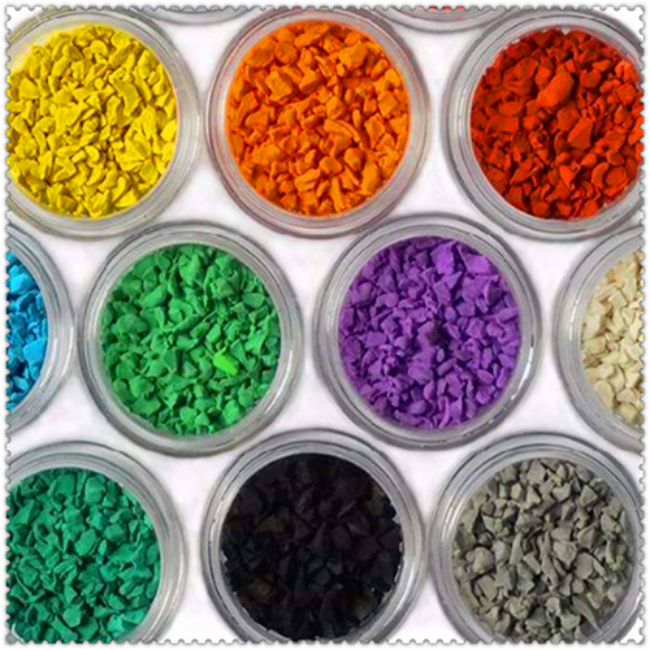
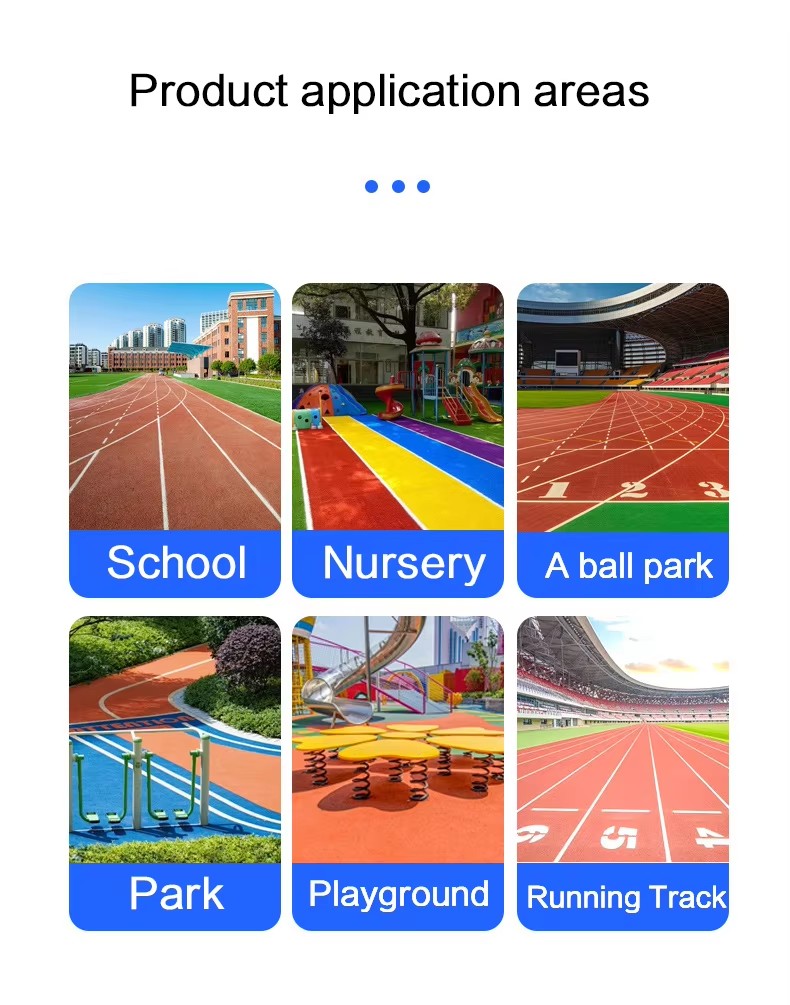
Key Applications of EPDM Colored Rubber Granules
EPDM colored rubber granules are mainly used as the visible wear layer or decorative surface layer in poured rubber systems. Common applications include:
Wet pour playground surfacing
Poured-in-place rubber (PIP)
Running track systems
Sports surfacing
Safety surfacing for schools and kindergartens
Outdoor rubber surfacing
Walking paths and recreational areas
Splash pads and water play areas
Parks and municipal projects
Commercial outdoor spaces
In these applications, EPDM granules are not just decorative. They help define the surface’s safety performance, visual appearance, durability, and resistance to sunlight, rain, temperature changes, and daily use.
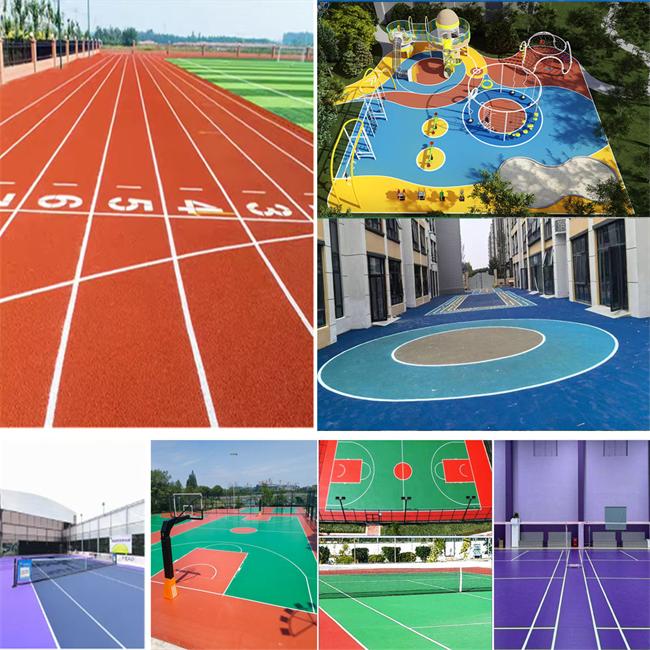
Why EPDM Granule Properties Matter in Real Projects
For contractors and project owners, EPDM granule properties influence both installation and long-term performance.
For contractors, the right granule properties can improve:
Mixing consistency
Workability
Binder efficiency
Surface smoothness
Color uniformity
Installation speed
Material waste control
For engineers and architects, EPDM granule properties affect:
Shock absorption
Elastic recovery
Weather resistance
UV stability
Color retention
Long-term performance
Compliance with project specifications
For importers and purchasing managers, the same properties determine:
Product consistency across batches
Supplier reliability
Risk of color variation
Risk of premature fading
Customer complaints
Project warranty performance
Long-term supply stability
This is why EPDM granule properties should be evaluated before bulk purchasing, not after installation problems appear.
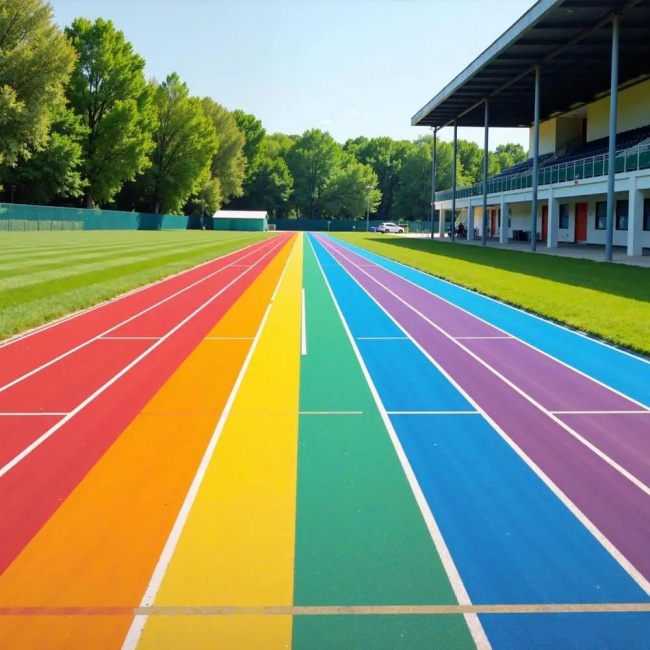
Main EPDM Granule Properties Buyers Should Evaluate
Color Stability and UV Resistance
One of the most important EPDM granule properties is color stability. Outdoor rubber surfaces are exposed to sunlight, rain, temperature changes, and long-term UV radiation. If the granules have weak UV resistance, the surface may fade, discolor, or lose visual consistency over time.
High-quality EPDM granules should maintain a stable appearance after prolonged outdoor exposure. This is especially important for:
School playgrounds
Municipal parks
Commercial recreational areas
Sports courts
Walking paths
Splash pads
Projects with strict color-matching requirements
For projects where color consistency matters, buyers should ask suppliers about pigment quality, UV stability testing, batch-to-batch color control, and long-term weathering performance.
Elasticity and Tensile Performance
Elasticity is another critical property. EPDM granules contribute to the flexibility, resilience, and shock-absorbing performance of poured rubber surfaces.
In our production, EPDM granules can reach a tensile strength range of approximately 4–7 MPa, with improved elasticity and tensile performance compared with conventional EPDM granules. This helps support better surface resilience, especially in playgrounds, sports areas, and high-traffic outdoor zones.
However, elasticity should not be evaluated in isolation. It must be considered together with particle size, binder ratio, installation thickness, base preparation, and curing conditions.
Aging Resistance and Long-Term Durability
Outdoor rubber surfaces must resist oxidation, UV exposure, temperature fluctuation, moisture, and repeated mechanical stress. Strong aging resistance helps the surface maintain performance over time.
Our EPDM granules are produced using a sulfur-free technology, which helps improve molecular stability and reduce the risk of sulfur-related degradation under high temperature and strong UV exposure. This contributes to better aging resistance and more consistent long-term performance.
For buyers comparing suppliers, aging resistance is one of the most valuable properties to verify through technical data sheets, test reports, sample evaluation, and supplier production transparency.
Odor Performance
Odor is often overlooked in technical specifications, but it matters for schools, kindergartens, indoor-outdoor transition areas, splash pads, and public recreational spaces.
Because our EPDM granules do not contain sulfur components, they do not produce sulfuric acid decomposition under high temperature or strong UV exposure. As a result, the granules have low odor performance, making them more suitable for sensitive environments where user comfort and environmental quality are important.
Particle Shape, Density, and Surface Texture
EPDM granule properties also include physical characteristics such as particle shape, bulk density, and surface texture.
Our granules are designed with a low bulk density and three-dimensional angular structure, which can help improve visual depth, surface texture, and aesthetic appearance in finished wet pour surfaces.
Particle shape also affects how granules pack, mix, and bond with PU binder. Irregular or poorly controlled particles may lead to uneven surfaces, inconsistent color appearance, or higher binder consumption.
Particle Size Consistency
Consistent particle size is essential for smooth installation and predictable performance. Common size ranges include:
0.5–1.5 mm
1–3 mm
1–4 mm
2–4 mm
Custom sizes based on project requirements
The correct particle size depends on the surface layer, base layer, application type, design thickness, and desired finish. Choosing the wrong size can affect appearance, binder usage, workability, and surface uniformity.
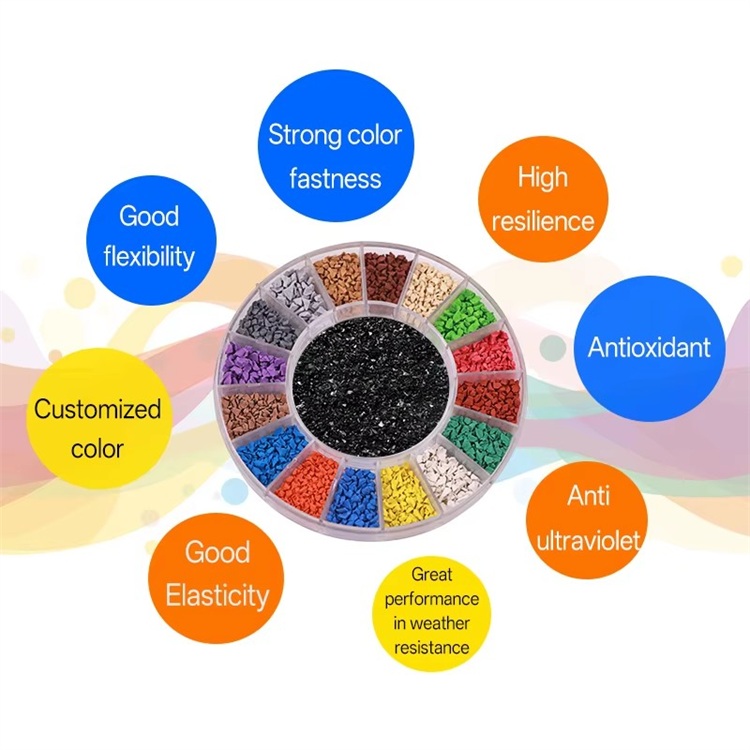
Common Challenges When Selecting EPDM Granules
Challenge 1: Color Fading After Installation
Some projects experience color fading because the granules lack sufficient UV stability or use lower-quality pigments. This is especially visible in bright colors such as red, blue, green, and yellow.
Solution: Choose EPDM granules with proven UV resistance, stable pigment systems, and consistent batch production. Request samples, color chips, and technical documentation before placing large orders.
Challenge 2: Batch-to-Batch Color Variation
For large projects or phased installations, color consistency between batches is critical. Even small differences can become visible after installation.
Solution: Work with a manufacturer that controls color formulation, production parameters, and batch consistency. If your project requires exact color matching, provide Pantone, RAL, or physical samples for customization.
Challenge 3: Poor Elasticity or Weak Surface Performance
If EPDM granules have weak elasticity or poor mechanical performance, the finished surface may feel less resilient or perform below expectations.
Solution: Evaluate tensile strength, elasticity, granule quality, and binder compatibility. Avoid making decisions based only on price, because granule quality directly affects installation results and project lifespan.
Challenge 4: Odor Concerns in Sensitive Projects
For schools, kindergartens, splash pads, and public playgrounds, odor can become a concern if low-quality rubber materials are used.
Solution: Choose sulfur-free EPDM granules with low odor characteristics, especially for projects involving children, public users, or sensitive environments.
Challenge 5: Inconsistent Particle Size
Inconsistent particle size can lead to uneven mixing, poor surface finish, and unpredictable binder consumption.
Solution: Select a supplier with controlled screening, grading, and particle size management. Confirm the required size range before production.

How to Choose the Right EPDM Granules for Your Project
Step 1: Define the Application
Start with the project type. A kindergarten playground, a municipal park path, a running track, and a splash pad may all use EPDM granules, but their performance priorities can differ.
Ask:
Is the surface for children’s play areas?
Will it be exposed to strong sunlight?
Is color consistency important?
Does the project require shock absorption?
Will the surface be used heavily every day?
Is low odor required?
Step 2: Choose the Correct Particle Size
Particle size affects appearance, texture, binder usage, and installation behavior.
0.5–1.5 mm is often suitable for finer surface layers and smoother finishes.
1–3 mm is commonly used in many wet pour applications.
1–4 mm and 2–4 mm may be selected based on design requirements, base layers, or specific performance needs.
The best choice depends on the surface system, layer structure, and contractor experience.
Step 3: Confirm Color Requirements
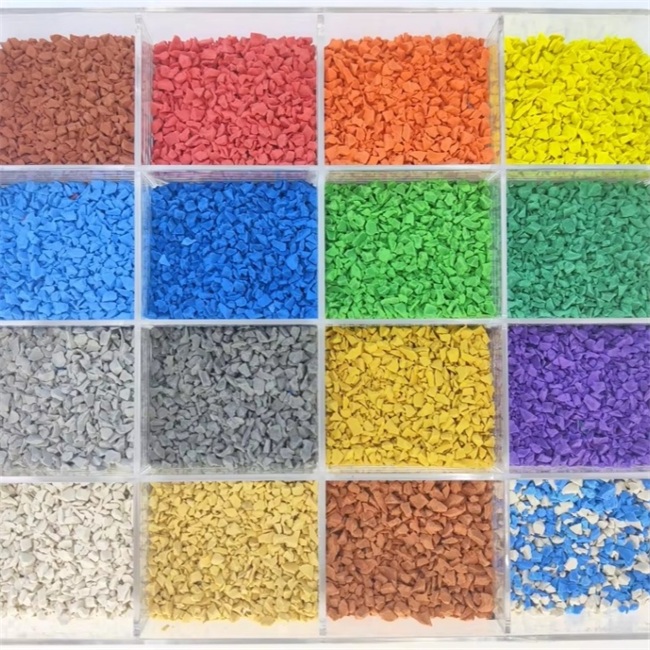
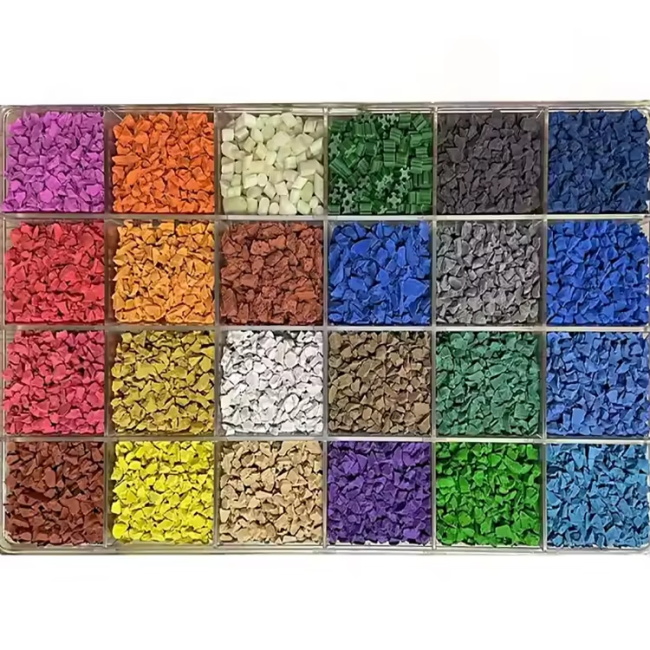
If your project uses standard colors, confirm the color chart and sample before bulk ordering. If your project requires custom branding, themed playground designs, or precise color matching, provide:
RAL color codes
Pantone references
Physical color samples
Project photos or design drawings
Custom color matching should be confirmed through sample approval before mass production.
Step 4: Evaluate the Supplier’s Manufacturing Capability
For importers and distributors, supplier stability is as important as product quality. A reliable EPDM granule manufacturer should demonstrate:
Consistent production control
Clear quality inspection processes
Flexible color and size customization
Stable raw material sourcing
Professional export experience
Clear communication
Ability to support OEM, ODM, and private label requirements
Technical Specifications and Performance Highlights
Our EPDM colored rubber granules are produced with a focus on stability, color performance, elasticity, and outdoor durability. The following performance highlights reflect our manufacturing approach:
Sulfur-free formulation for improved molecular stability
Low odor performance, suitable for sensitive environments
Improved UV and weather resistance for outdoor applications
Enhanced aging resistance compared with conventional sulfur-containing EPDM
Tensile strength range of approximately 4–7 MPa
Improved elasticity and tensile performance
Better performance retention under long-term outdoor exposure
Low bulk density with three-dimensional angular particle structure
More environmentally friendly formulation, suitable for projects requiring higher hygiene and safety standards
Custom colors, sizes, and packaging available
These properties should be verified through samples and technical documentation for each specific project, because installation conditions, binder selection, thickness, climate, and maintenance all influence final performance.
Manufacturer Insights: Practical Advice from an EPDM Granule Producer
As a manufacturer with more than 25 years of industry experience and full production lines dedicated to EPDM colored rubber granules, we often advise buyers to focus on the parameters that truly affect installation and long-term performance.
Choose Particle Size Based on Surface Layer Function
Do not choose particle size only by appearance. The top layer, base layer, and decorative layer may require different sizes. Finer granules usually create a smoother visual finish, while larger granules may be used where texture, drainage, or specific design effects are needed.
Confirm Color Before Mass Production
For projects with strict visual requirements, always approve a sample first. If you provide RAL, Pantone, or a physical sample, we can customize colors to match your design. This is especially important for branded playgrounds, school projects, municipal parks, and multi-phase installations.
Do Not Ignore Odor and Sulfur Content
For kindergartens, schools, splash pads, and public playgrounds, odor and chemical stability matter. Sulfur-free EPDM granules help reduce odor risks and improve long-term molecular stability, especially in hot climates or high-UV environments.
Balance Price With Performance Retention
The cheapest granules may save money at purchase, but poor UV resistance, weak elasticity, or inconsistent particle size can increase project risk. For contractors and importers, consistent quality is often more valuable than a small initial price difference.

Why Global Buyers Choose Our EPDM Colored Rubber Granules
We are a professional EPDM colored rubber granules manufacturer and exporter, focused only on EPDM granule production and customization. We do not produce or install finished surfacing or running tracks, which allows us to concentrate fully on granule quality, color accuracy, particle size control, and export reliability.
Our advantages include:
More than 25 years of EPDM granule industry experience
Full production lines for colored EPDM rubber granules
Sulfur-free technology for better stability and low odor
Custom colors based on RAL, Pantone, or customer samples
Custom particle sizes including 0.5–1.5 mm, 1–3 mm, 1–4 mm, 2–4 mm, and other specifications
OEM, ODM, and private label support
Custom packaging options
FCL and LCL shipment support
Flexible order quantity with no MOQ requirement
Strict quality control and batch consistency management
Global export experience serving contractors, importers, distributors, and project buyers
We support buyers who need reliable EPDM granules for playgrounds, sports surfaces, safety surfacing, walking paths, splash pads, parks, schools, and municipal projects.

FAQ: EPDM Granule Properties Answered
What are the most important EPDM granule properties?
The most important properties include color stability, UV resistance, elasticity, tensile strength, aging resistance, odor performance, particle size consistency, bulk density, and weather resistance. These properties affect both installation quality and long-term surface performance.
How long can EPDM granules last outdoors?
Service life depends on climate, UV exposure, installation quality, binder ratio, thickness, maintenance, and granule quality. High-quality EPDM granules with strong UV and aging resistance are generally preferred for long-term outdoor projects.
Can EPDM granules fade over time?
All outdoor materials can be affected by prolonged UV exposure. However, high-quality EPDM granules with strong UV stability and antioxidant performance are designed to resist fading and maintain better color retention than lower-quality alternatives.
Which particle size should I choose?
The best size depends on the application:
0.5–1.5 mm for finer surface finishes
1–3 mm for common wet pour applications
1–4 mm and 2–4 mm for specific design or performance requirements
Confirm the particle size with your installer or engineer before ordering.
Can you customize EPDM granule colors?
Yes. We support custom colors based on RAL codes, Pantone references, or customer-provided samples. For projects requiring high color accuracy, we recommend approving a sample before mass production.
Do your EPDM granules have odor?
Our EPDM granules are produced without sulfur components, so they do not produce sulfuric acid decomposition under high temperature or strong UV exposure. This gives them low odor performance, making them suitable for schools, kindergartens, splash pads, and public playgrounds.
How much PU binder is needed for EPDM granules?
Binder consumption depends on particle size, granule density, surface design, mixing method, installation thickness, and project requirements. There is no universal ratio for all projects. We recommend conducting a small test area to confirm the best binder-to-granule ratio for your specific system.
Is there a minimum order quantity?
We support flexible purchasing with no MOQ requirement, making it easier for contractors, distributors, brand owners, and project buyers to order samples, trial quantities, or bulk shipments.
Can you support OEM, ODM, and private label?
Yes. We support OEM, ODM, private label, custom packaging, custom colors, and custom particle sizes. This is suitable for importers, wholesalers, distributors, brand owners, and contractors who need consistent supply under their own brand or project specifications.
EPDM granule properties are the foundation of a reliable wet pour playground surface, sports surface, safety surface, or outdoor rubber surfacing system. The right granules should offer color stability, UV resistance, elasticity, aging resistance, low odor, consistent particle size, and long-term durability.
For contractors, engineers, importers, and project buyers, the best purchasing decision is not based on price alone. It should be based on verified performance, consistent quality, reliable color matching, flexible customization, and a supplier who understands EPDM granule production in depth.
As a professional EPDM colored rubber granules manufacturer and exporter, we help global buyers select the right granule size, color, performance grade, and packaging for their projects. If you need samples, technical data, color matching, or a quotation for your next playground, sports, safety surfacing, or municipal project, contact us to discuss your requirements.

WOW(LYG) New Material Co Ltd is a manufacturer specializing in the production of EPDM rubber granules. We use sulfur-free vulcanization technology, it increases the service life by more than 3 times than traditional EPDM granules, and enhances the performance, including anti-aging, high-temperature resistance, and colorfastness.
We have over 25 years of production experience and offer customization for colors and granule sizes. NO MOQ.


